
When Eric Wood lowered his 2020 BMW 330i xDrive on coilovers, he liked everything about the car except the wheels. Factory 19-inch alloys at ET+27 up front and ET+40 at the rear sit surprisingly deep in the arches of a G20 — BMW’s chassis code for the seventh-generation 3 Series — and that gap was the one thing the coilovers couldn’t fix. He wanted a flush stance without paying for new wheels.
That’s exactly the job for 2020 BMW 3 Series 12mm wheel spacers at the front axle and 15mm spacers at the rear. What follows is his car’s real installation record: every measurement our staff took with a vernier caliper, a micrometer, and a high-accuracy ruler, the extended-bolt math, the torque used, what the job cost, and a 24,318-mile follow-up since October 6, 2024. No guesses, no stock photography, no rounding up in our favor.
If you share the three doubts most G20 owners bring us — will a 12mm spacer actually fit the hub, will the centering be precise enough to run vibration-free, and do the stock bolts survive — the measurements below settle all three. Short version: yes, yes, and no, in that order.
Spec Quick Reference: This Exact 2020 BMW 330i xDrive
Every value below was measured on Eric’s car on installation day, with the tool noted — nothing is transplanted from a generic spec sheet. The two torque rows deserve a careful read; the note underneath explains how to use them.
| Item | Spec / Measured Value |
|---|---|
| Vehicle | 2020 BMW 3 Series (G20) 330i xDrive, coilovers fitted |
| Bolt pattern (PCD) | 5×112 |
| Thread size | M14x1.25, conical seat |
| Wheel socket | 17mm hex (measured) |
| Hub pilot diameter | 66.47mm, vernier caliper |
| Wheel center bore | 66.62mm, micrometer |
| Spacer centering pilot OD | 66.5mm |
| Hub flange step height | 10.96mm, vernier caliper |
| Stock bolt thread below seat | 27mm, vernier caliper |
| Spacer thickness | Front 12mm / Rear 15mm, forged 7075-T6 |
| Extended bolts | 39mm thread (front) / 42mm thread (rear), ISO grade 12.9 |
| Final torque — BONOSS extended bolts | 140 Nm (103.5 ft-lb), per BONOSS installation instructions |
| OEM torque — stock bolts only | 140 Nm (103.5 ft-lb), per the owner’s manual |
One torque value for the entire installation — that’s the rule, and it comes first here because it’s the step people get wrong. On this car both published figures happen to be identical, so both are acceptable: the BONOSS value applies to the extended bolts actually fitted, and the owner’s manual value applies to the stock bolts. Since Eric’s car runs BONOSS extended hardware, final tightening followed BONOSS installation instructions at 140 Nm (103.5 ft-lb).
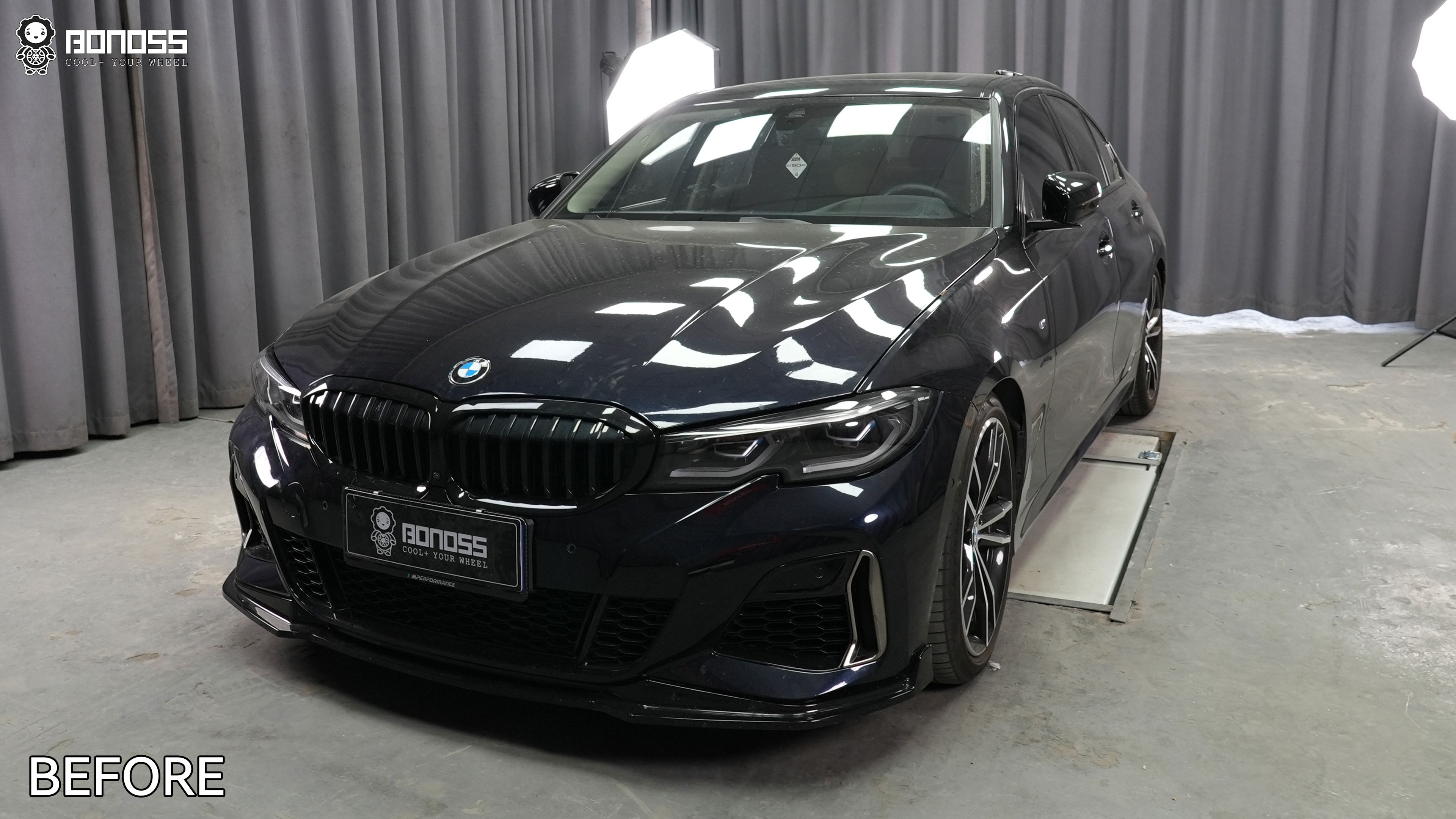
The Car and the Plan
Here’s the starting point: a 2020 330i xDrive on coilovers, still wearing its original 225/40ZR19 front and 255/35ZR19 rear alloys. A spacer works on offset by simple subtraction — 12mm up front takes ET+27 to ET+15, and 15mm at the rear takes ET+40 to ET+25. Same wheels, same tires, just translated outward along the hub axis until the tire face sits where the fender line says it should.
The goal, for the record, is flush — the tire’s outer face in plane with the fender line — not poking past it. Flush reads as factory-intended; poke reads as a mistake you can see from across a parking lot. Twelve and fifteen millimeters sit on the right side of that line on this car.
One detail shaped every hardware decision on this build: xDrive. An all-wheel-drive platform feeds torque through all four corners all the time, so wheel centering and bolt clamping loads are engineering facts, not style opinions. That’s why the plan called for multi-stage hub-centric forgings rather than universal slip-ons, and why the bolts were sized from a measured thread length instead of a fitment chart.
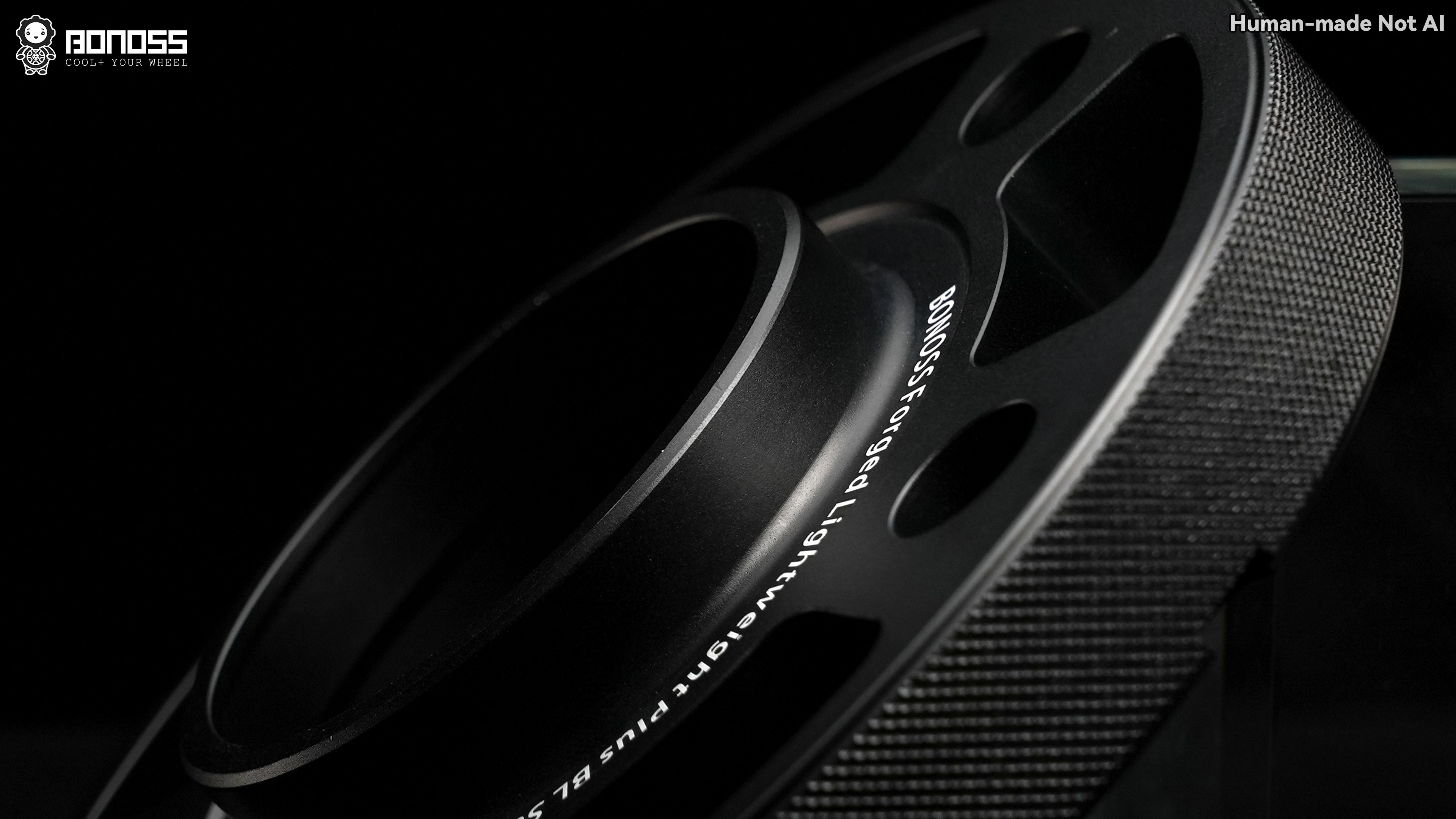
The parts our staff selected were BONOSS forged lightweight plus wheel spacers for the BMW 3 Series G20 — slip-on style forgings in 7075-T6 aluminum, machined for the 5×112 bolt pattern and the factory 66.6mm center bore, paired with matched extended wheel bolts. Here’s how each of the owner’s three doubts checked out against the numbers.
Doubt #1: “Will 12mm Spacers Fit My Hubs — and Will They Rub?”
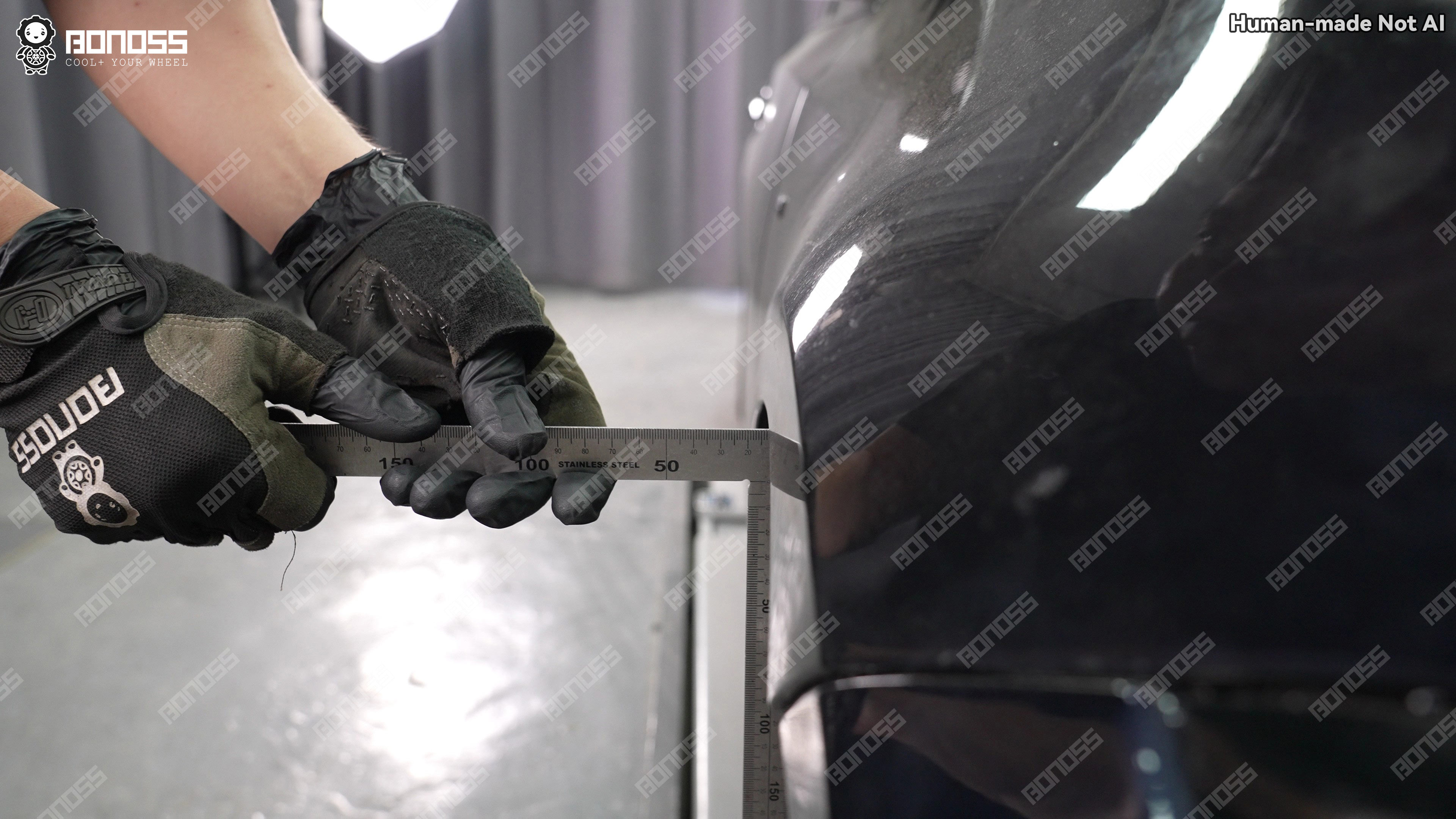
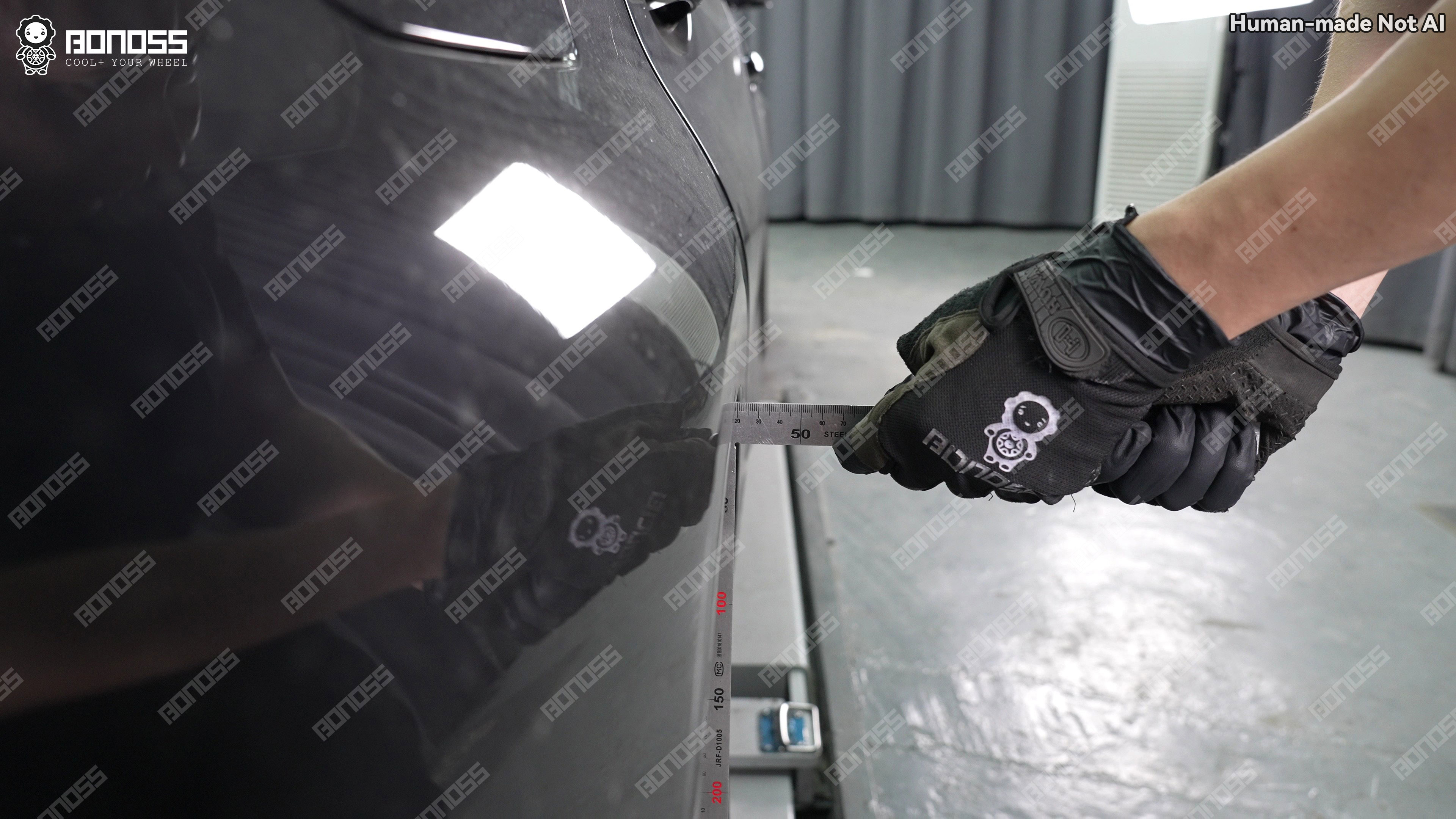
Step one: measure the fender clearance instead of guessing it. With the car on level ground, our staff spanned a high-accuracy ruler from the tire’s outer face to the fender arch. The front axle showed 12mm to a flush line; the right rear showed 15mm. That set the whole plan: 12mm front, 15mm rear.
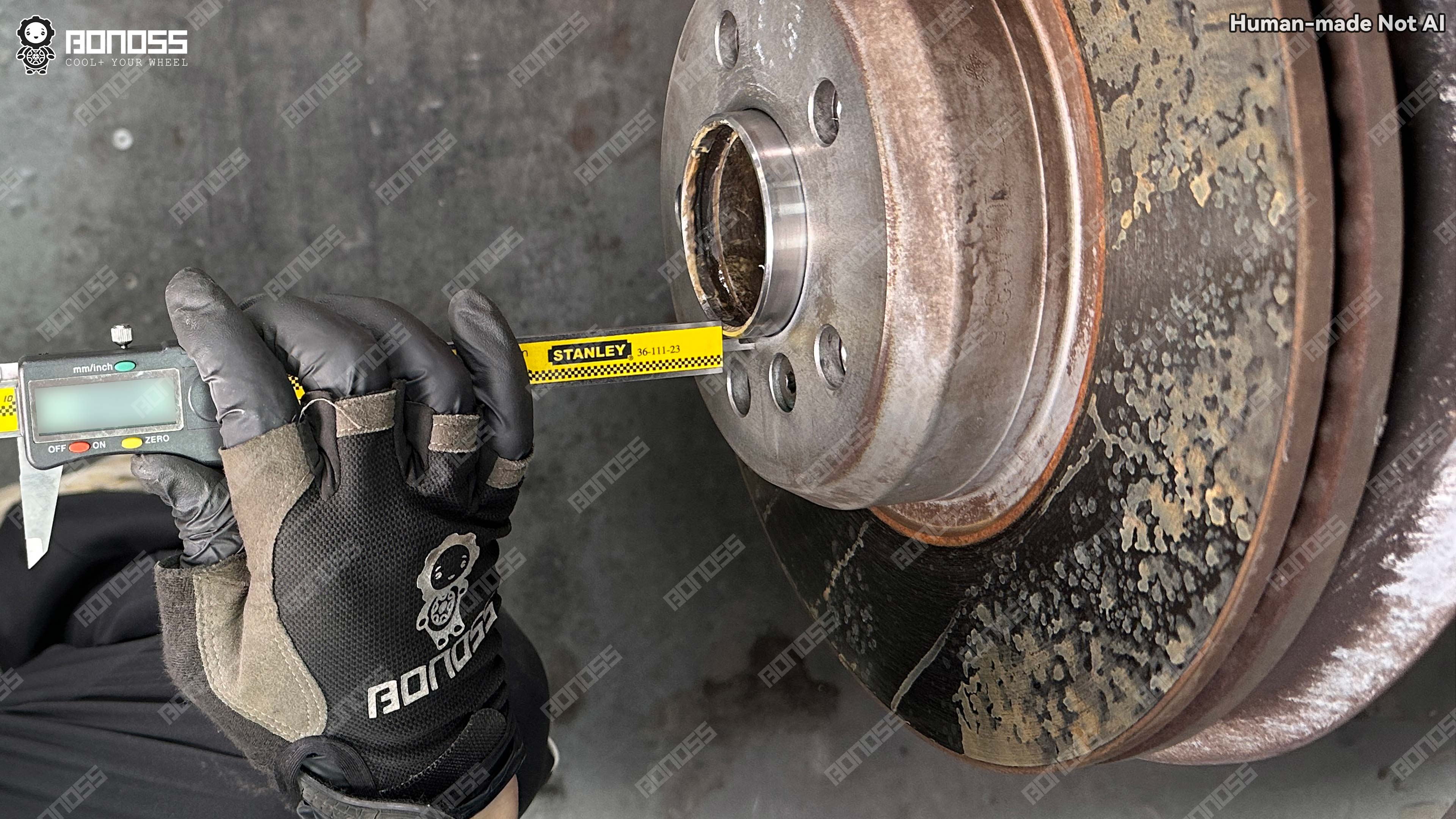
The hub half of the question needs a caliper. The G20’s hub flange carries a raised centering step — the ring the wheel actually locates on — and on Eric’s car it measured 10.96mm with a vernier caliper. The long-standing fitment rule says a spacer must be at least as thick as that step, and the 12mm front spacer passes with margin: 12mm is taller than 10.96mm.
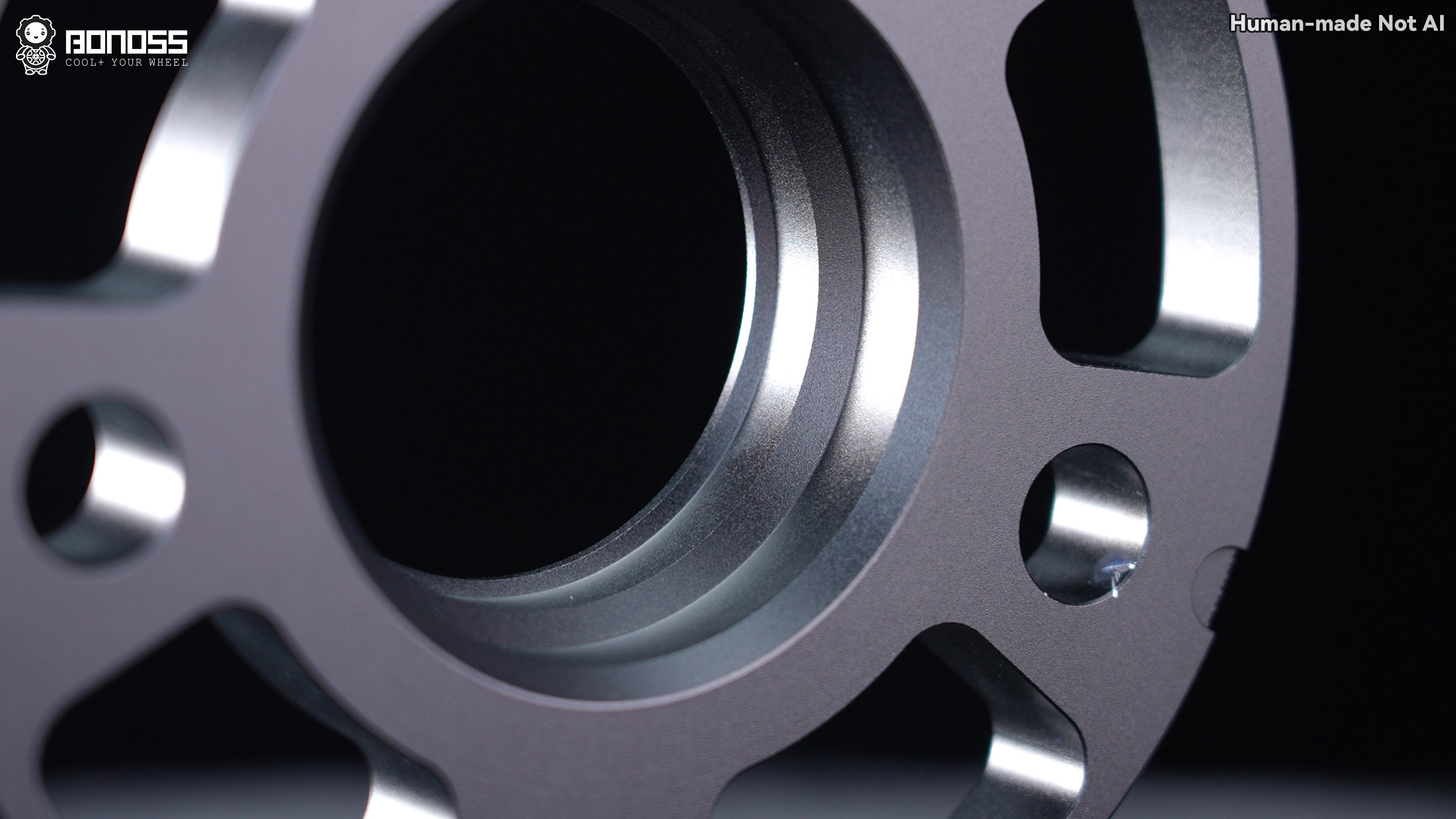
There’s a smarter version of that rule, though, and it’s the reason this install could stay thin. BONOSS multi-stage hub-centric 12mm spacers machine a stepped center bore that accepts up to 13.5mm of hub projection — the steps nest around the hub’s own step instead of having to clear it in one flat pass. Two benefits follow. First, a 12mm spacer becomes viable on hubs where a flat-bore design would force a thicker part.
Eric keeps the stance he measured for instead of jumping to 15mm. Second, the stepped engagement adds a second centering surface, which cuts the odds of wheel wobble at speed. To be explicit, because this matters: that 13.5mm figure belongs to BONOSS multi-stage hub-centric 12mm spacers specifically — a generic flat 12mm spacer does not inherit it.
Rubbing was the follow-up question, and the ruler had already answered it: at Eric’s coilover ride height, 12mm front and 15mm rear clear the arches — which is exactly why our staff recommended those sizes after measuring. This is also where the 12mm vs. 15mm vs. 20mm G20 spacer debate should end. An arch that measures 12mm to flush gains 8mm of poke if you force a 20mm spacer into it. Measure first, then choose.
Doubt #2: “Why Do the Hub, Wheel, and Spacer Measure Three Different Bores?”
This one confused Eric, and it confuses most people. The hub’s centering step measured 66.47mm with a vernier caliper. The wheel’s center bore measured 66.62mm with a micrometer. The spacer’s centering pilot is 66.5mm. Three numbers for what looks like one hole — because they are not the same mating surface. A spacer has to match the car on one face and the wheel on the other, and those two dimensions differ on purpose.
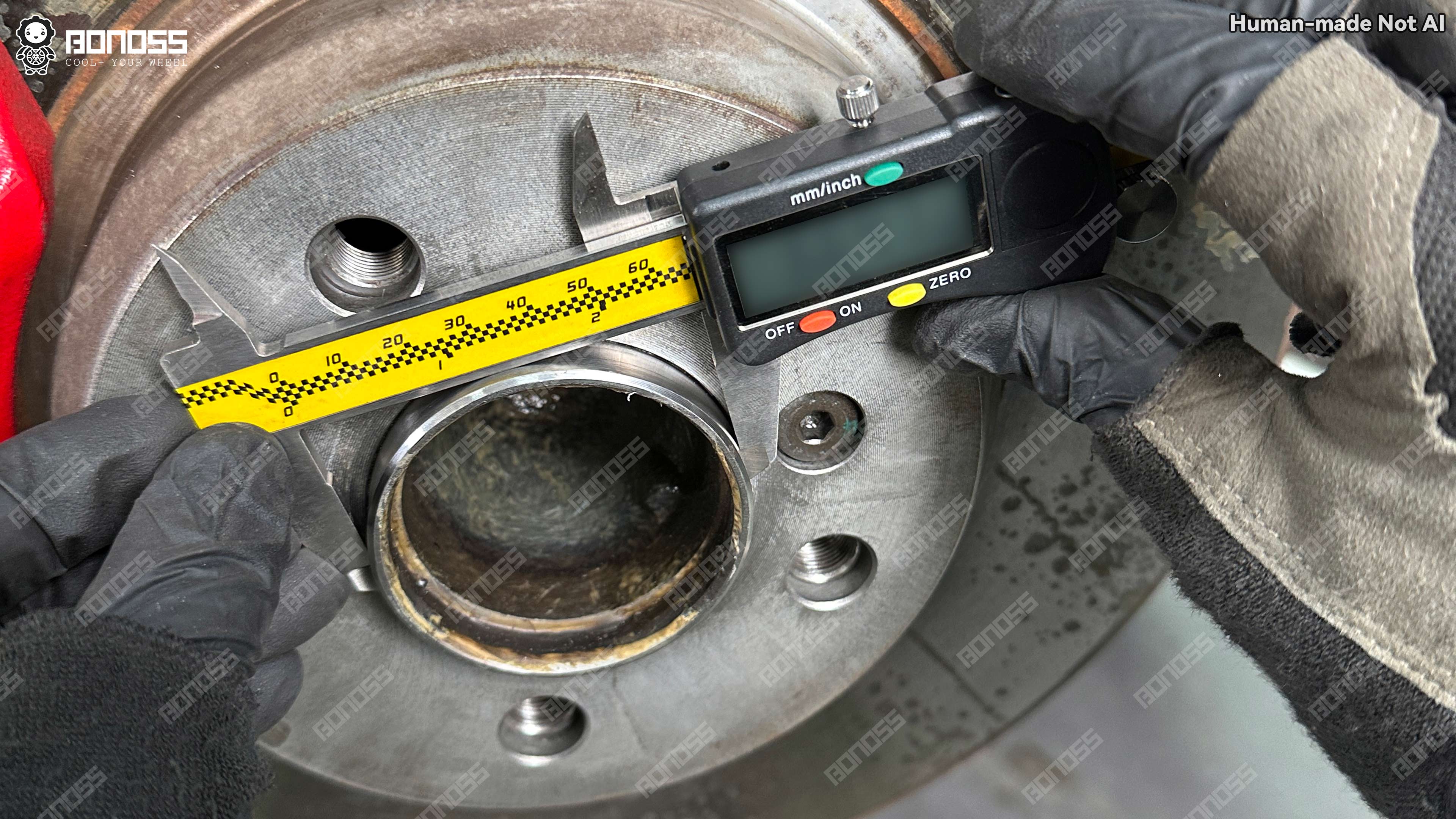
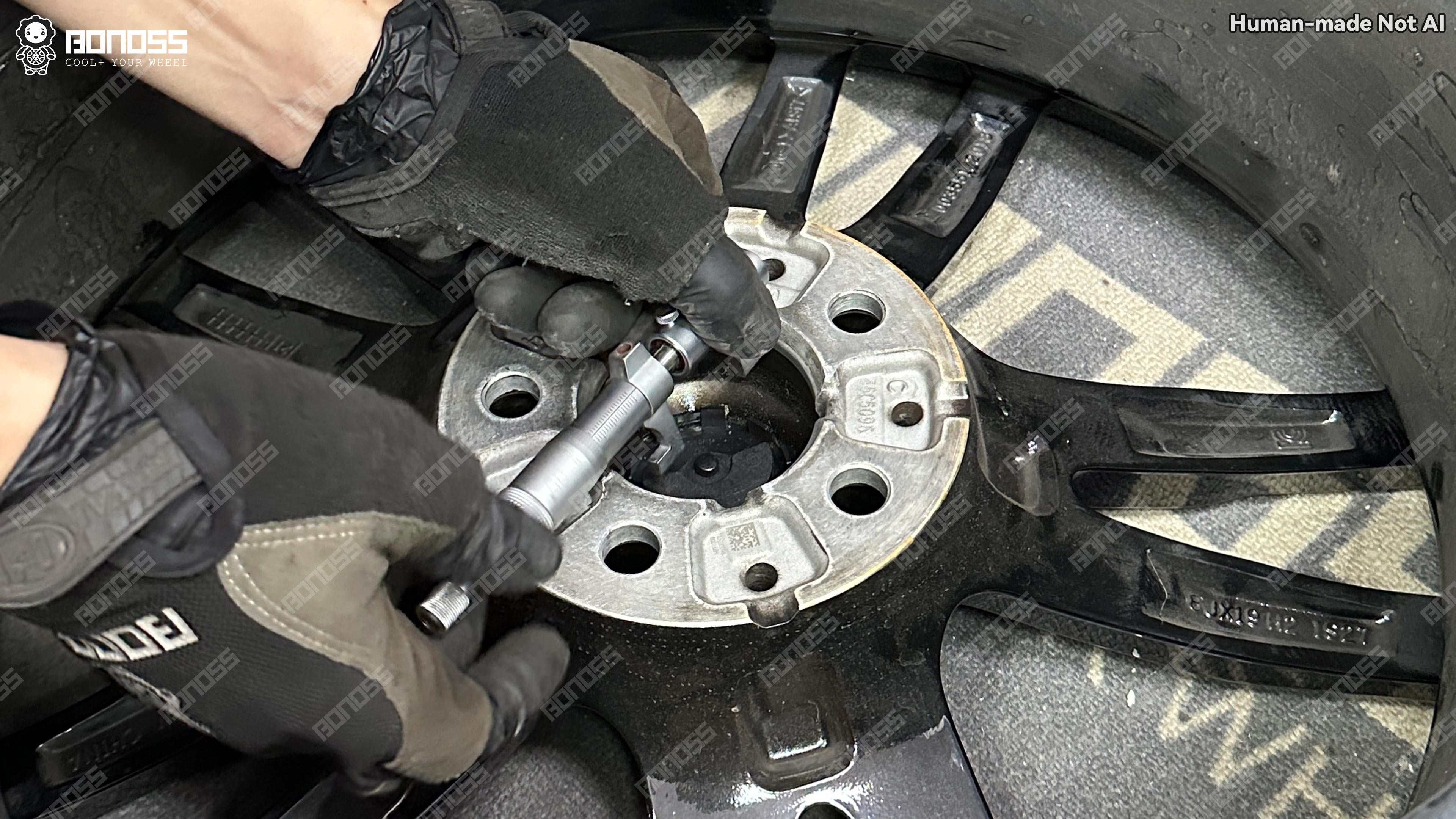
Start with the factory’s own numbers: the wheel bore is 0.15mm larger than the hub step. That gap is deliberate — assembly clearance, manufacturing tolerance, and a margin for corrosion. Nothing on a production car is zero-clearance. Now the spacer’s job: its 66.5mm pilot meets the 66.62mm wheel bore with 0.12mm of diametral clearance — 0.06mm per side, a genuinely snug hub-centric fit — while its stepped inner bore wraps the 66.47mm hub on the car side.
Holding both faces to that standard is why BONOSS machines to a 0.02mm CNC tolerance. The payoff is concentricity: the wheel spins true, bolt loading stays even, and the classic high-speed vibration complaint never gets the gap it needs to start.
That’s also the practical case for BMW 3 Series hubcentric spacers over the lug-centric alternative in 5×112. A lug-centric part lets the bolt cones do the centering — workable, but the tolerances stack somewhere nobody can inspect. A hub-centric pilot locates the wheel on a machined surface you can check with calipers, which is exactly what our staff did. On a daily-driven xDrive sedan, we’ll take the measurable option every time. The 66.5mm hub bore spacers on this 2020 330i carry both interfaces in one part, which is why the machining precision matters as much as the forging.
Doubt #3: “The Stock Bolts Have to Go — Here’s the Math”
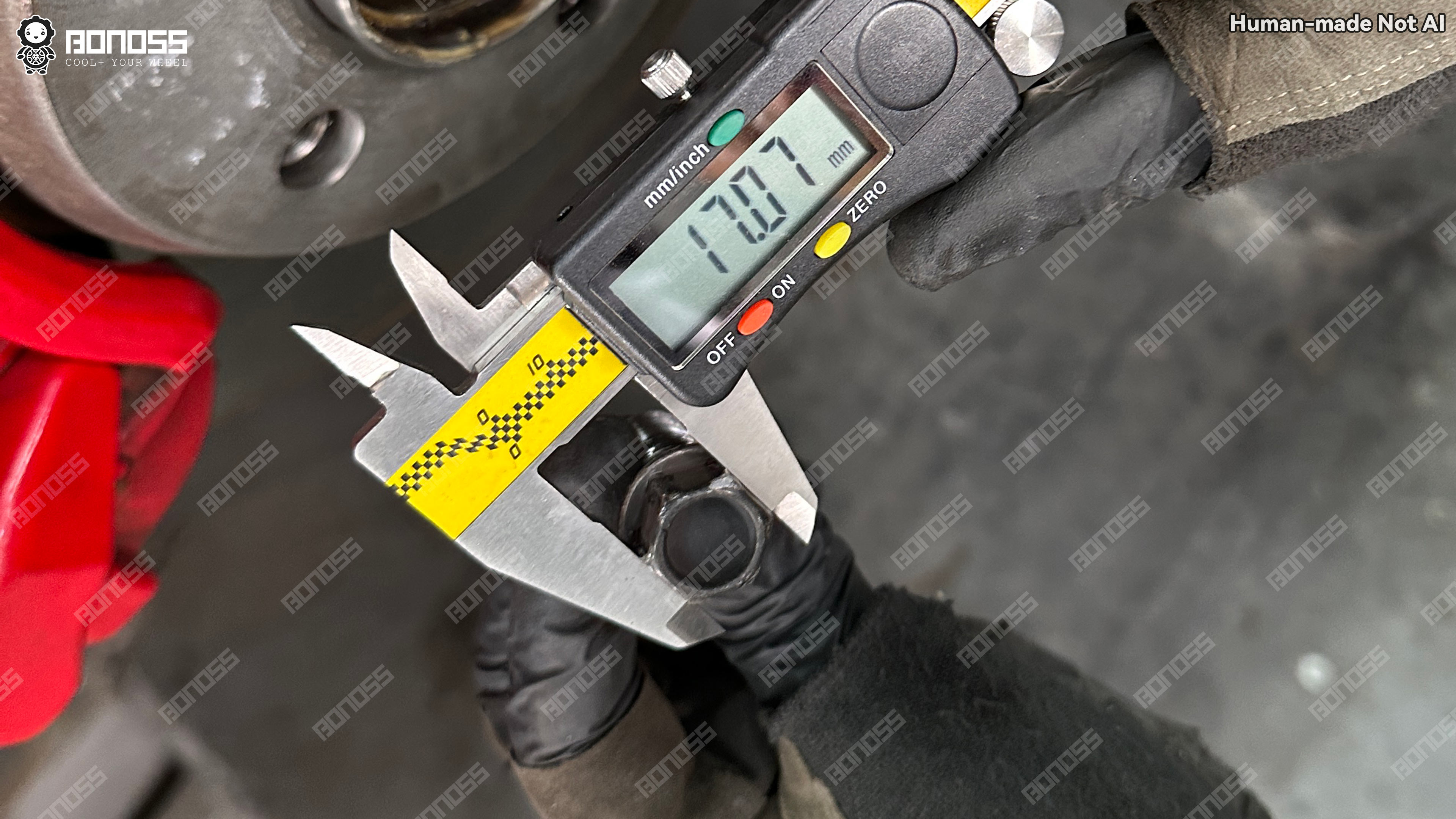
Here’s the part shortcut tutorials get wrong. The stock wheel bolts on this car are M14x1.25 with conical seats, and our staff measured 27mm of usable thread below the seat with a vernier caliper. Slide a 12mm spacer under the bolt head and you need 27 + 12 = 39mm of thread to keep the same engagement. At the rear, 27 + 15 = 42mm. That’s arithmetic, not opinion: 39mm extended bolts up front, 42mm extended bolts at the rear.
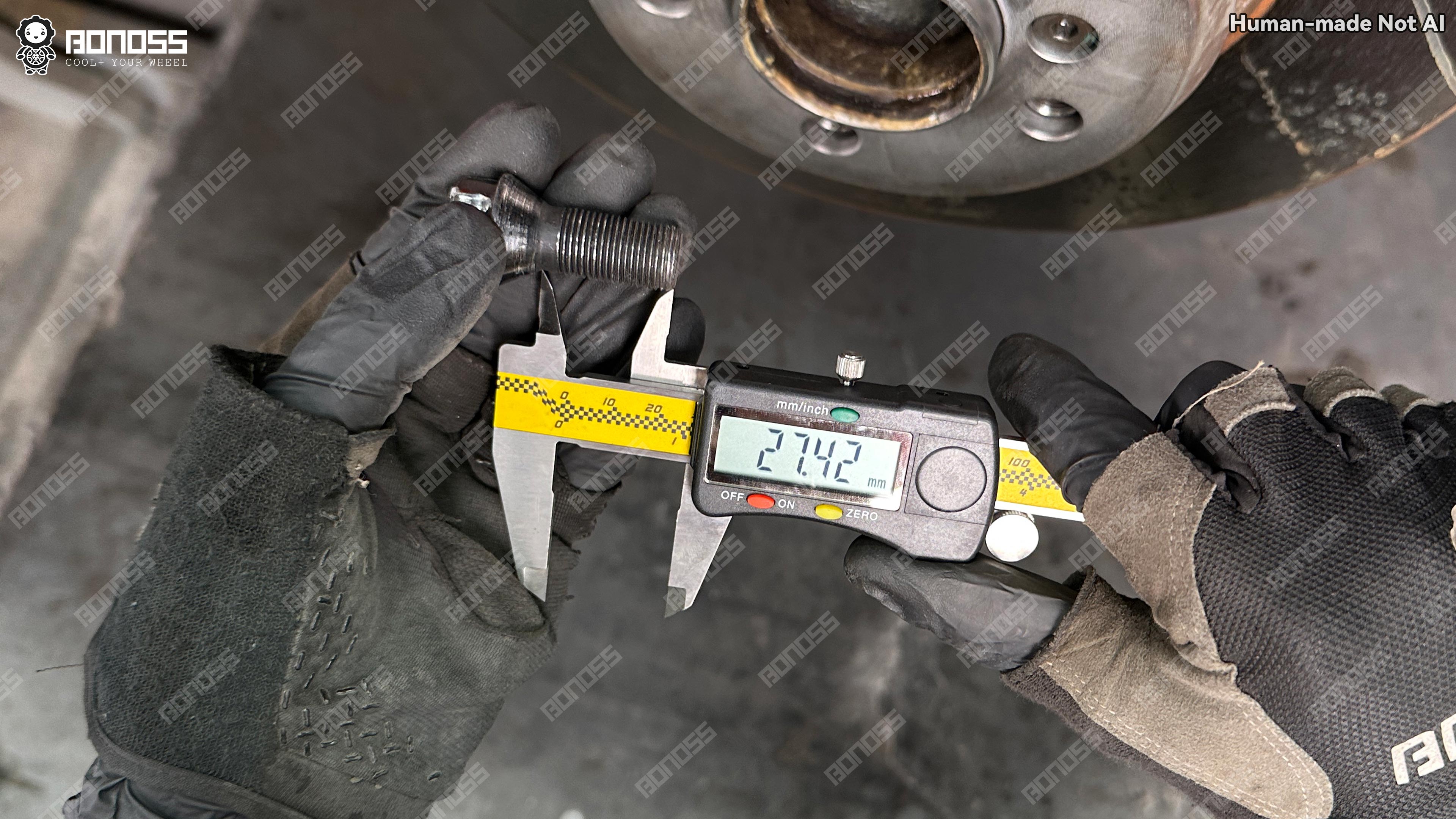
Because the factory wheels stay on the car, the replacements copy the originals: same M14x1.25 thread, same conical seat, same 17mm hex socket — measured against the bolt head, not assumed. What changes is length and grade. The extended bolts are ISO grade 12.9, and they arrived with lab reports rather than promises.
The reports matter, so here are the numbers with their sources. SGS tested the M14x1.25 extended bolts at 1272 MPa tensile strength (ISO 898-1:2013), with hardness at 394 HV10 (ISO 6507-1:2018) and proof load at 970 MPa.
TÜV Rheinland’s testing on the same thread returned 1256 MPa tensile and 125 kN proof load, 397 HV10 hardness, and 192 hours of neutral salt spray resistance (ISO 9227:2017). The spacer bodies themselves — forged 7075-T6 aluminum — carry a TÜV hardness result of 146 HBW 5/250 (ISO 6506-1:2014).
Why don’t the SGS and TÜV figures match each other exactly? Because different labs, different test samples, and normal measurement uncertainty produce different readings — and because hardware is not interchangeable: an M14x1.5 result doesn’t transfer to M14x1.25, and a nut’s numbers differ from a bolt’s because the thread engagement differs. The certified report for your exact part is the number that governs.
Eric’s own reasoning, from his post-install feedback, kept verbatim: “Great fitment, excellent experience. Installed coilovers on my 2020 BMW 330i xDrive and needed spacers to get a flush stance. BONOSS has solid options. Price was fair, but what sold me was their lightweight 7075-T6 aluminum spacers with the correct extended lug bolts—so I didn’t have to worry about messing up the AWD.”
Install Day: One Clean Hub, One Torque Spec
The install itself is short; the prep is what matters. The hub flanges carried light corrosion — normal for a four-year-old car — so our staff sprayed penetrant, let it work, and went over the surface with abrasive cloth until the flange was clean metal. Here’s the detail most tutorials skip: under 1mm of rust or oxide is enough to stop a 12mm spacer from seating flat. The spacer locates on that step; if the step isn’t clean, the hub-centric fit you measured for doesn’t exist. On thin spacers, cleaning is a mandatory installation step, not prep nicety.
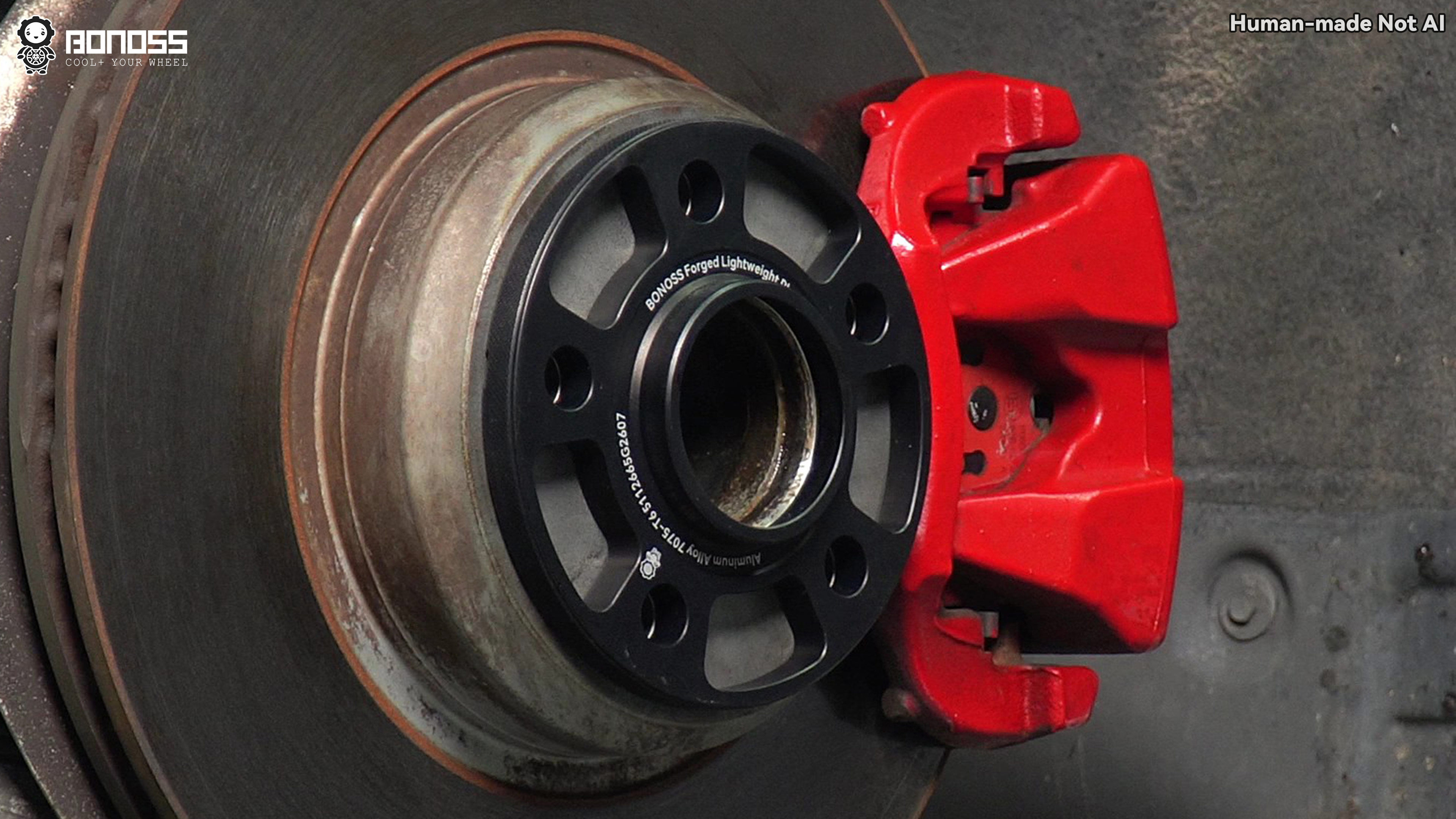
From there the job is simple. Slip-on spacers slide over the cleaned hub step, the wheel goes on, and the extended bolts thread into the factory hubs. The socket is the same 17mm hex as stock — checked with a caliper before the first pull — and final torque went to 140 Nm (103.5 ft-lb) per BONOSS installation instructions, one value, every corner.
Eric’s one technical question during the install: does he need a four-wheel alignment afterward? He’d already had the car aligned after the coilovers went in, so the answer was no — and the physics agrees. An alignment adjusts camber, caster, and toe, all set by the positions of control arms, struts, and tie rods. A spacer translates the whole wheel assembly outward along the hub axis; it doesn’t move a single suspension pickup point, so those three angles are unchanged. Install quality hub-centric spacers correctly on an already-aligned car and the alignment holds.
Running different wheels, a different thickness, or another BMW chassis? Our BMW rim spacers and wheel bolts fitment guide walks the bolt-length and bore-matching math end to end, with the same measure-first approach.
Before and After: Four Corners, Eight Photos
Numbers say it fits; photos say it looks right. Here’s the full BMW 3 Series 12mm spacers before and after — every corner of Eric’s car. Watch the tire-to-fender relationship in each pair; that’s the whole story.
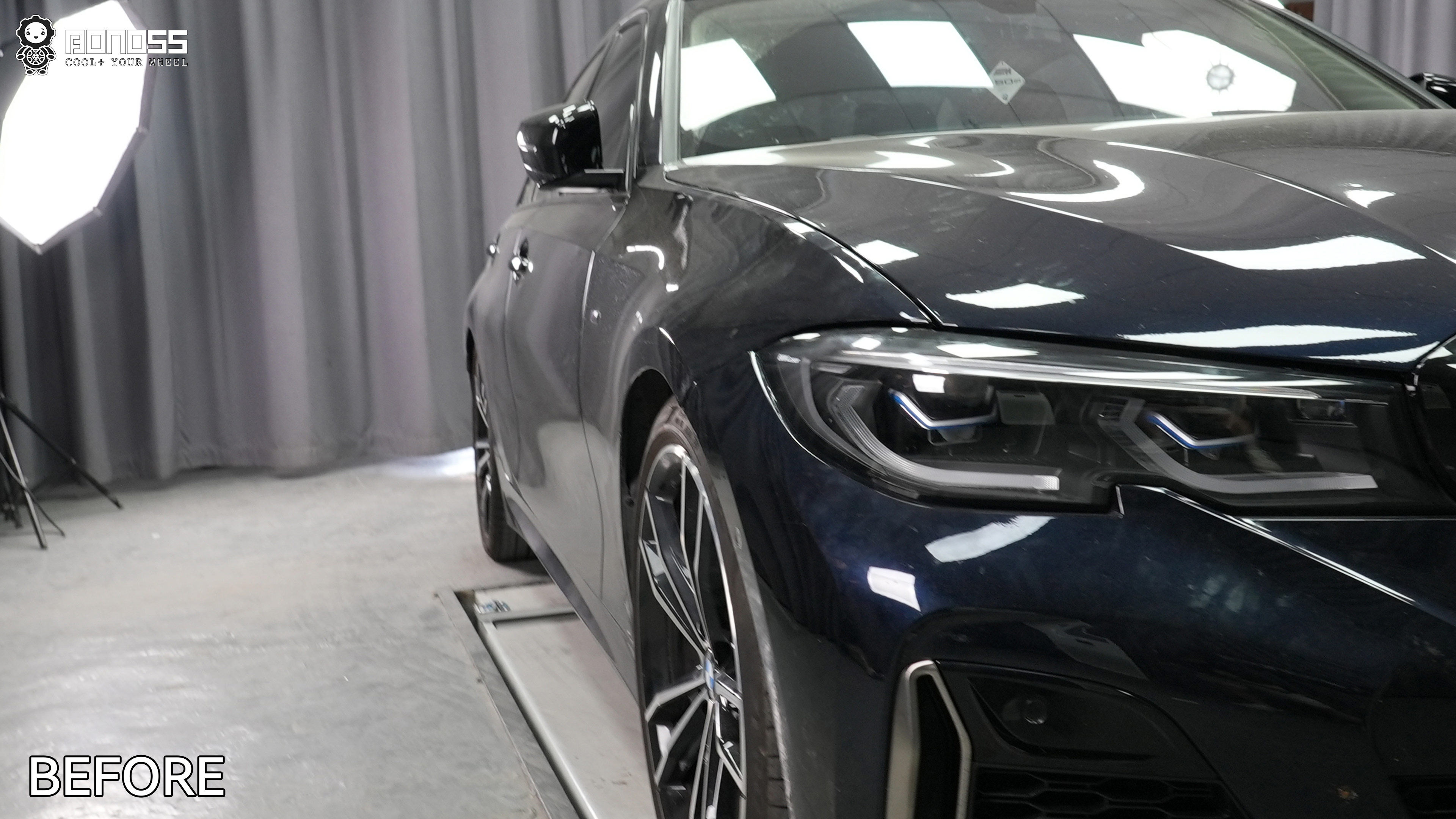
Left front, before: the ET+27 wheel sits visibly inside the arch, the gap obvious even standing square to the car.
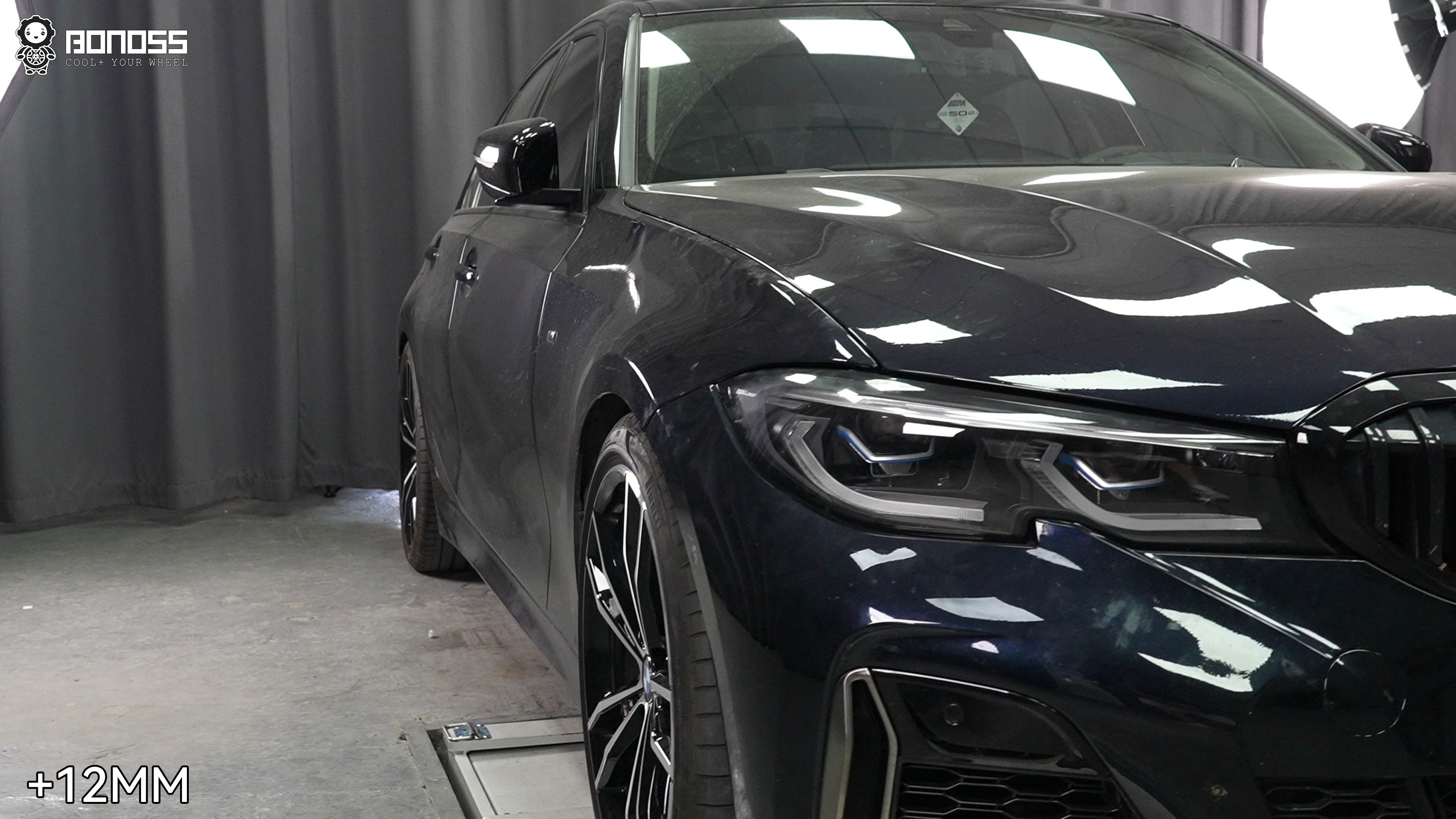
Left front, after 12mm: ET+15, and the tire face now runs within a few millimeters of the fender line at ride height.
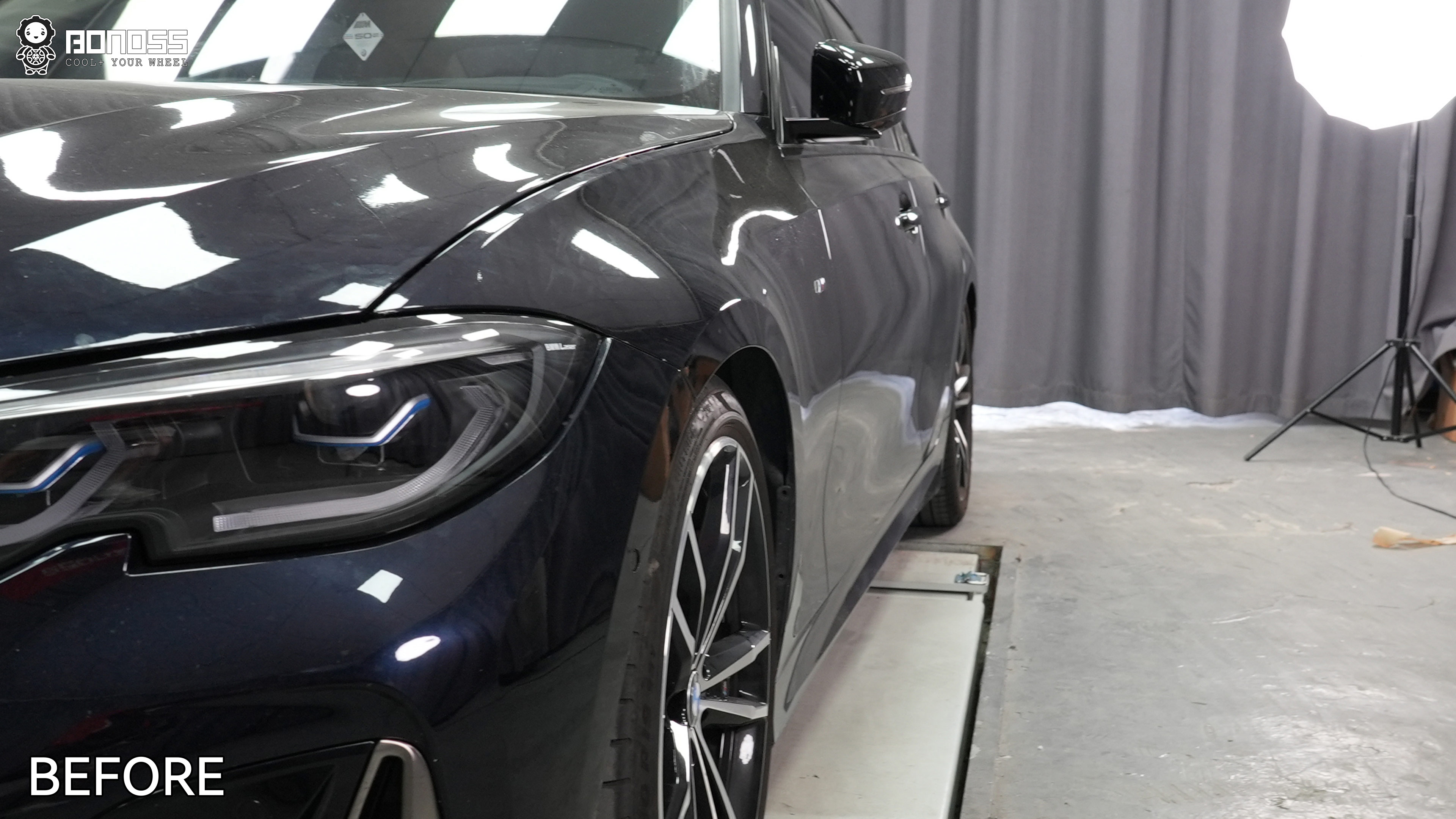
Right front, before: same tuck, same daylight between tire and arch.
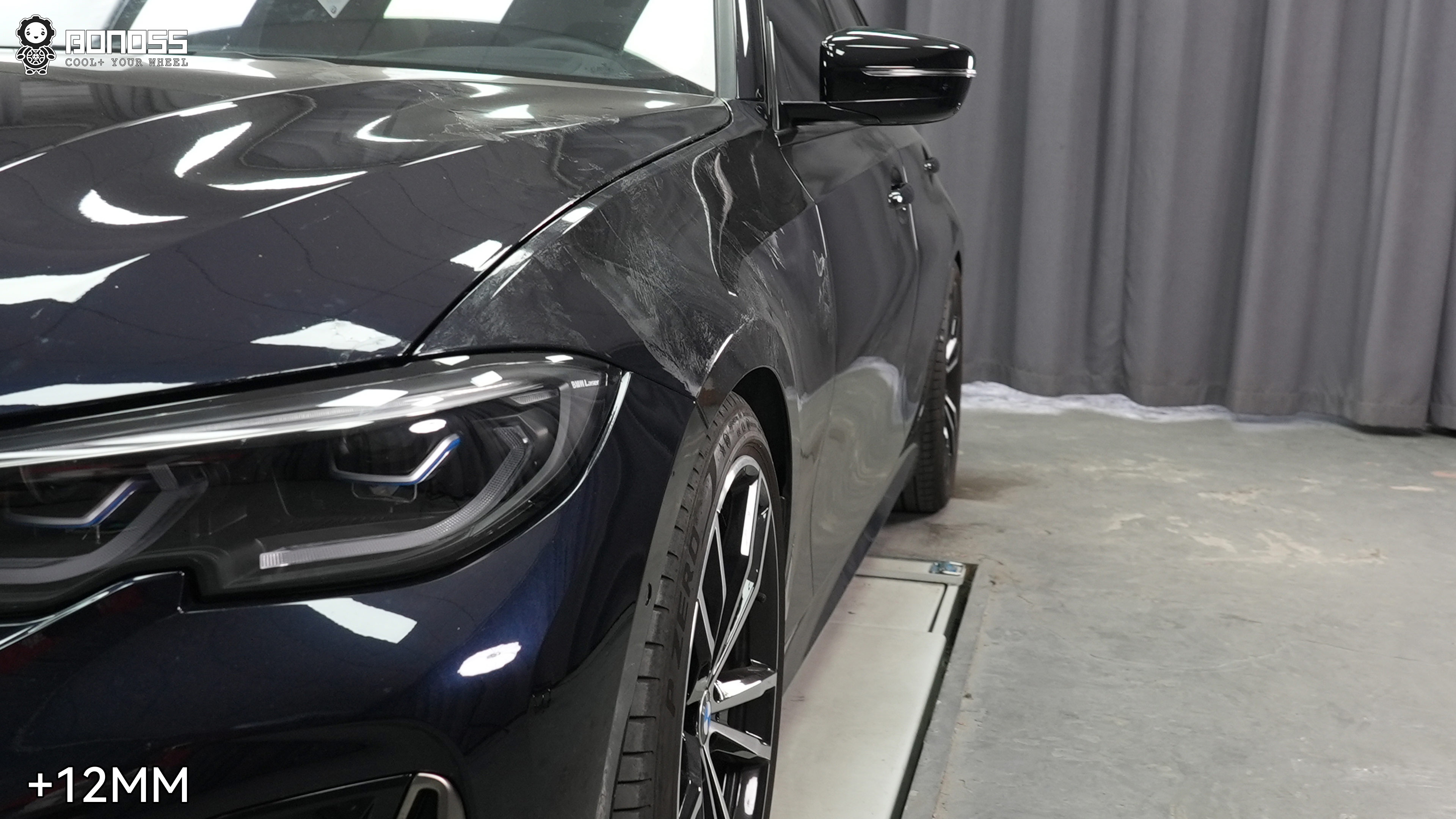
Right front, after: symmetric with the driver’s side — both fronts now read as one deliberate stance instead of two happy accidents.
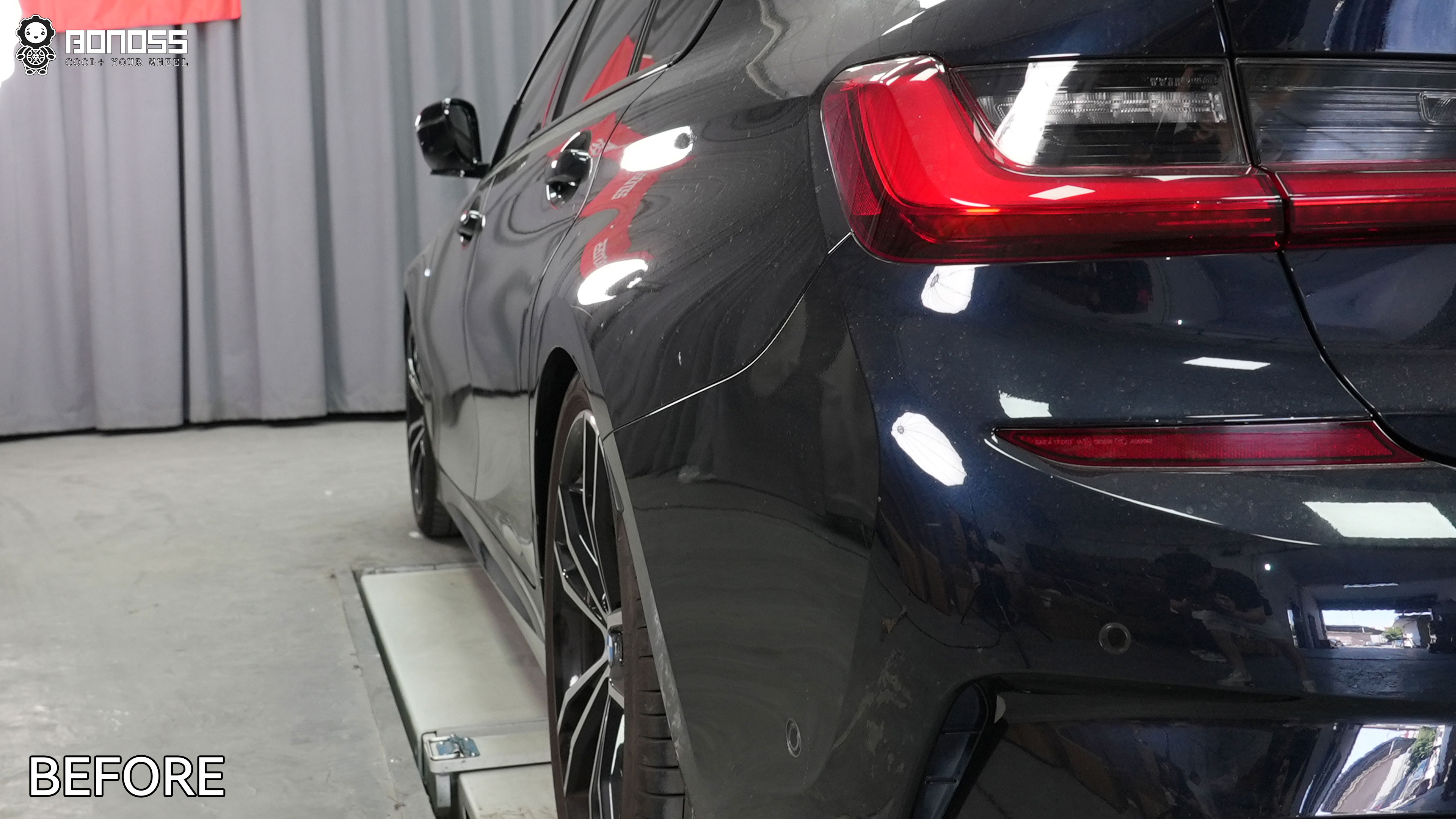
Left rear, before: the deepest tuck on the car. At ET+40, the 255/35ZR19 sits 15mm inside where it should live.
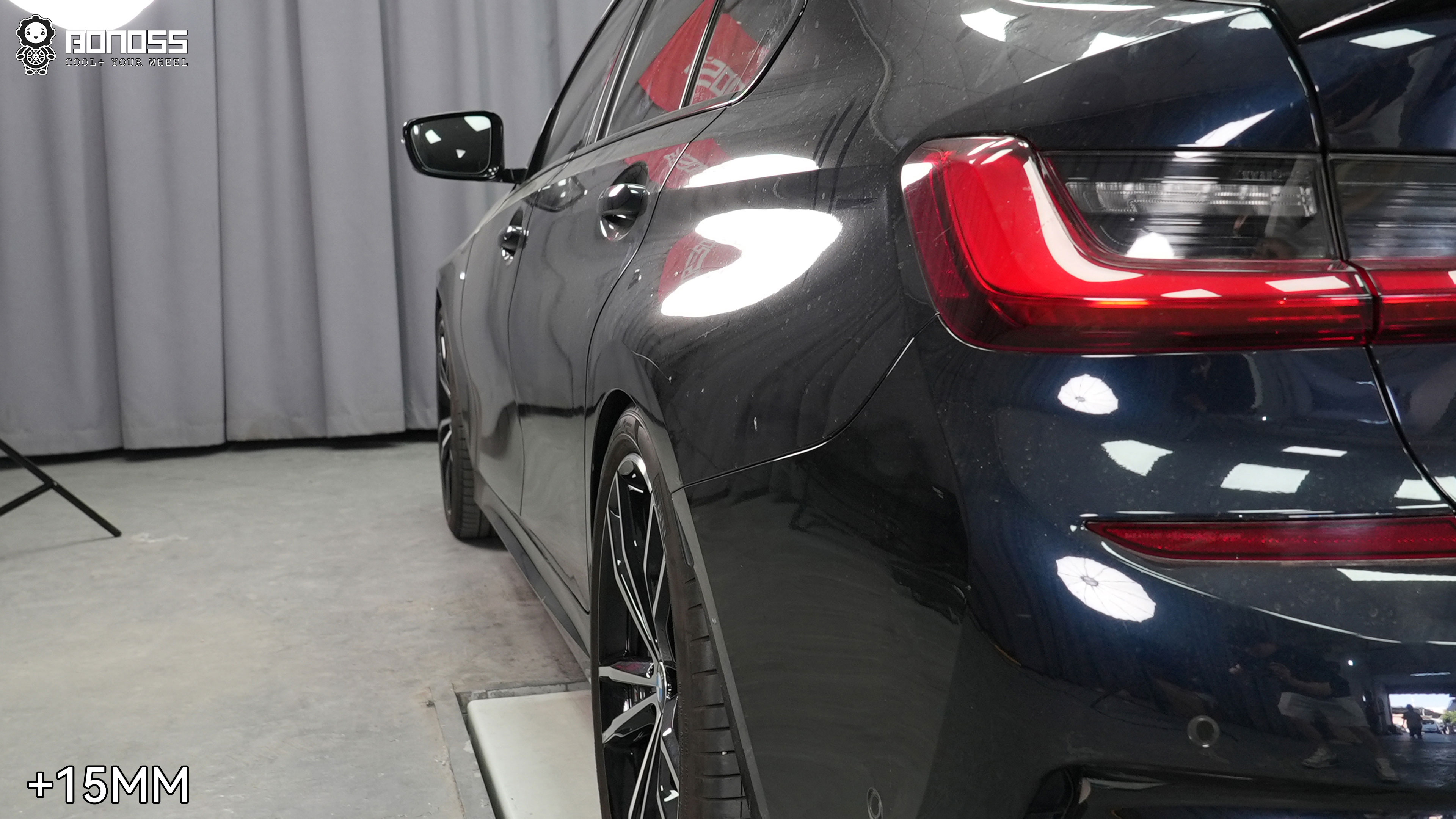
Left rear, after 15mm: ET+25, hips filled, the rear track widened 30mm across the axle.
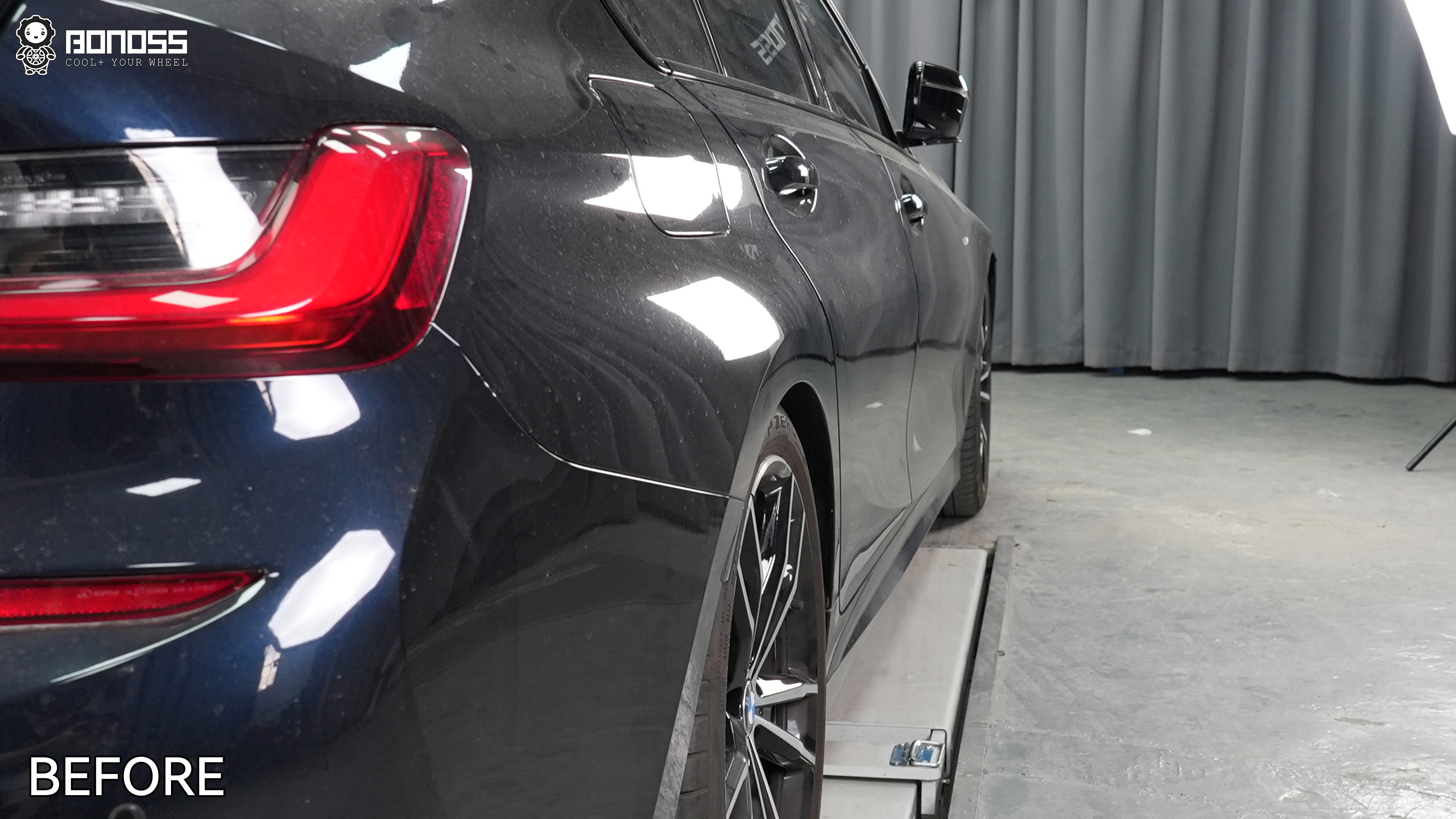
Right rear, before: the mirror of the left — tucked and waiting.
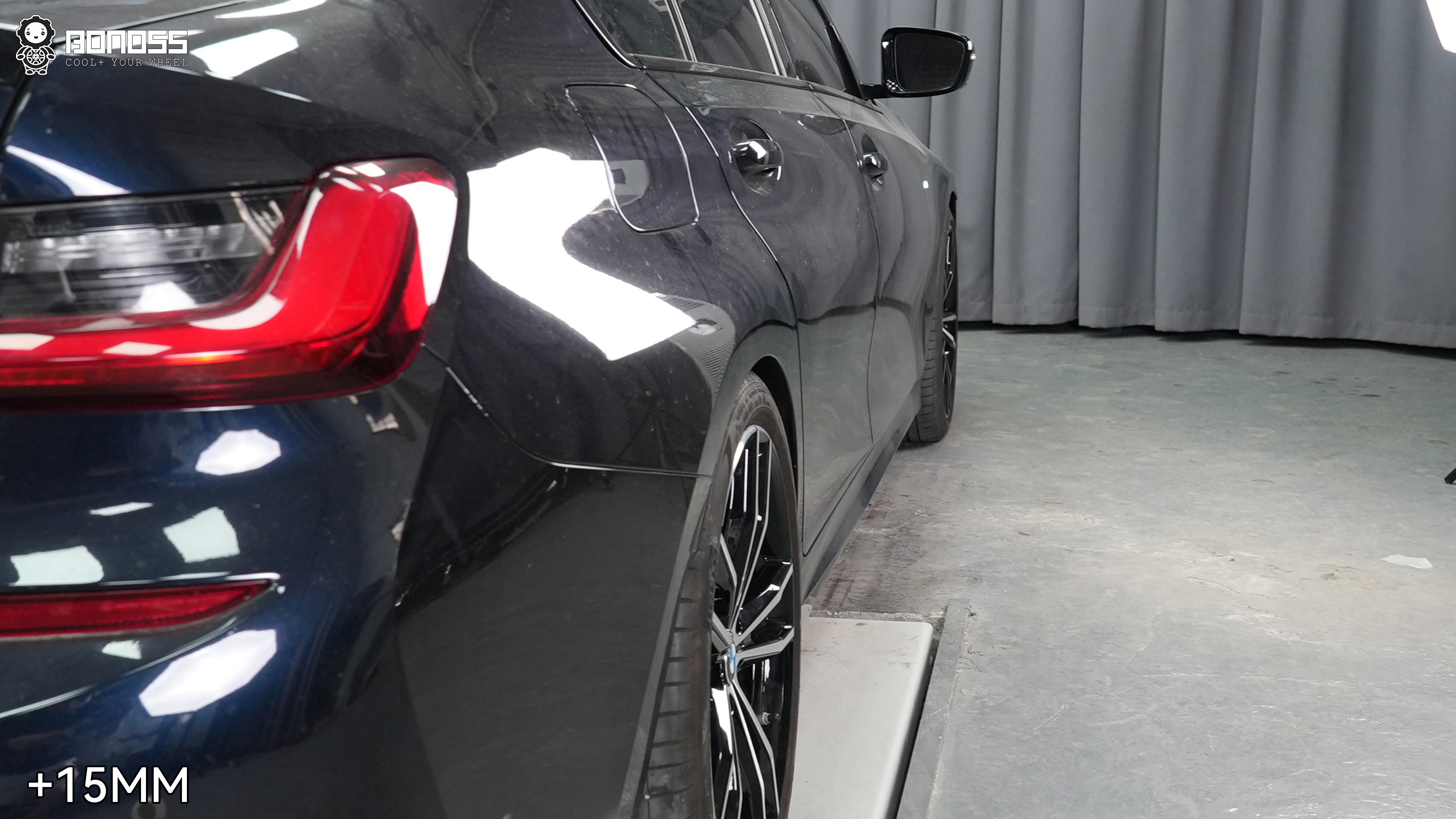
Right rear, after: flush and level with the opposite corner.
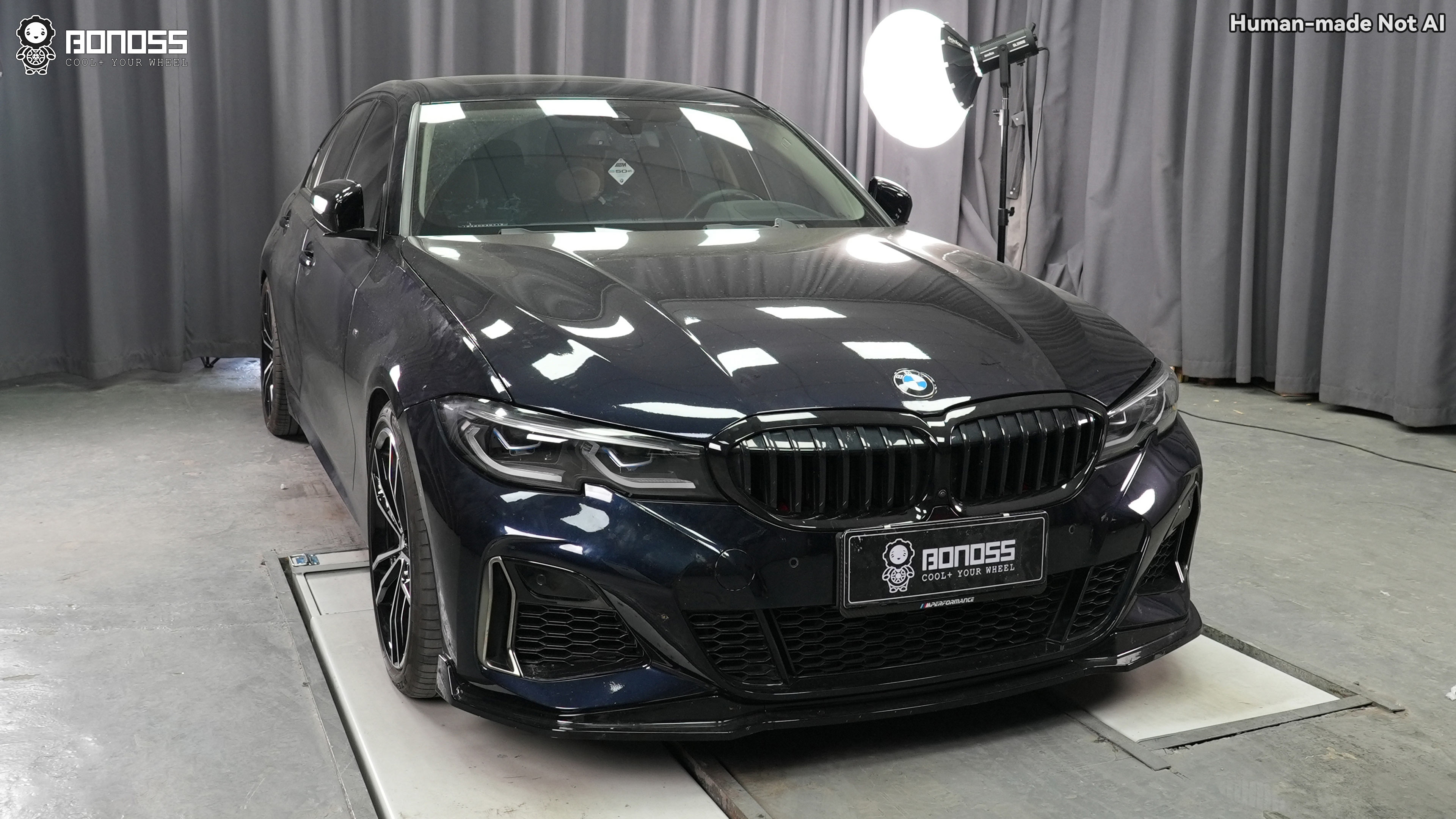
The finished car from the left-front three-quarter angle. Net effect: front track up 24mm, rear track up 30mm, offsets at ET+15 and ET+25, and the wheels finally fill the arches the way the chassis was styled to sit. The extra track width buys brake caliper clearance if bigger hardware ever lands in those arches — a side benefit, not the reason we did it.
24,318 Miles Later
A fitment story that ends at the curb isn’t a story, so we followed up. Since October 6, 2024, Eric has put 24,318 miles on the setup. His report, verbatim: “Car drives and looks great! 24,318 miles on them so far, and wear is barely noticeable. They should easily last to 35k.”
For anyone asking “are wheel spacers safe” as a blanket question, this is the honest shape of the answer: conditional, not reflexive. Hub-centric fit, correct bolt engagement, a clean hub, one torque spec, and miles of evidence — those conditions, met, are what “safe” actually means.
What It Cost
Real pricing, from the actual invoice. The front kit — two 12mm 7075-T6 spacers plus ten 39mm extended bolts — came to $158.99. The rear kit — BMW 3 Series 15mm wheel spacers, two pieces plus ten 42mm extended bolts — came to $165.99. Labor was $20, because a slip-on install with proper prep is straightforward shop work. Bought as a complete BMW 3 Series wheel spacers set of 4, the two kits total $324.98 before labor. For forged aluminum and grade 12.9 hardware with published lab reports attached, that math is hard to argue with.
Why BONOSS — in One Paragraph
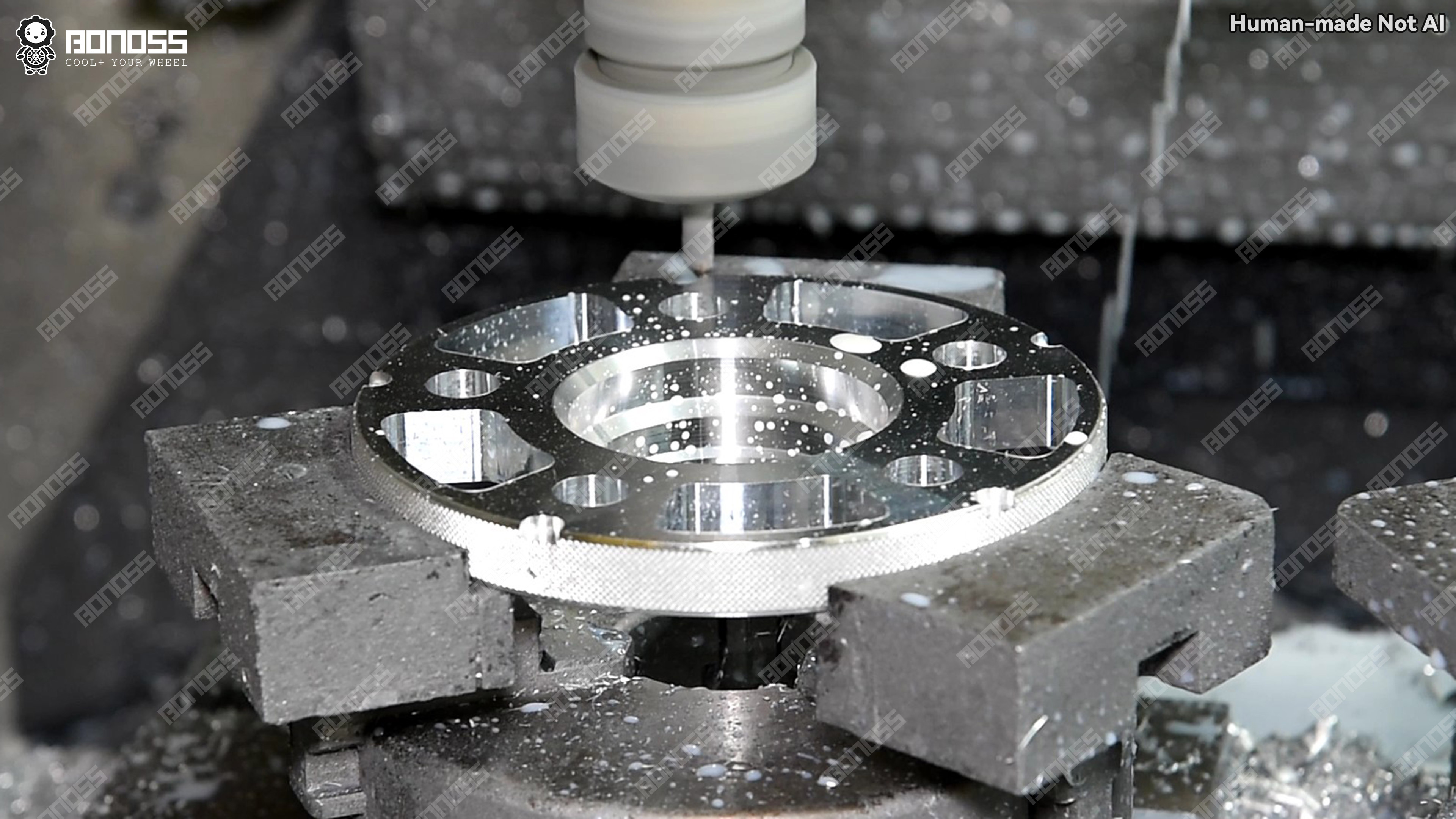
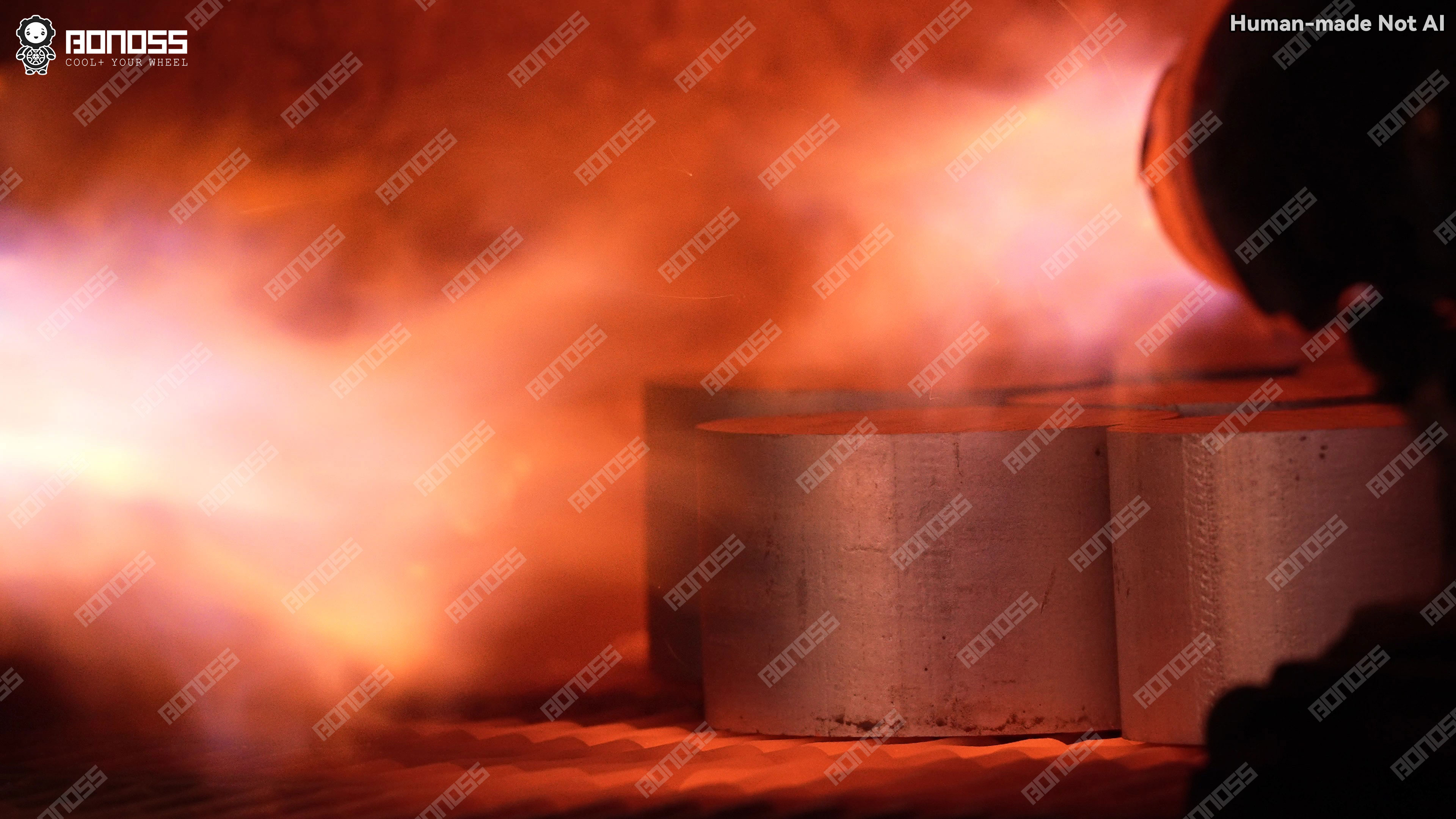
We’ll keep this short, because the article above is the argument. Eric’s kit comes from the BONOSS forged lightweight plus line — forged AL7075-T6 BMW G20 12mm spacers that start life as a heated billet pressed to shape, then finish on CNC machines holding 0.02mm. The multi-stage hub-centric bores do the centering work you watched get measured; the hard-anodized finish fights corrosion; a 10-year warranty and more than 75 published SGS and TÜV test reports stand behind both pieces. These are the lightweight wheel spacers 5×112 BMW G20 drivers keep buying for exactly those reasons, and we see no point padding the paragraph beyond them.
FAQ
Are 12mm wheel spacers safe on a 2020 BMW 3 Series?
Yes — when three conditions hold, and this car documents all three. The spacer must sit hub-centric on a hub step shorter than the spacer is thick (10.96mm versus 12mm here), the bolts must match the thread and engagement the hub needs (M14x1.25, 39mm front and 42mm rear), and the assembly must be torqued to a published figure (140 Nm, 103.5 ft-lb). Safety lives in the fit and the hardware, not in the thickness itself.
Do 12mm spacers have a hub-centric lip for the G20?
The BONOSS G20 12mm wheel spacers do — their multi-stage bore accepts up to 13.5mm of hub projection, covering the 10.96mm step measured on this 330i with room to spare, and the 66.5mm pilot centers the wheel within 0.12mm of diametral clearance. A generic flat-bore 12mm spacer may not clear that step at all, so measure your hub before buying anything.
What wheel bolt length do I need for 15mm spacers on a BMW G20?
42mm of thread below the seat, given the stock 27mm bolt and factory wheels — 27mm of engagement plus 15mm of spacer equals 42. The front 12mm spacers take 39mm bolts, and both sizes keep the M14x1.25 thread and conical seat.
What torque should I use when fitting wheel spacers on a 2020 3 Series?
140 Nm (103.5 ft-lb), applied once across the whole job. With BONOSS extended bolts, follow BONOSS installation instructions; with stock bolts, follow the owner’s manual — on this car, both publish the same figure.
Do F30 spacers fit a G20 3 Series?
No — the bolt patterns differ. The F30-generation 3 Series uses 5×120; the G20 switched to 5×112 with a 66.6mm center bore, so F30 hardware physically cannot bolt onto a G20 hub. Match spacers to the chassis under the car, not the badge on the trunk.
Do I need a four-wheel alignment after installing hub-centric spacers?
Not if the car was aligned after its last suspension change — Eric aligned after his coilovers, and his spacers didn’t move camber, caster, or toe. A spacer shifts the wheel outward along the hub axis without relocating any suspension pickup point, so the alignment angles are untouched. If you lowered the car and never aligned it, do that first, spacers or not.
The Verdict
So do 2020 BMW 3 Series 12mm wheel spacers deliver? On this car, the answer is a documented yes: a measured fit, a stepped hub-centric bore that turns a 10.96mm hub step into a non-issue, bolts sized by arithmetic and backed by lab reports, one clean hub, one torque spec, and 24,318 miles of use wearing like the install happened last month.
If you’re shopping for the best 12mm wheel spacers for a 2020 BMW 3 Series, hold every candidate to this article’s standard: measured hub-step height, published test reports for the exact thread, and a seller who can tell you which bore mates to which surface. Vague fitment charts and “universal” claims should end the conversation on the spot. The BMW G20 12mm front 15mm rear spacer kit Eric runs — forged, multi-stage hub-centric, with matched grade 12.9 bolts — is available from BONOSS now; check current pricing and the full spec sheet on the product page, and quote your measured numbers when you order.

About Jack Miller
Jack Miller is a certified automotive technician specializing in wheel and tire systems, with over a decade of hands-on repair experience. He has served as a senior technical specialist at BONOSS for the past 7 years, advising on wheel spacer fitment, wheel bolt & wheel nut selection for thousands of customer builds. Jack’s technical guides on BONOSS are grounded in real customer cases — not theory.