
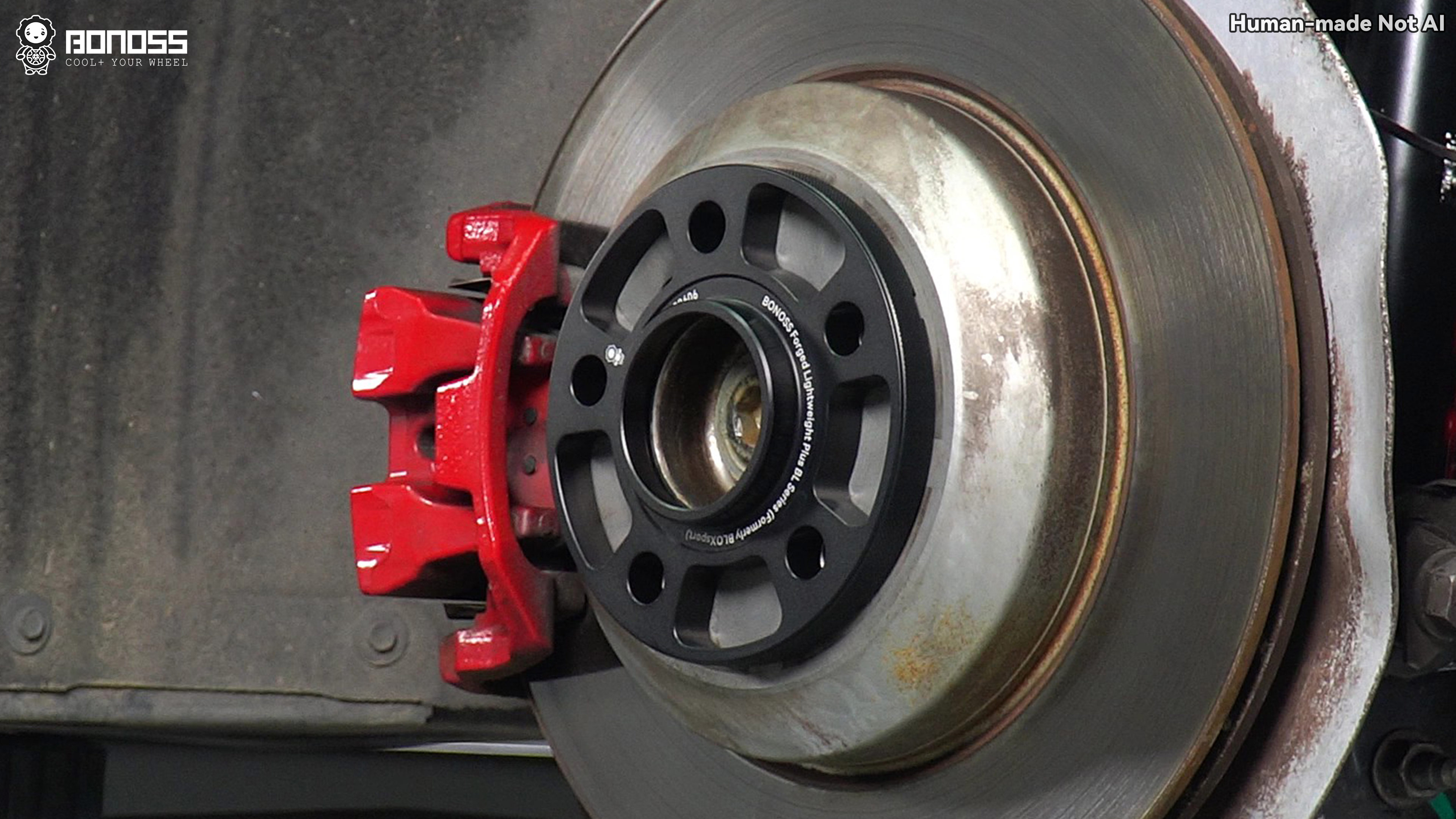
BMW 3 Series wheel spacers split into three hardware families: the G20 (2019+) runs 5×112 with a 66.6mm center bore and M14x1.25 bolts, the E36 through F30 run 5×120 with a 72.6mm bore, and regular E30 and E21 models run 4×100 with a 57.1mm bore. Safe thickness lands at 12–20mm on a G20, 12–25mm on an F30, and 15–35mm on an E46 with high-offset wheels, always cross-checked against your measured fender gap and hub protrusion. Factory torque is 103.5 ft-lb (140 Nm) on G20 and F30, 88.5 ft-lb (120 Nm) on E90, 74 ft-lb (100 Nm) on E46, and 85 ft-lb (115 Nm) on E36, E30, and E21 — and every install gets a re-torque after 50–100 km.
Fifty years of 3 Series, seven chassis codes, three bolt patterns, and two wheel bolt threads. That’s why a single “what spacers fit my BMW” answer keeps falling apart in forum threads — someone with a 2015 F30 quotes numbers that are flat wrong for a 2022 G20, and nobody notices until the vibration starts. This guide settles it generation by generation: the PCD, center bore, thread pitch, torque, and safe thickness ranges in one place, plus the hub protrusion trap that causes most of the complaints in the first place.
We build these parts, so we’d rather you buy the right size once than the wrong size twice.
BMW 3 Series Wheel Spacers: Full Spec Quick Reference
| Generation / Year | Bolt Pattern | Center Bore | Thread Pitch | Wheel Offset | Suggested Spacer Sizes | Factory Lug Nut Torque |
|---|---|---|---|---|---|---|
| 2019-2027 G20 330i | 5x112mm | 66.6mm | M14x1.25 | ET25 / ET30 | 12mm to 20mm | 103.5 ft-lb / 140 Nm |
| 2019-2027 G20 330i xDrive | 5x112mm | 66.6mm | M14x1.25 | ET25 | 10mm to 15mm | 103.5 ft-lb / 140 Nm |
| 2019-2027 G20 M340i | 5x112mm | 66.6mm | M14x1.25 | ET27 / ET25 / ET40 | 12mm to 20mm | 103.5 ft-lb / 140 Nm |
| 2019-2027 G20 M340i xDrive | 5x112mm | 66.6mm | M14x1.25 | ET27 / ET25 | 10mm to 15mm | 103.5 ft-lb / 140 Nm |
| 2019-2024 G20 330e | 5x112mm | 66.6mm | M14x1.25 | ET30 / ET25 / ET40 | 12mm to 20mm | 103.5 ft-lb / 140 Nm |
| 2019-2024 G20 330e xDrive | 5x112mm | 66.6mm | M14x1.25 | ET30 / ET25 / ET40 | 12mm to 20mm | 103.5 ft-lb / 140 Nm |
| 2012-2018 F30 320i | 5x120mm | 72.6mm | M14x1.25 | ET37 | 12mm to 25mm | 103.5 ft-lb / 140 Nm |
| 2012-2018 F30 320i xDrive | 5x120mm | 72.6mm | M14x1.25 | ET37 | 12mm to 25mm | 103.5 ft-lb / 140 Nm |
| 2012-2018 F30 328d | 5x120mm | 72.6mm | M14x1.25 | ET37 | 12mm to 25mm | 103.5 ft-lb / 140 Nm |
| 2012-2018 F30 328d xDrive | 5x120mm | 72.6mm | M14x1.25 | ET37 | 12mm to 25mm | 103.5 ft-lb / 140 Nm |
| 2012-2018 F30 328i | 5x120mm | 72.6mm | M14x1.25 | ET37 | 12mm to 25mm | 103.5 ft-lb / 140 Nm |
| 2012-2018 F30 328i xDrive | 5x120mm | 72.6mm | M14x1.25 | ET37 | 12mm to 25mm | 103.5 ft-lb / 140 Nm |
| 2016-2018 F30 330i | 5x120mm | 72.6mm | M14x1.25 | ET37 | 12mm to 25mm | 103.5 ft-lb / 140 Nm |
| 2016-2018 F30 330i xDrive | 5x120mm | 72.6mm | M14x1.25 | ET37 | 12mm to 25mm | 103.5 ft-lb / 140 Nm |
| 2016-2018 F30 330e | 5x120mm | 72.6mm | M14x1.25 | ET37 | 12mm to 25mm | 103.5 ft-lb / 140 Nm |
| 2016-2018 F30 340i | 5x120mm | 72.6mm | M14x1.25 | ET37 | 12mm to 25mm | 103.5 ft-lb / 140 Nm |
| 2016-2018 F30 340i xDrive | 5x120mm | 72.6mm | M14x1.25 | ET37 | 15mm to 25mm | 103.5 ft-lb / 140 Nm |
| 2012-2015 F30 335i | 5x120mm | 72.6mm | M14x1.25 | ET34 | 10mm to 25mm | 103.5 ft-lb / 140 Nm |
| 2012-2015 F30 335i xDrive | 5x120mm | 72.6mm | M14x1.25 | ET34 | 10mm to 25mm | 103.5 ft-lb / 140 Nm |
| 2012-2015 F30 ActiveHybrid 3 | 5x120mm | 72.6mm | M14x1.25 | ET34 | 10mm to 25mm | 103.5 ft-lb / 140 Nm |
| 2006-2011 E90 328i | 5x120mm | 72.6mm | M12x1.5 | ET31 / ET34 | 10mm to 20mm | 88.5 ft-lb / 120 Nm |
| 2006-2011 E90 328i xDrive | 5x120mm | 72.6mm | M12x1.5 | ET31 / ET34 | 10mm to 20mm | 88.5 ft-lb / 120 Nm |
| 2008-2011 E90 335d | 5x120mm | 72.6mm | M12x1.5 | ET34 | 12mm to 20mm | 88.5 ft-lb / 120 Nm |
| 2006-2011 E90 335i | 5x120mm | 72.6mm | M12x1.5 | ET34 | 12mm to 20mm | 88.5 ft-lb / 120 Nm |
| 2006-2011 E90 335i xDrive | 5x120mm | 72.6mm | M12x1.5 | ET34 | 12mm to 20mm | 88.5 ft-lb / 120 Nm |
| 2008-2011 E90 335is | 5x120mm | 72.6mm | M12x1.5 | ET34 / ET37 | 12mm to 25mm | 88.5 ft-lb / 120 Nm |
| 2006-2008 E90 325i / 330i | 5x120mm | 72.6mm | M12x1.5 | ET34 | 12mm to 20mm | 88.5 ft-lb / 120 Nm |
| 2006-2008 E90 325xi / 328xi / 330xi /335xi | 5x120mm | 72.6mm | M12x1.5 | ET34 | 12mm to 20mm | 88.5 ft-lb / 120 Nm |
| 1999-2005 E46 325Ci / 325i / 325xi | 5x120mm | 72.6mm | M12x1.5 | ET47 | 12mm to 30mm | 74 ft-lb / 100 Nm |
| 1999-2005 E46 330Ci / 330i / 330xi | 5x120mm | 72.6mm | M12x1.5 | ET47 / ET41 / ET50 | 15mm to 35mm | 74 ft-lb / 100 Nm |
| 1999-2002 E46 323Ci / 323i / 330xi | 5x120mm | 72.6mm | M12x1.5 | ET46 / ET47 / ET42 | 15mm to 35mm | 74 ft-lb / 100 Nm |
| 1999-2002 E46 328Ci / 328i | 5x120mm | 72.6mm | M12x1.5 | ET46 / ET47 / ET41 / ET50 | 15mm to 35mm | 74 ft-lb / 100 Nm |
| 1991-1998 E36 318i / 318is / 318ti | 5x120mm | 72.6mm | M12x1.5 | ET42 / ET47 | 12mm to 30mm | 85 ft-lb / 115 Nm |
| 1991-1998 E36 323i / 325i / 328i | 5x120mm | 72.6mm | M12x1.5 | ET47 | 12mm to 25mm | 85 ft-lb / 115 Nm |
| 1991-1998 E36 323is / 325is / 328is | 5x120mm | 72.6mm | M12x1.5 | ET47 | 12mm to 25mm | 85 ft-lb / 115 Nm |
| 1991-1998 E36 M3 | 5x120mm | 72.6mm | M12x1.5 | ET41 | 12mm to 20mm | 85 ft-lb / 115 Nm |
| 1984-1990 E30 318i / 318is | 4x100mm | 57.1mm | M12x1.5 | ET35 | 12mm to 20mm | 85 ft-lb / 115 Nm |
| 1984-1990 E30 325 / 325e /325es / 325i / 325iX / 325is | 4x100mm | 57.1mm | M12x1.5 | ET35 / ET41 | 10mm to 20mm | 85 ft-lb / 115 Nm |
| 1986-1990 E30 M3 2.3 | 5x120mm | 72.6mm | M12x1.5 | ET30 | 10mm to 20mm | 85 ft-lb / 115 Nm |
| 1984-1986 E30 315 / 316 / 320i / 323i / 324d | 4x100mm | 57.1mm | M12x1.5 | ET35 | 12mm to 20mm | 85 ft-lb / 115 Nm |
| 1975-1983 E21 315 / 316 / 318i / 320 / 320i / 320is / 323i | 4x100mm | 57.1mm | M12x1.5 | ET25 | 10mm to 25mm | 85 ft-lb / 115 Nm |
Measure First: How to Pick a Thickness That Actually Fits
Forget the forum-recommended thickness for a minute. The size you actually need sits between your tire sidewall and your fender lip, and you can measure it with a ruler in ten minutes. Park the car on level ground at ride height, suspension settled, then lay a straight edge across the fender lip at the widest point of the tire and measure the gap down to the sidewall. That number is your flush spacer size. Front and rear often differ — measure both and write them down.
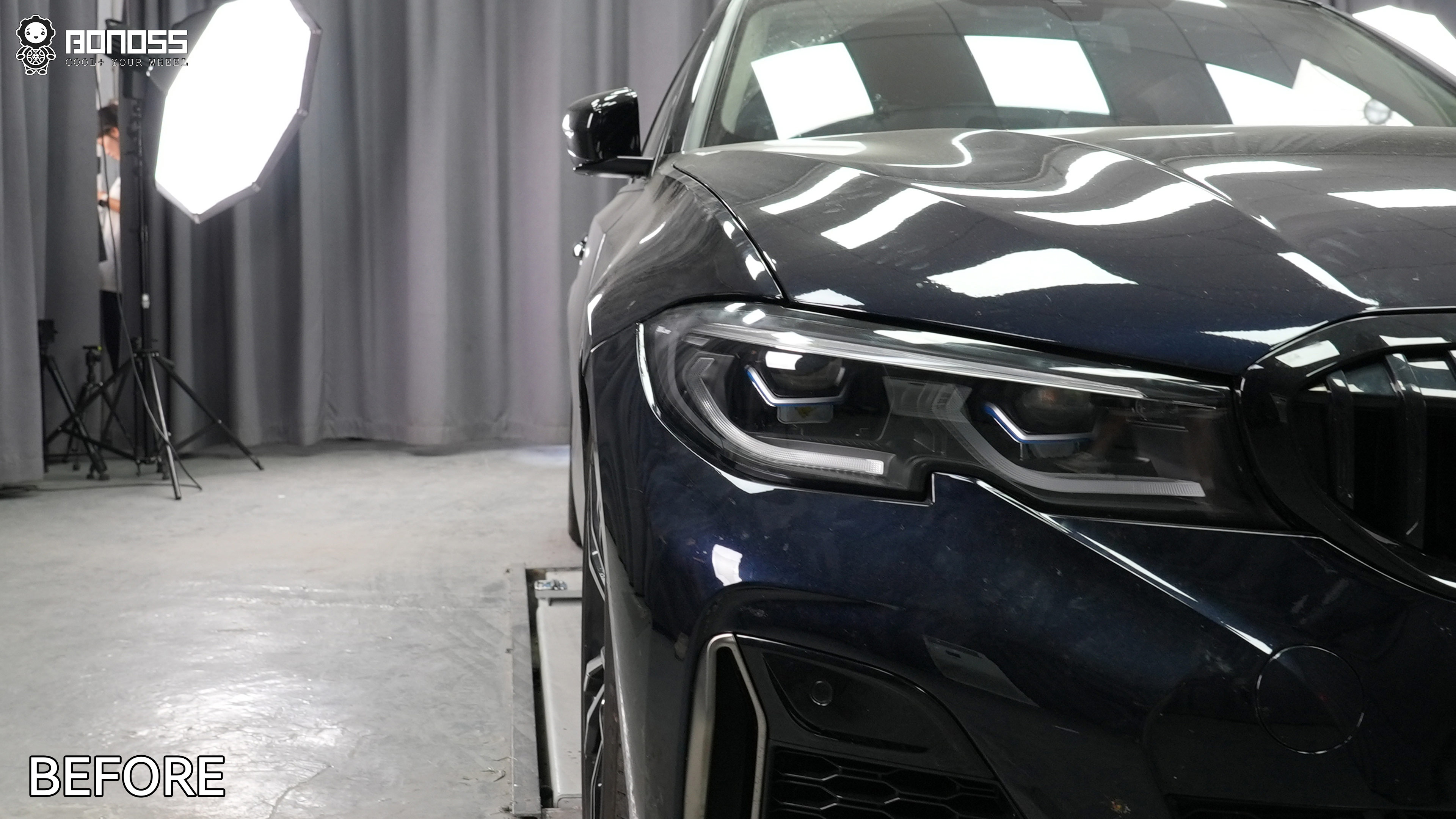
This is what a proper BMW 3 Series wheel spacers before and after starts with: the stock wheel sitting deep in the arch. It looks reserved. The flush stance most people want needs the track width pushed out to the fender edge, no more.
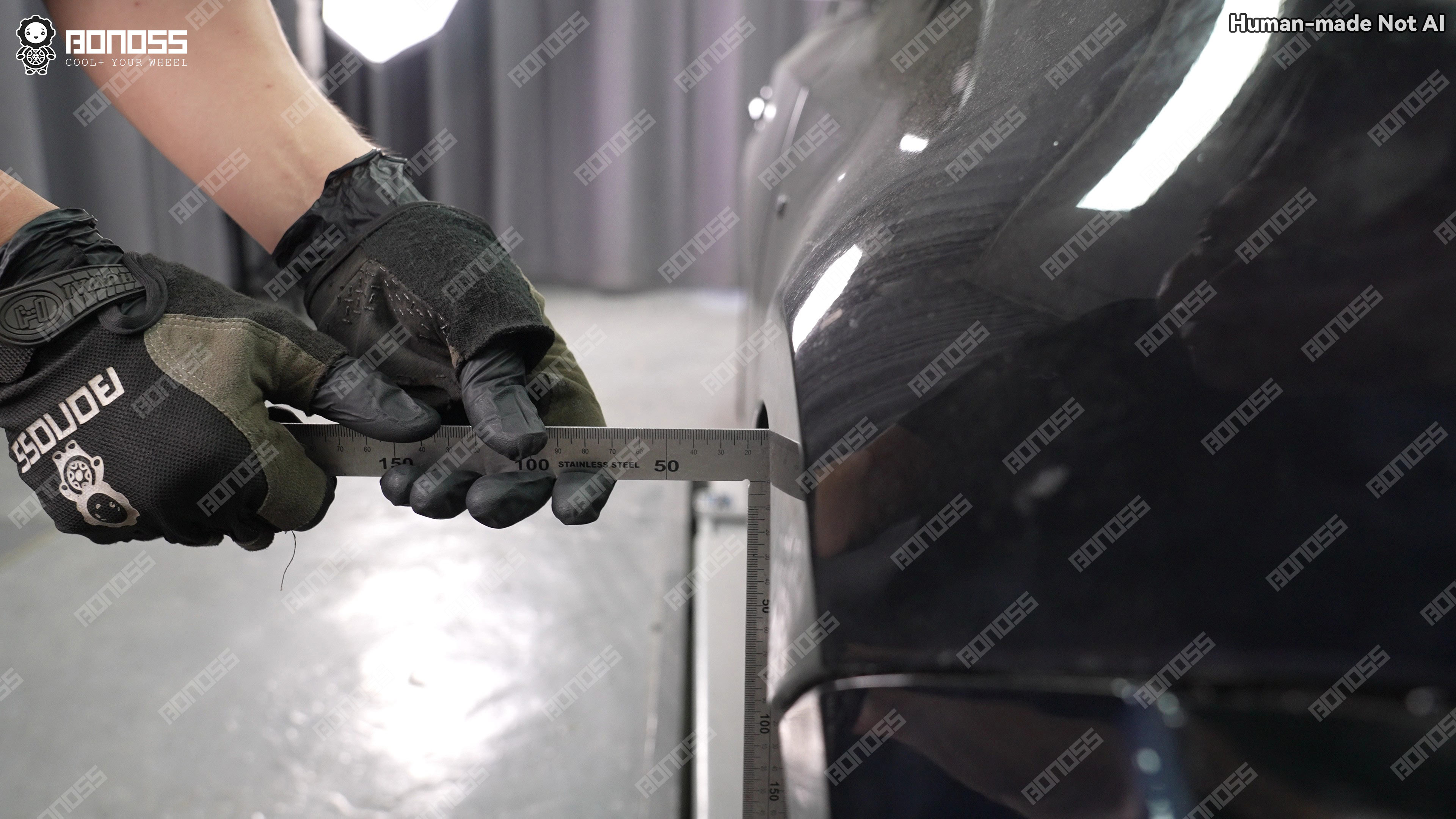
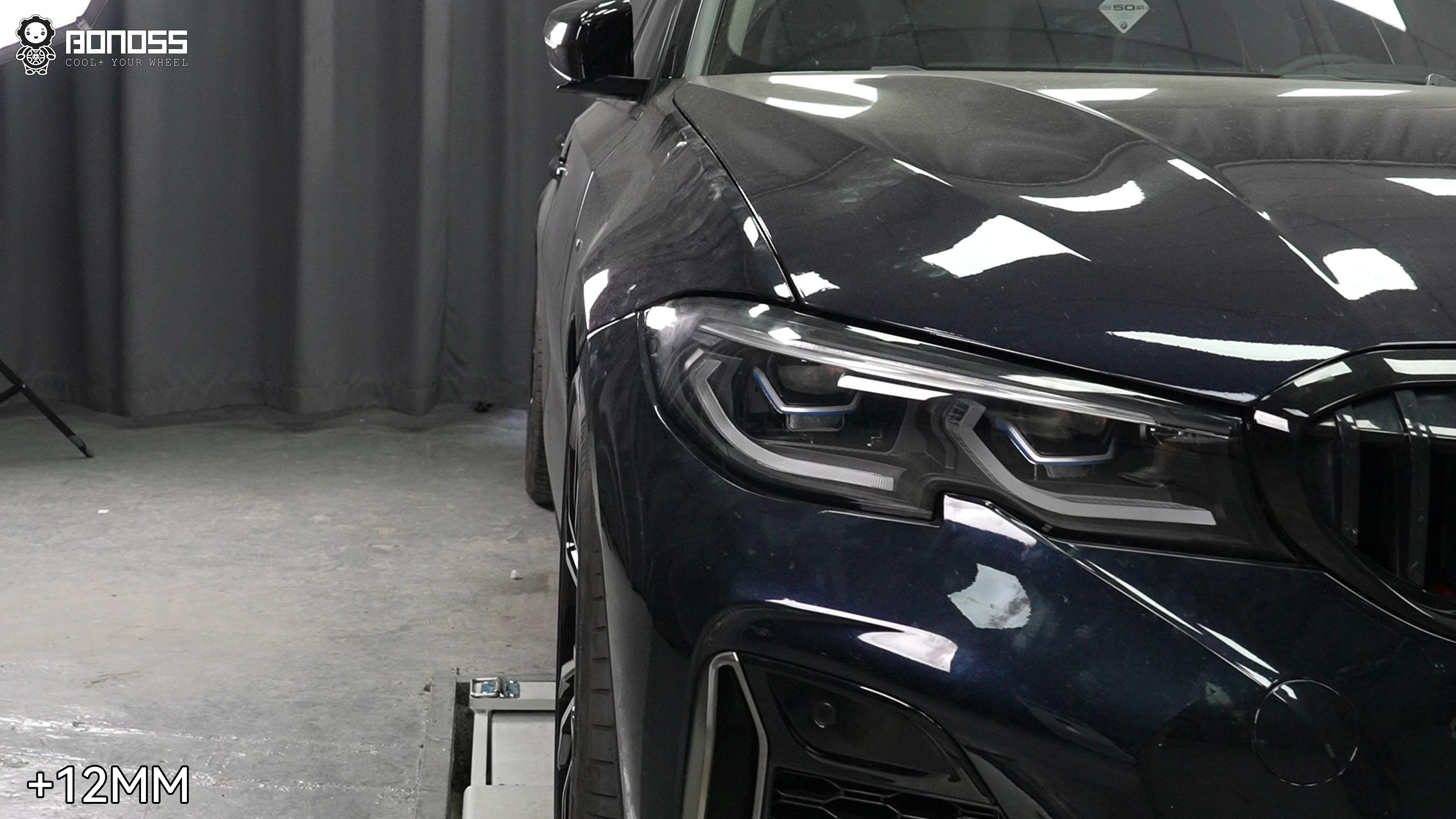
If the gap measures 12mm, a 12mm spacer sits flush. That’s exactly what happened on a 2020 G20: the front gap measured about 12mm, a set of 12mm spacers went on the front axle, and the wheel landed level with the fender line. The full job, with the measurement photos, is documented in the 12mm wheel spacers on a 2020 BMW 3 Series case study — same car, same workflow.
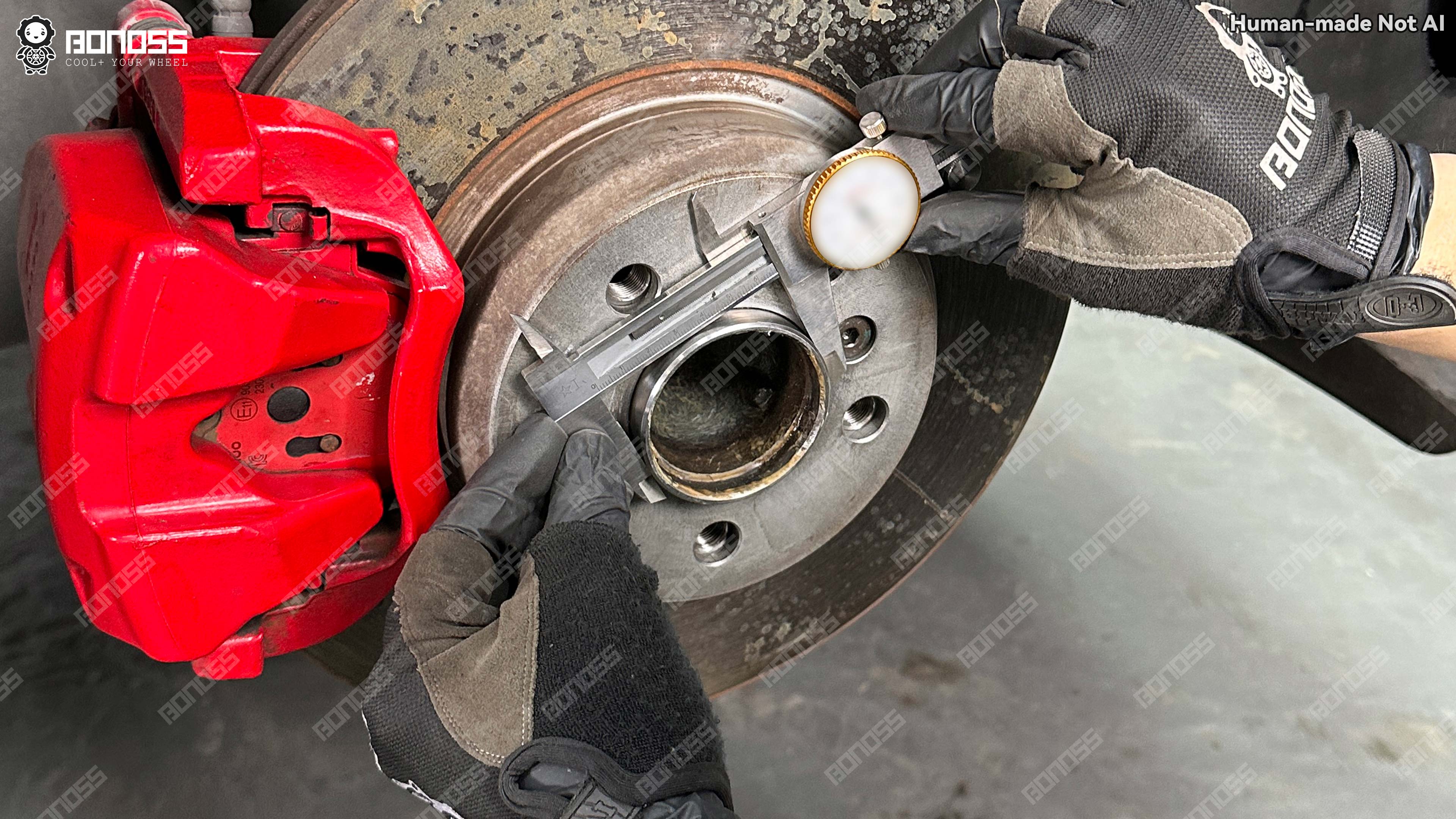
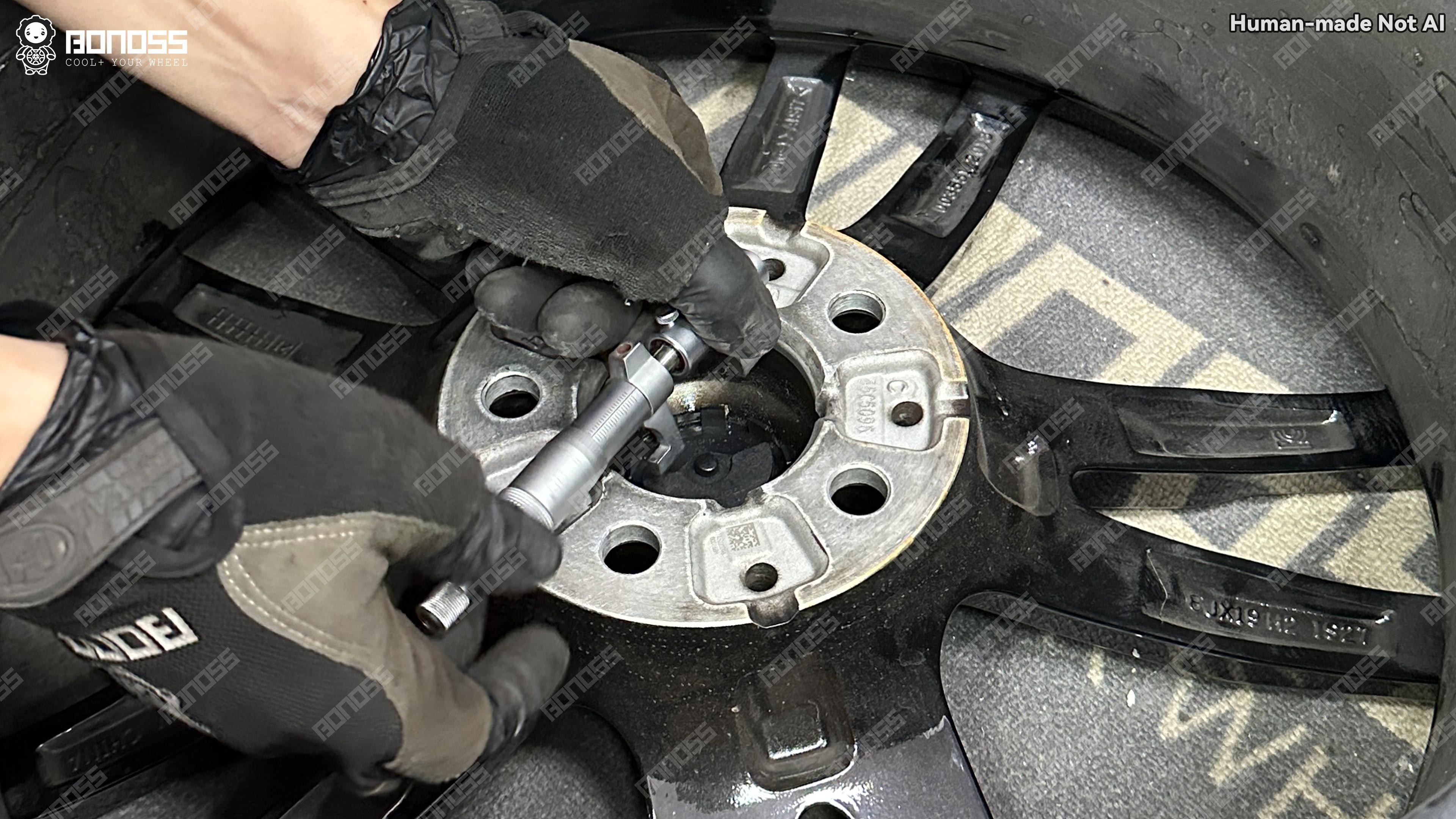
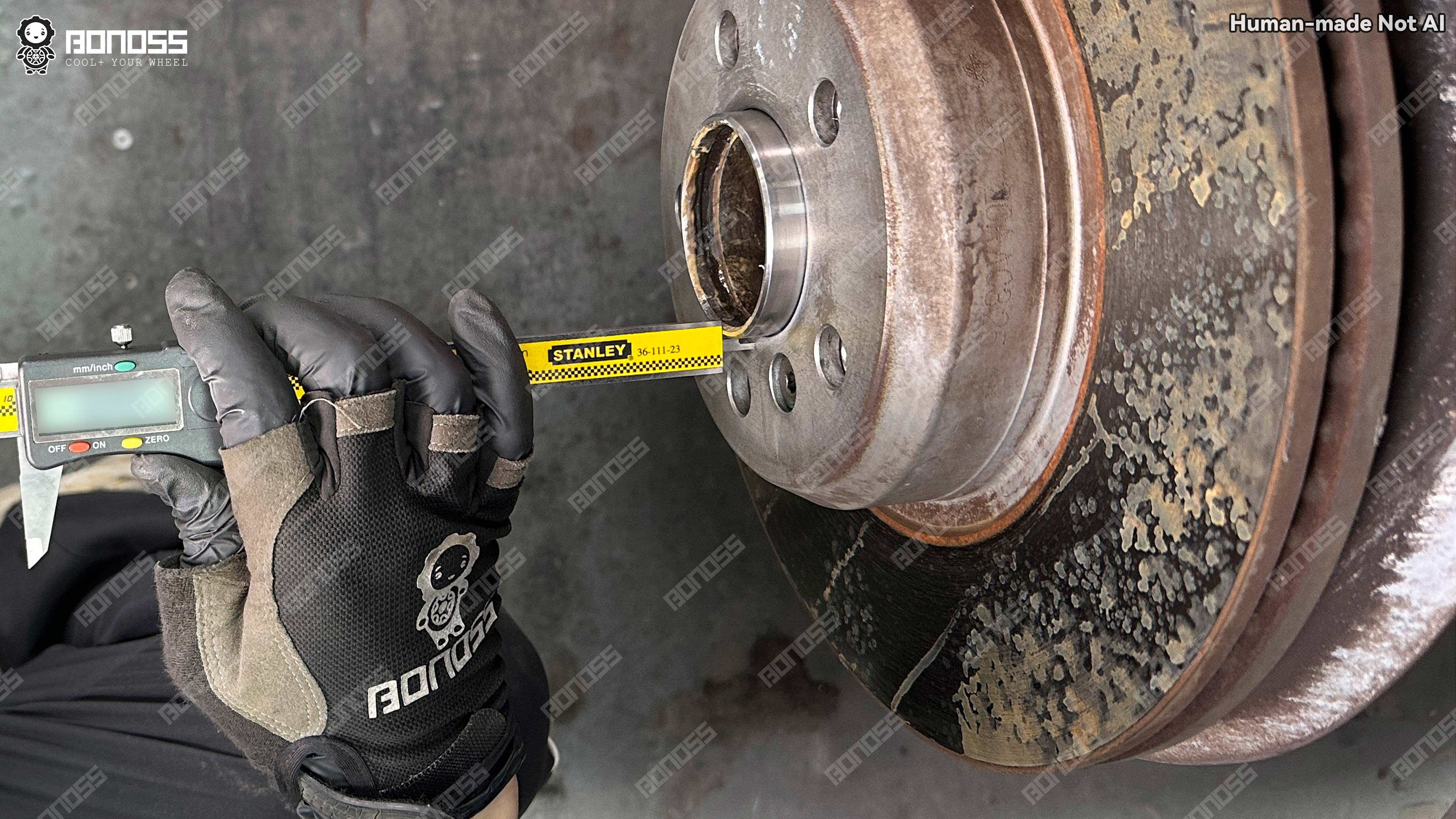
Before ordering anything, take the second set of measurements. The hub center bore diameter, measured with a caliper, has to match the spacer’s bore exactly — that’s what makes a spacer hub-centric rather than lug-centric, and that difference decides whether your steering wheel stays quiet at 120 km/h. Then check the wheel bore of the wheels you actually run, with a micrometer; it only needs to be equal to or larger than the hub, never smaller.
The Hub Protrusion Trap: Why BMW Spacers Vibrate
BMW hides one fitment trap better than most brands: the hub center protrusion. The hub face on a 3 Series carries a raised locating lip, and if your spacer is thinner than that lip is tall, the spacer cannot land on the hub face. Instead it rides on the lip itself, the bolts clamp a cockeyed assembly, and you get the classic shake that owners blame on “spacers” generally. It was never the spacers. It was the thickness.
So measure the step height with a caliper before you compare prices. The rule is blunt: spacer thickness must be greater than or equal to the hub protrusion. Chassis code first, caliper second, thickness last.
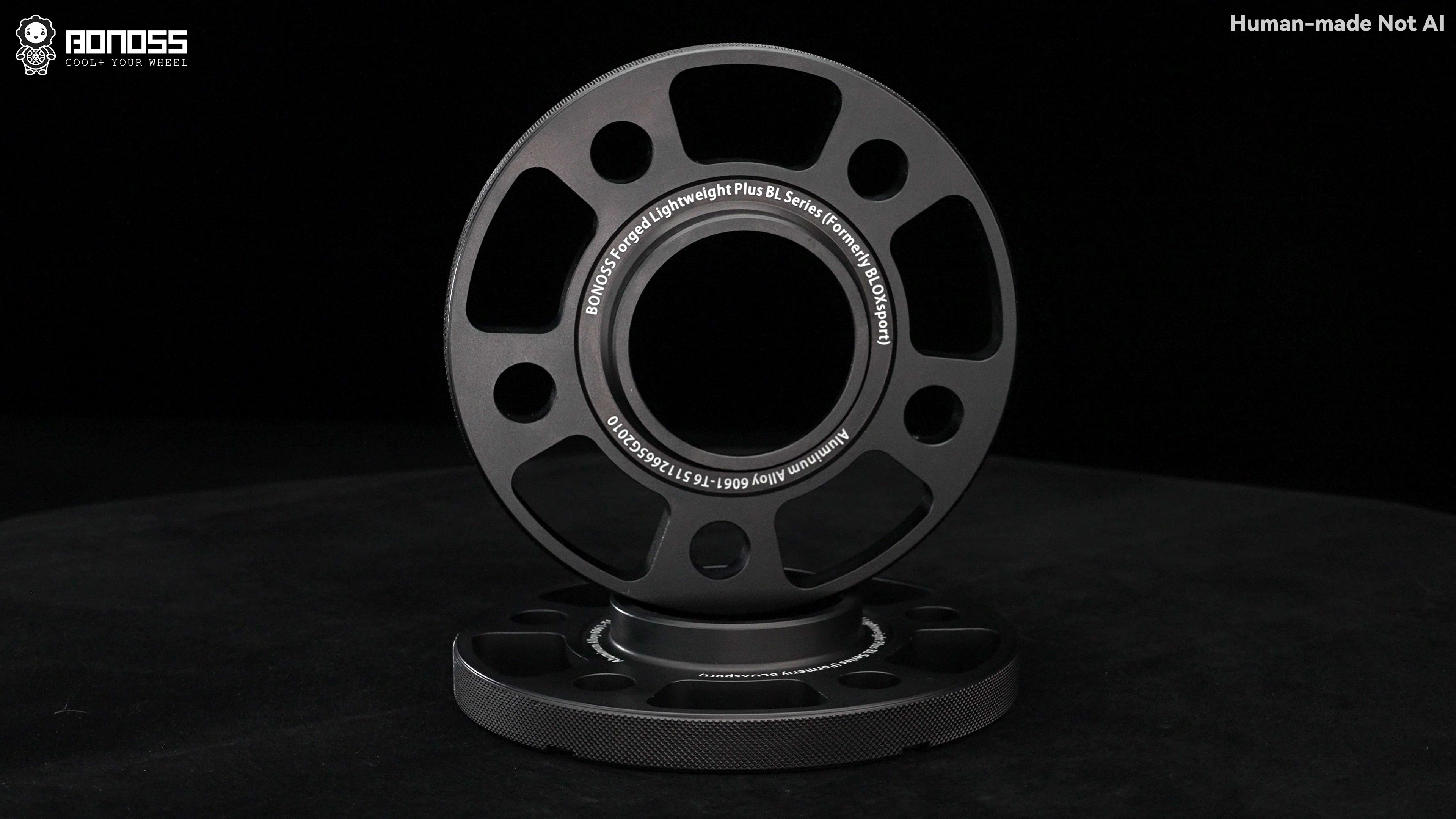
The BONOSS multi-stage hub-centric spacers answer this constraint with a stepped center bore that accepts up to 1.5mm more hub length than the spacer’s own thickness: a 10mm BONOSS multi-stage unit handles up to 11.5mm of protrusion, and a 12mm unit handles up to 13.5mm. In practice, that means when a flat-bore spacer would be ruled out because the lip stands two-tenths taller than the thickness you wanted, the multi-stage design still works — and because the step gives the hub a true seating register, the odds of vibration drop even with tight tolerances.
One straight caveat: that tolerance is specific to BONOSS multi-stage hub-centric spacers, not a generic feature of anything labeled “hub-centric.” A competitor’s one-piece spacer cannot copy it, so don’t apply the 1.5mm allowance to parts that don’t have the stepped bore.
G20 (2019–2027): 5×112, 66.6mm, M14x1.25
The seventh generation changed more under the hub cap than any 3 Series before it, which is exactly why pre-2020 forum advice is wrong for it.
What specs does this generation need?
G20 5×112 wheel spacers are the ones you’re after: 5×112 bolt pattern, 66.6mm center bore, and M14x1.25 conical seat bolts for the wheel hardware. That’s a double break from the F30’s 5×120/72.6mm — both the PCD and the bore changed, so older 3 Series spacers physically cannot mount on a G20. Factory offsets run ET25–ET30 on the 330i, ET25–ET40 on the M340i, and ET25–ET40 on the 330e, with factory torque at 103.5 ft-lb (140 Nm). Any BMW G20 5×112 spacers you see listed elsewhere should come with a 66.6mm bore and M14x1.25 thread or they’re the wrong part.
How thick can G20 spacers go?
The suggested range is 12–20mm on rear-wheel-drive cars and 10–15mm on xDrive, where the front end has less margin to spare. With typical factory ET25–ET30 wheels, 12–15mm already fills the arch; 20mm is the flush limit on factory offset. Check brake caliper clearance visually as you approach the upper end of the range.
Torque, and are the factory bolts enough?
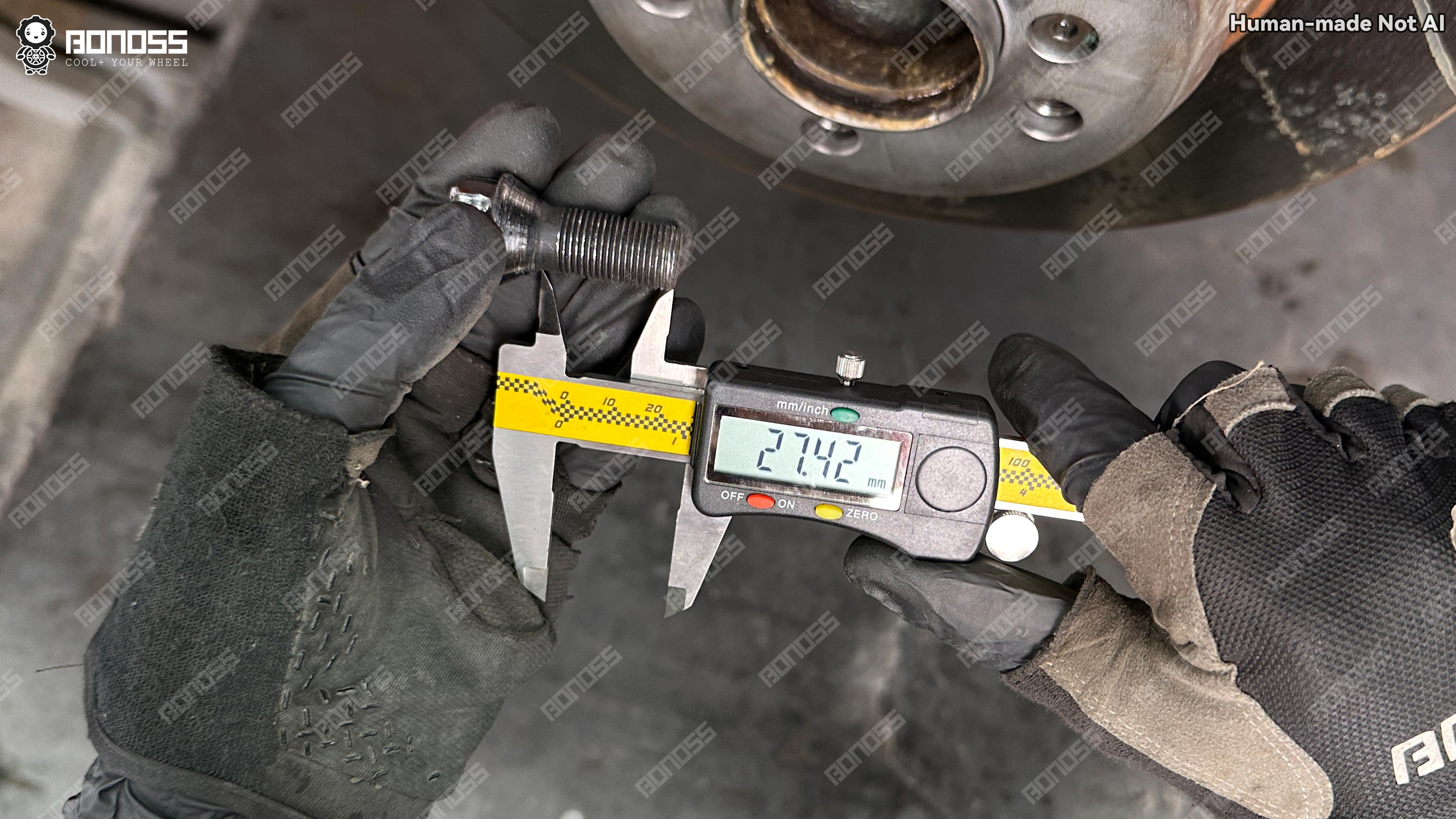
103.5 ft-lb (140 Nm) at the wheel, per the owner’s manual. For slip-on spacers the issue is bolt length, not torque: the OEM BMW M14x1.25 lug bolt length 27mm under the contact face leaves roughly 15mm of engagement after a 12mm spacer — right at the minimum for an M14 thread — so extended bolts are the default safe answer on slip-ons, not an optional upgrade.
Generation-specific gotchas
Three. The hub protrusion, above — newer chassis run taller locating lips, so measure yours before committing to a thickness. The 66.6mm bore, which means nothing carried over from an F30 or E90 fits. And the M14x1.25 thread, which is easy to confuse with its lookalike M14x1.5; they are not interchangeable, and test report data is thread-specific. Always match the thread pitch before checkout.
F30 (2012–2018): 5×120, 72.6mm, M14x1.25
What specs does this generation need?
F30 72.6mm hub bore spacers on a 5×120 pattern with M14x1.25 conical seat bolts. Offsets run ET37 on most sedans and ET34 on the 335i; torque is 103.5 ft-lb (140 Nm). The F30 5x120mm wheel spacers application is the single largest 3 Series market, which is why nearly every size is available off the shelf — the fitment is easy, the thickness choice is where people go wrong.
How thick can F30 spacers go?
The suggested range runs 12–25mm on most trims, 15–25mm on the 340i xDrive, and 10–25mm on the 335i. In practice, factory wheels sit noticeably deep, and owners chasing the flush look on 18-inch and larger wheels with ET37–ET40 offsets most often land on BMW 20mm wheel spacers at the rear with 12–15mm up front. Measure both ends — the F30 rear hub runs tall, which sets a practical 12mm rear minimum.
Torque, and are the factory bolts enough?
Bolts torque to 103.5 ft-lb (140 Nm). Thread-wise the F30 shares M14x1.25 with the G20, so the same rule applies: extended bolts on slip-on spacers, seated fully by hand before the wrench comes out, then torqued in a crisscross sequence.
Generation-specific gotchas
The E90-to-F30 upgrade path. Do E90 spacers fit an F30? No. The pattern (5×120) and bore (72.6mm) are identical, but the E90’s M12x1.5 bolts became M14x1.25 on the F30 — so slip-on spacers need the correct thread, and E90 bolt-on spacer kits, which carry M12 studs, will not hold an F30 wheel. The hardware changed even though the holes didn’t.
E90 (2005–2011): 5×120, 72.6mm, M12x1.5
What specs does this generation need?
The E90 5×120 wheel spacers BMW 3 Series owners keep asking for all share one spec sheet: 5×120 pattern, 72.6mm center bore, M12x1.5 conical seat bolts. Don’t mix it up with the F30 — the E90’s bolts are M12, not M14. Offsets run ET31–ET34 on the 328i, ET34 on the 335i, and ET34–ET37 on the 335is.
How thick can E90 spacers go?
Suggested ranges are 10–20mm on most trims and 12–25mm on the 335is. Factory wheels tuck 20mm or more inside the arch, so 15mm spacers are the single most popular E90 size.
Torque, and are the factory bolts enough?
88.5 ft-lb (120 Nm), and use exactly that number. The OEM BMW M12x1.5 lug bolt length 25mm under the contact face means 10–12mm slip-on spacers can reuse the factory bolts; beyond that, order extended M12x1.5 bolts, which are cheap and easy to source.
Generation-specific gotchas
Used hardware. The M12x1.5 bolt served BMW for two decades across models, which makes old bolts easy to find and easy to trust — wrongly. A fifteen-year-old stretched bolt is not a reusable part. If your build reuses secondhand hardware, replace the bolts; they’re the cheapest component in the whole assembly.
E46 (1998–2005): 5×120, 72.6mm, M12x1.5
What specs does this generation need?
BMW 3 Series E46 wheel spacers bolt onto the same 5×120 pattern, 72.6mm bore, and M12x1.5 thread as the E90, but with wider offset variance: ET47 on the 325 line and ET41–ET50 across the 330 line depending on the wheels. Factory torque is 74 ft-lb (100 Nm).
How thick can E46 spacers go?
The E46 is the flush-fit sweetheart of the family: high-offset (ET47) factory wheels sit deep, so the range runs 12–30mm on the 325 line and 15–35mm on the 330 line. E46 25mm hub-centric spacers are a common final choice — the size fills the arch on factory ET47 wheels without changing to lower-offset wheels.
Torque, and are the factory bolts enough?
74 ft-lb (100 Nm). The same bolt-length logic as the E90 applies: the 25mm shank covers sub-10mm spacers, and extended M12x1.5 bolts cover everything above, with the engagement check done first (a bolt should thread in at least as deep as its diameter — 12mm minimum for an M12).
Generation-specific gotchas
Offset variance. ET41, ET46, ET47, and ET50 all exist within this one generation, and the 9mm spread between the highest and lowest equals half a spacer. Someone else’s “E46 answer” is meaningless without your exact offset — measure the gap on your car, both axles.
E36 (1990–1998): 5×120, 72.6mm, M12x1.5
What specs does this generation need?
The E36 runs the classic BMW 5×120 pattern, 72.6mm bore, and M12x1.5 bolts, with offsets of ET42–ET47 on standard cars and ET41 on the M3. Factory torque is 85 ft-lb (115 Nm).
How thick can E36 spacers go?
Suggested ranges: 12–30mm on the 318 line (ET42–ET47), 12–25mm on the 323/325/328 line, and 12–20mm on the M3 with factory ET41 wheels. The E46-style deep tuck isn’t as extreme here, so mid-range thicknesses usually reach flush.
Torque, and are the factory bolts enough?
85 ft-lb (115 Nm). The M12x1.5 thread is shared with the E46 and E90, so extended bolt options are broad — just run the engagement check before ordering.
Generation-specific gotchas
Age. Twenty-eight-plus years of service leaves corrosion pitting on hub faces, which can stop a spacer from seating flat. Wire-brush the hub face and check for runout before installation. On this generation, that one step is often the difference between a flush build and a permanent shake.
E30 (1982–1990): Regular Cars 4×100, M3 5×120
What specs does this generation need?
The biggest fitment trap in 3 Series history lives here. Regular E30s are 4×100 with a 57.1mm center bore and M12x1.5 bolts; the E30 M3 is 5×120 with a 72.6mm bore. Two different cars on two different footings, sharing only the badge. Offsets run ET35–ET41 on regular cars and ET30 on the M3; torque is 85 ft-lb (115 Nm) across the board.
How thick can E30 spacers go?
Regular cars: 10–20mm. M3: 10–20mm. The arches run generous relative to factory wheels, so mid-range sizes typically reach flush.
Torque, and are the factory bolts enough?
85 ft-lb (115 Nm), and the crisscross sequence matters more on old soft threads than on new ones. For regular cars, confirm your chosen bolt exists in the 4×100 pattern before buying a slip-on set.
Generation-specific gotchas
Adapters disguised as spacers. Putting M3 wheels (5×120) on a regular E30 (4×100) is a wheel adapter job, not a wheel spacers vs wheel adapters confusion you want to make twice. Spacers keep the same bolt pattern; adapters change it. Two different parts, two different rulebooks.
E21 (1975–1983): 4×100, 57.1mm, M12x1.5
What specs does this generation need?
The first 3 Series: 4×100 pattern, 57.1mm bore, M12x1.5 bolts, ET25 offset, 85 ft-lb (115 Nm) torque. The suggested range is 10–25mm, with 15–20mm filling most ET25-wheel gaps.
How thick can E21 spacers go?
The low ET25 offset means E21 wheels already sit close to the fender compared with later generations; most builds reach flush within 10–20mm. Measure both ends, especially on lowered cars.
Torque, and are the factory bolts enough?
85 ft-lb (115 Nm). The M12x1.5 thread carries over, but buy fresh hardware — a forty-plus-year-old bolt meeting a new clamping load is not a trustworthy combination.
Generation-specific gotchas
The hubs themselves. Five decades of service can leave worn threads and brake-drum-era tolerances. Check hub runout before spacing; a well-centered spacer cannot straighten a bent hub.
Slip-On vs Bolt-On: Do You Need Longer Bolts?
The size range splits into two product families, and the difference is who holds the spacer to the car.
- 5–20mm slip-on spacers slide onto the hub and depend entirely on the wheel bolts for clamping. There are no pre-embedded nuts in the body, so they require extended wheel bolts — the wheel has to reach through the added thickness. This is why you measure the bolt shank length: the engagement depth must always stay at least equal to the thread diameter (M12 → at least 12mm, M14 → at least 14mm). Check what your current hardware has left before ordering anything.
- 25–50mm bolt-on spacers, like the BONOSS BLA kits, are a two-step install. The kit’s bolts fasten the spacer flange to the hub, the spacer body carries pre-embedded nuts, and your existing factory bolts then hold the wheel to the flange. No extended bolts needed — the wheel-side hardware stays stock, which is why bolt-on is the clean answer once you’re past slip-on thicknesses or already running long bolts.
Installation: Torque, Sequence, and the Wheel Hanger Trick
Torque is two operations, not one number, and each operation pairs with its own hardware:
| Hardware | Torque | Source |
|---|---|---|
| BONOSS bolts, M12x1.5 | 113 Nm (83.3 ft-lb) | per BONOSS installation instructions |
| BONOSS bolts, M14x1.25 | 140 Nm (103.5 ft-lb) | per BONOSS installation instructions |
| Factory lug bolts | per the generation table (103.5 / 88.5 / 74 / 85 ft-lb) | per the owner’s manual |
The M12x1.5 row covers the E21 through E90 generations, and the M14x1.25 row covers the F30 and G20 — the only two 3 Series generations that carry the M14x1.25 thread. Those two BONOSS values apply when BONOSS hardware clamps the spacer to the hub; when factory bolts clamp the wheel to the spacer, the owner’s manual value governs.
Use ONE torque value per fastening step for the entire installation. Both the BONOSS and the factory approach are acceptable — as long as each value stays paired with its own hardware. When in doubt, take the more conservative number and confirm compatibility first.
The physical sequence: slide the spacer on, confirm it seats on the hub face rather than the lip, hang the wheel, thread every bolt in fully by hand, then torque in a crisscross pattern over two to three passes. The re-torque after 50–100 km is not optional — a perfectly centered assembly still settles, and the re-torque is what finishes the job.
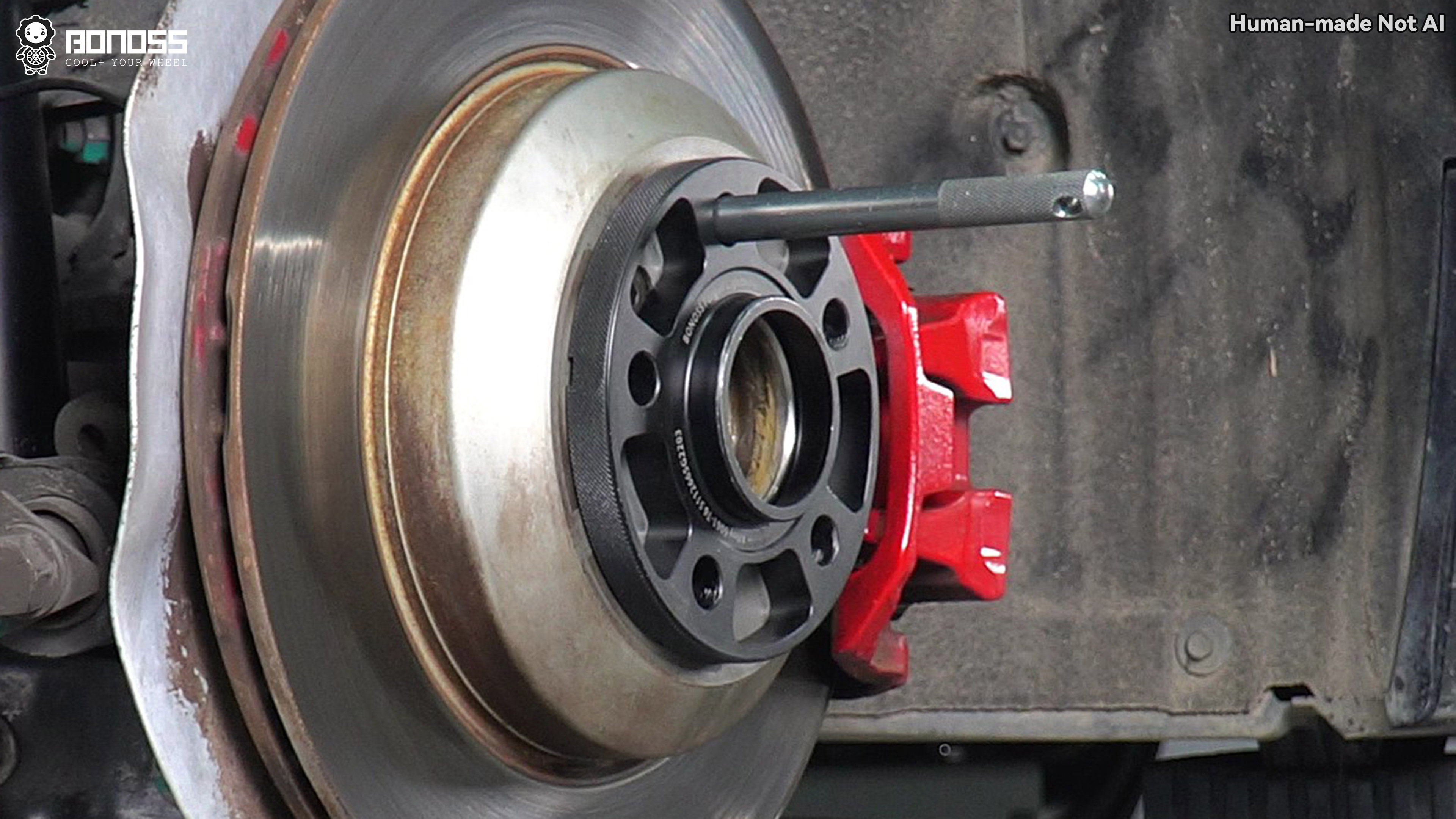
On a bolted-wheel car, which every 3 Series is, the awkward part is that the wheel has no support once the bolts are out. The BMW wheel hanger tool solves it: thread one hanger into a bolt hole first, hang the wheel on it, and you get both hands free, perfect alignment on the remaining holes, and zero risk of the wheel slipping and chewing a bolt thread. Twenty dollars of insurance against pinched fingers and crossed threads.
6061-T6 or 7075-T6: What the Test Reports Say
Two alloys, both forged, both third-party tested rather than promised.
6061-T6 for daily driving. It takes impacts without cracking, which is the property you want on paved roads, and it’s the standard BONOSS BL series material. The TÜV Rheinland 6061-T6 wheel spacers hardness test report (No: 01 220 CHN-T-2500961+) records hardness of 101–103 (test method ISO 6506-1:2014) — in plain terms, hard enough to resist denting and brinelling from road impacts. The BONOSS 6061-T6 wheel spacers neutral salt spray test (TÜV, No: 01 220 CHN-T-2500958-1+, test method ISO 9227:2022+Amd 1:2024) ran 240 hours of exposure with no defects — that’s the hard anodized surface earning its keep through winter salt.
7075-T6 for hard driving. The aerospace-grade alloy with substantially higher strength, which is why track cars wear it. The TÜV 7075-T6 hardness report (No: 01+220+CHN-T-2501547+, test method ISO 6506-1:2014) records 146 HBW 5/250 — a real step up from 6061, and the reason it survives track abuse.
BONOSS publishes over 75 SGS and TÜV test reports covering materials, bolts, and nuts, so the report for your exact hardware is on file. Any seller quoting a single “strength number” for spacers in general is not telling you the whole picture.
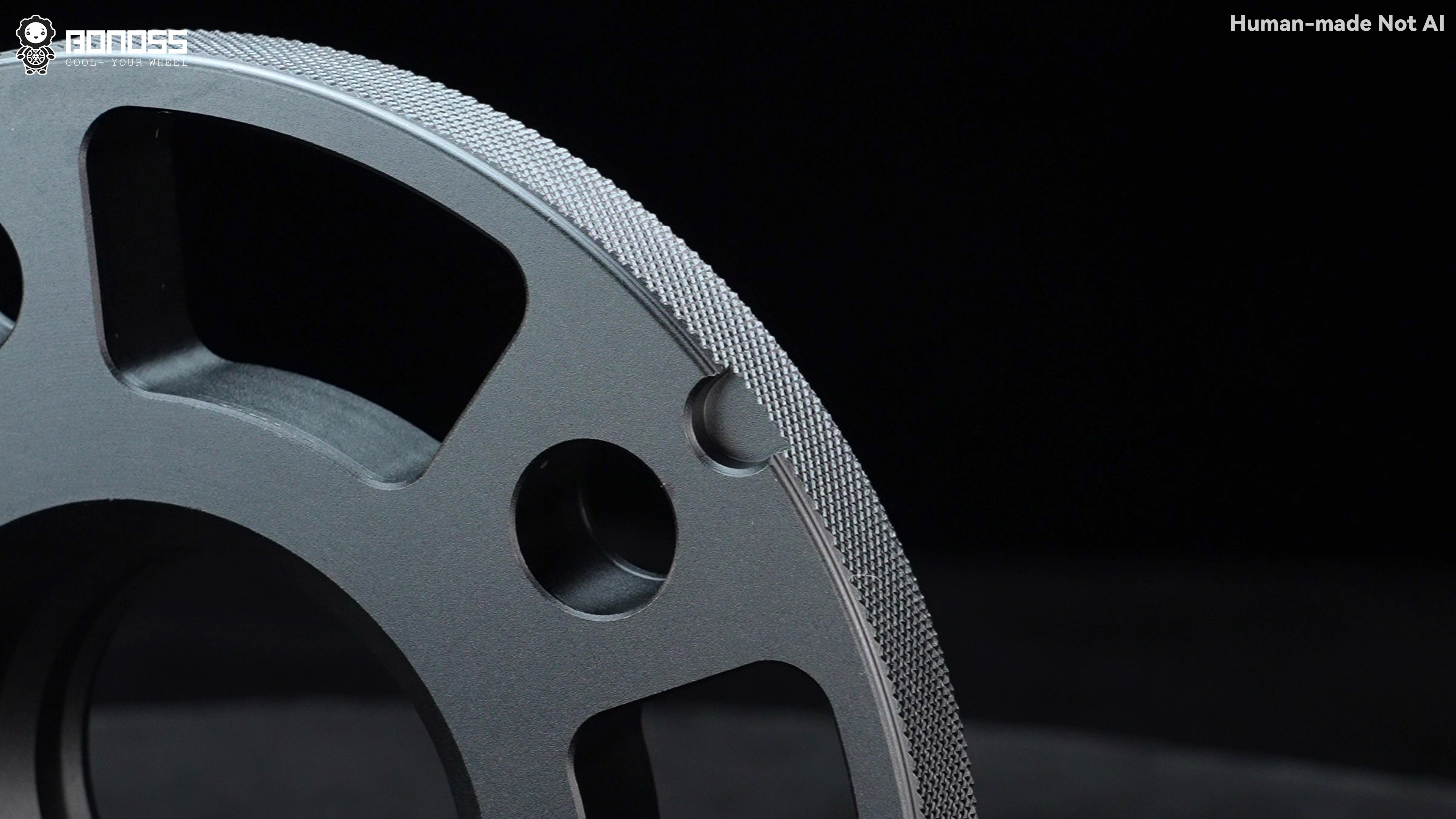
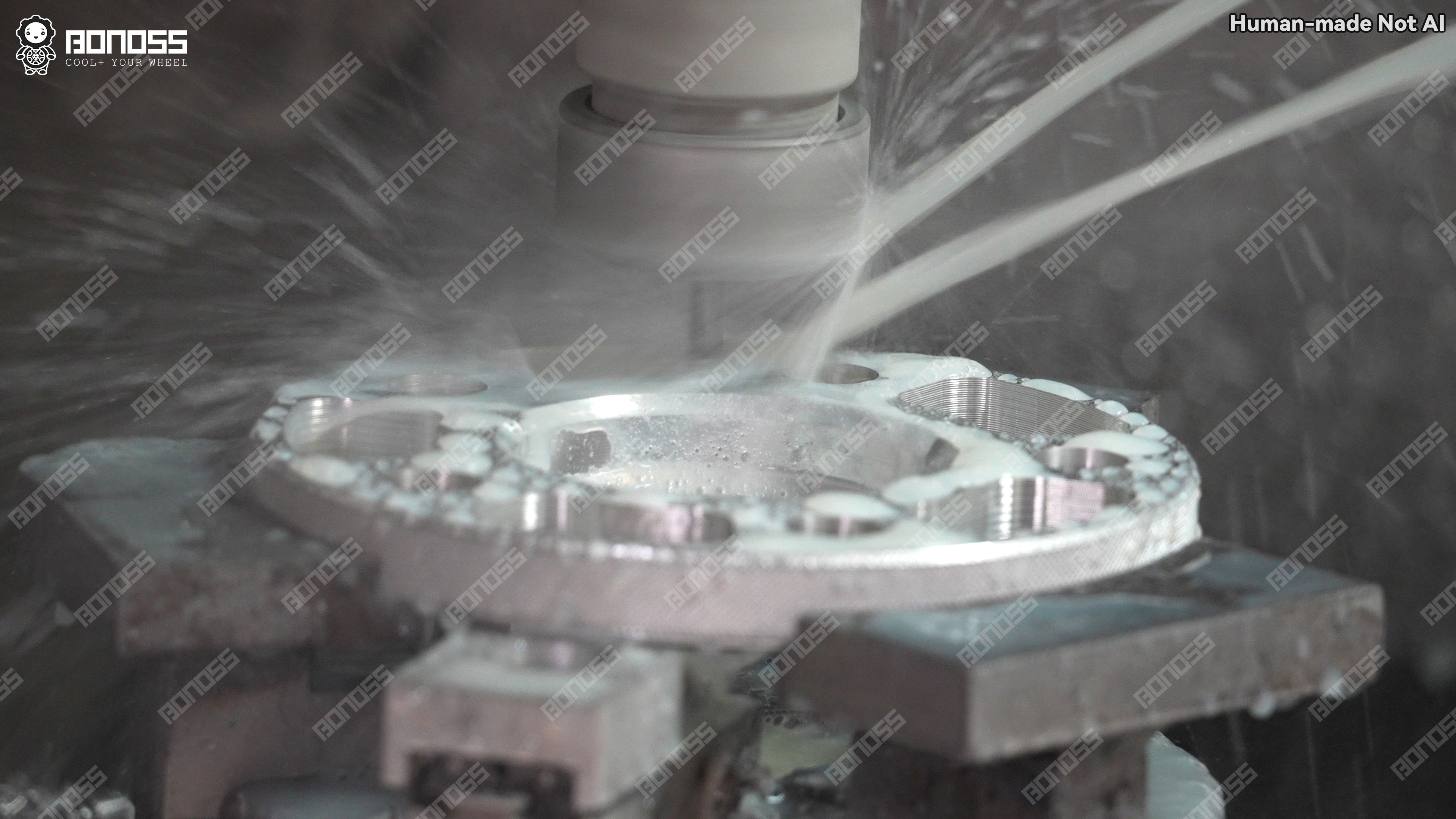
The parts themselves come off CNC machines holding a 0.02mm tolerance — tighter than the factory bore they marry — with side knurling (more surface area for heat dissipation and grip when removing) and disassembly grooves so the spacer doesn’t stay frozen to the hub after the bolts come out.
E46 vs E90 vs F30 vs G20: Fitment Differences at a Glance
| Chassis | Bolt Pattern | Center Bore | Bolt | Factory Torque | Spacer Thickness Range |
|---|---|---|---|---|---|
| G20 (2019–2027) | 5×112 | 66.6mm | M14x1.25 | 140 Nm / 103.5 ft-lb | 10–20mm |
| F30 (2012–2018) | 5×120 | 72.6mm | M14x1.25 | 140 Nm / 103.5 ft-lb | 10–25mm |
| E90 (2006–2011) | 5×120 | 72.6mm | M12x1.5 | 120 Nm / 88.5 ft-lb | 10-25mm |
| E46 (1998–2005) | 5×120 | 72.6mm | M12x1.5 | 100 Nm / 74 ft-lb | 12–35mm |
| E36 (1990–1998) | 5×120 | 72.6mm | M12x1.5 | 115 Nm / 85 ft-lb | 12–30mm |
| E30 (1984–1990) | 4×100 / 5×120 (M3) | 57.1 / 72.6mm | M12x1.5 | 115 Nm / 85 ft-lb | 10-20mm |
| E21 (1975–1983) | 4×100 | 57.1mm | M12x1.5 | 115 Nm / 85 ft-lb | 10–25mm |
The short version of E46 vs E90 vs F30 spacer fitment: the five-lug cars share 5×120, the bolt thread changed from M12x1.5 to M14x1.25, and the whole G20 assembly changed to 5×112/66.6mm in 2019. Buy across any of those lines and you own a paperweight.
Recommended BONOSS Spacers by Generation
Two product lines, both multi-stage hub-centric:
- BONOSS forged lightweight plus BL series (6061-T6 / 7075-T6): the weight-optimized design, lighter than a solid spacer of the same size, for street builds where unsprung mass matters.
- BONOSS forged active cooling BLA series (6061-T6 / 7075-T6): the active cooling design. Cooling grooves on the spacer’s outer edge let airflow pull heat out of the brake zone as the wheels spin; the side knurling adds surface area for the same job. For hard driving, track days, and any build that works its brakes, this is the one. In the bolt-on BLA kits, the flange bolts to the hub with kit hardware and the wheel mounts with your factory bolts.
G20 owners: BONOSS forged lightweight plus 5×112 wheel spacers for the G20 in 6061-T6 or the 7075-T6 version for track use; if you want the cooling design, the BLA active cooling spacers for the G20 330i/M340i and the BLA 7075-T6 version are both in stock.
F30 owners (72.6mm bore, M14x1.25): the BLA active cooling 5×120 spacers for the F30 covers most builds; the 7075-T6 version and 6061-T6 lightweight xDrive applications are stocked too.
E90 owners (M12x1.5): forged lightweight plus 6061-T6 spacers for the E90 covers the 325i/330i.
E46 owners: 5×120 spacers for the E46 and E36 in forged 6061-T6, or the 7075-T6 version for the E46 for hard driving.
Every set carries the 10-year warranty, and every batch traces back to the lab report chain. Ask for the report if you want it; it exists.
FAQ
What bolt pattern does my BMW 3 Series use for wheel spacers?
It depends on the generation: 5×112 on the G20 (2019+), 5×120 on everything from the E36 through the F30 (plus the E30 M3), and 4×100 on regular E30 and E21 models. The pattern changed three times within one nameplate, so check your chassis code before buying.
Can I reuse my factory lug bolts with BMW spacers?
Only if at least a bolt-diameter’s worth of thread still engages: 12mm minimum thread length for an M12 bolt, 14mm thread length for an M14. A G20’s 27mm factory shank is not enough for any slip-on spacer, so you needs extended bolts.
Do BMW 3 Series wheel spacers fit all generations?
No — the center bore changed twice (72.6mm to 66.6mm in 2019, with 57.1mm on regular E30/E21), the bolt thread changed in 2012, and the pattern changed in 2019. Matching the pattern alone (E90 and F30 both 5×120/72.6mm) is not enough: the E90’s M12x1.5 bolts do not fit an F30’s M14x1.25 holes.
Do BMW 3 Series wheel spacers cause vibration?
Not when they’re hub-centric and seated on the hub face. The complaints trace to spacers resting on the hub lip (thickness below the protrusion) or to torque shortcuts. A hub-centric spacer with a measured protrusion and a proper re-torque is as stable as a factory wheel.
Are wheel spacers safe on a BMW 3 Series?
Yes — forged construction, hub-centric fitment, correct torque, and a re-torque after 50–100 km. BONOSS spacers are tested by TÜV Rheinland and SGS labs (hardness per ISO 6506-1:2014, 240-hour neutral salt spray per ISO 9227:2022), machined to 0.02mm, and warrantied for 10 years. The safety variable is the installation, not the part.
What spacer size gives a flush fitment on a BMW 3 Series?
The fender gap you measure with a straight edge across the fender lip. On factory wheels that typically lands at 12–15mm on a G20, 15–20mm on an F30, and 20–25mm on an E46 — but your wheel offset decides everything, so measure both ends of the car rather than copying someone else’s number.
Bottom Line: Measure, Then Buy
Every 3 Series build comes down to three numbers, and all of them live on your car, not in a forum: the chassis code (which locks the PCD, bore, and thread), the hub protrusion (which sets your minimum thickness), and the fender gap (which sets your exact thickness). Get those three and the rest of this table is confirmation, not guesswork — from a G20 on factory 18s to any 3 Series you can find in a classifieds listing.
If you’re looking to buy BMW 3 Series wheel spacers, the split is simple: the BL lightweight plus line for street, the BLA active cooling line for hard driving, 6061-T6 for daily miles, 7075-T6 for the track. Every set ships with test reports on file, the 10-year warranty, and a torque card matched to your chassis. Open the product page for your generation, check the size list against your measurements, and if you’re not sure which number to trust — get the caliper out. We’re always happier when you measure first.

About Robert Wall
Robert Wall is a Senior Automotive Engineer at BONOSS with over 9 years of experience in automotive component R&D, specializing in the structural design and safety validation of wheel spacers, wheel adapters, and high-strength fasteners. He is actively involved in product testing and on-track evaluation and is dedicated to translating engineering expertise into accessible modification knowledge — helping enthusiasts upgrade their vehicle’s stance and handling without compromising safety.