
Quick answer: 15–25mm Tesla Model S wheel spacers put most trims flush with the fenders. Stance builds that want the wheels sitting proud run 25–30mm. Clearance problems — wider tires, bigger brakes, or new-style wheels fouling a rear damper — get solved at 15–20mm. And if you’re chasing just a few millimeters of correction, thin 5–10mm spacers exist, with strings attached.
Here’s what makes the Model S refreshingly easy to shop for: every car built since 2012, from the original 40 kWh sedan to the 2027 Plaid, rolls on the same 5×120 bolt pattern, the same 64.1mm hub bore, and the same M14x1.5 thread pitch. Fifteen model years, one set of specs. The question was never whether spacers fit — it’s how thick they should be, and that answer depends on what you’re trying to achieve, not on some magic number a forum thread promised you.
So this guide is organized by fitment goal instead of by model year. Pick the result you want, measure your own fender gap, then match the thickness to the math. The tape measure has never once lost to the comment section.
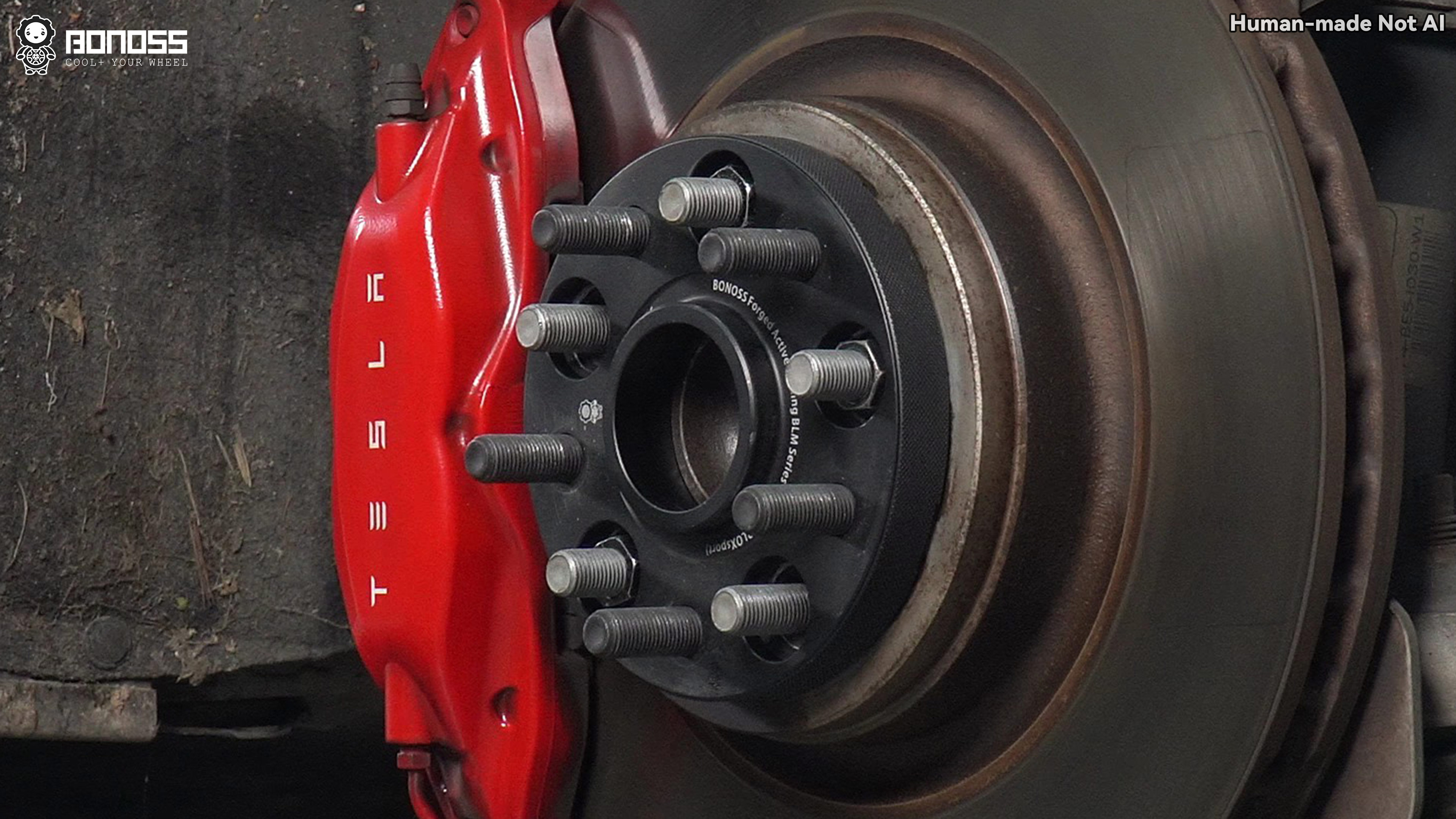
Tesla Model S Wheel Spacers Specs: Bolt Pattern, Center Bore, and Thread Pitch for Every Trim
The full spec sheet comes first, because it settles half the questions before they start. 5×120 wheel spacers for a Tesla Model S are the same across all 21 trims listed below — the pattern, the 64.1mm hub bore, and the M14x1.5 threads never changed. What shifts between trims is the suggested spacer range, and that comes down to wheel offset and how much room each body gives you.
Quick decode for anyone new to the numbers: 5×120 means five studs arranged on a 120mm circle, the 64.1mm center bore is the hole that locates the wheel on the hub, and M14x1.5 is the thread the nuts clamp down on. Get those three right, and the rest of this guide is just choosing a thickness.
| Generation / Year | Bolt Pattern | Center Bore | Thread Pitch | Wheel Offset | Suggested Spacer Sizes | Factory Lug Nut Torque |
|---|---|---|---|---|---|---|
| 2012 Model S 40 | 5x120mm | 64.1mm | M14x1.5 | ET40 | 15mm to 25mm | 129 ft-lb / 175 Nm |
| 2013-2015 Model S 60 | 5x120mm | 64.1mm | M14x1.5 | ET40 | 15mm to 25mm | 129 ft-lb / 175 Nm |
| 2013-2015 Model S 85 | 5x120mm | 64.1mm | M14x1.5 | ET40 | 15mm to 25mm | 129 ft-lb / 175 Nm |
| 2013-2015 Model S P85 | 5x120mm | 64.1mm | M14x1.5 | ET40 | 20mm to 25mm | 129 ft-lb / 175 Nm |
| 2014-2015 Model S 85D | 5x120mm | 64.1mm | M14x1.5 | ET40 | 15mm to 25mm | 129 ft-lb / 175 Nm |
| 2014-2015 Model S P85D | 5x120mm | 64.1mm | M14x1.5 | ET40 | 15mm to 30mm | 129 ft-lb / 175 Nm |
| 2015-2016 Model S 70 | 5x120mm | 64.1mm | M14x1.5 | ET40 | 15mm to 25mm | 129 ft-lb / 175 Nm |
| 2015-2016 Model S 70D | 5x120mm | 64.1mm | M14x1.5 | ET40 | 15mm to 25mm | 129 ft-lb / 175 Nm |
| 2015-2016 Model S P90D | 5x120mm | 64.1mm | M14x1.5 | ET40 | 15mm to 25mm | 129 ft-lb / 175 Nm |
| 2017-2021 Model S 100D | 5x120mm | 64.1mm | M14x1.5 | ET40 | 20mm to 25mm | 129 ft-lb / 175 Nm |
| 2017-2018 Model S 60 | 5x120mm | 64.1mm | M14x1.5 | ET40 | 15mm to 25mm | 129 ft-lb / 175 Nm |
| 2017-2018 Model S 60D | 5x120mm | 64.1mm | M14x1.5 | ET40 | 15mm to 25mm | 129 ft-lb / 175 Nm |
| 2017-2021 Model S 75 | 5x120mm | 64.1mm | M14x1.5 | ET40 | 15mm to 30mm | 129 ft-lb / 175 Nm |
| 2017-2019 Model S 75D | 5x120mm | 64.1mm | M14x1.5 | ET40 | 20mm to 25mm | 129 ft-lb / 175 Nm |
| 2017-2018 Model S 90D | 5x120mm | 64.1mm | M14x1.5 | ET40 | 15mm to 30mm | 129 ft-lb / 175 Nm |
| 2017-2021 Model S P100D | 5x120mm | 64.1mm | M14x1.5 | ET40 | 15mm to 25mm | 129 ft-lb / 175 Nm |
| 2019-2021 Model S Long Range | 5x120mm | 64.1mm | M14x1.5 | ET40 | 15mm to 25mm | 129 ft-lb / 175 Nm |
| 2019-2021 Model S Performance | 5x120mm | 64.1mm | M14x1.5 | ET40 | 15mm to 30mm | 129 ft-lb / 175 Nm |
| 2019-2021 Model S Standard Range | 5x120mm | 64.1mm | M14x1.5 | ET40 | 15mm to 25mm | 129 ft-lb / 175 Nm |
| 2022-2027 Model S Long Range | 5x120mm | 64.1mm | M14x1.5 | ET40 / ET45 | 15mm to 25mm | 129 ft-lb / 175 Nm |
| 2022-2027 Model S Plaid | 5x120mm | 64.1mm | M14x1.5 | ET40 / ET45 | 15mm to 25mm | 129 ft-lb / 175 Nm |
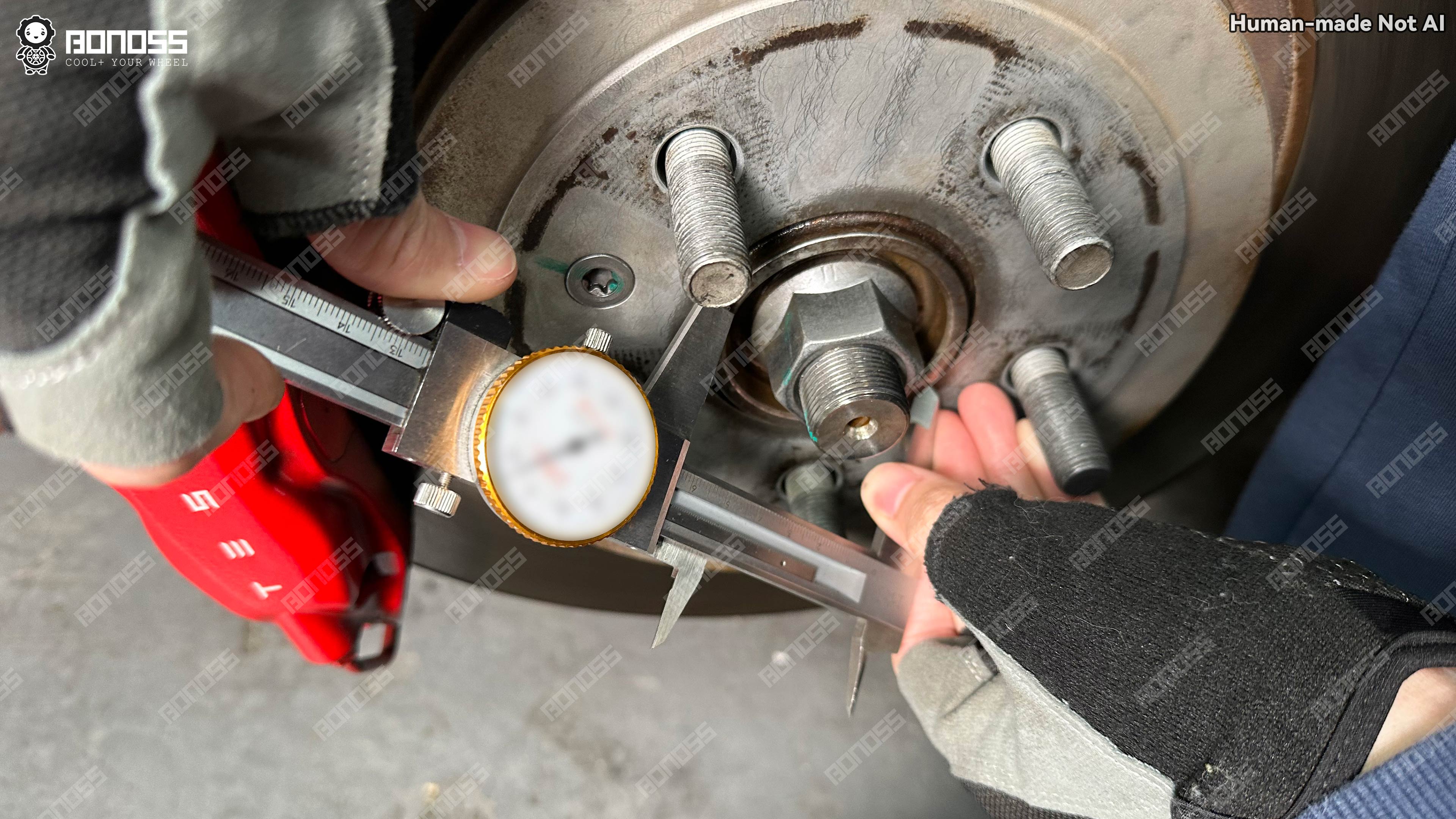
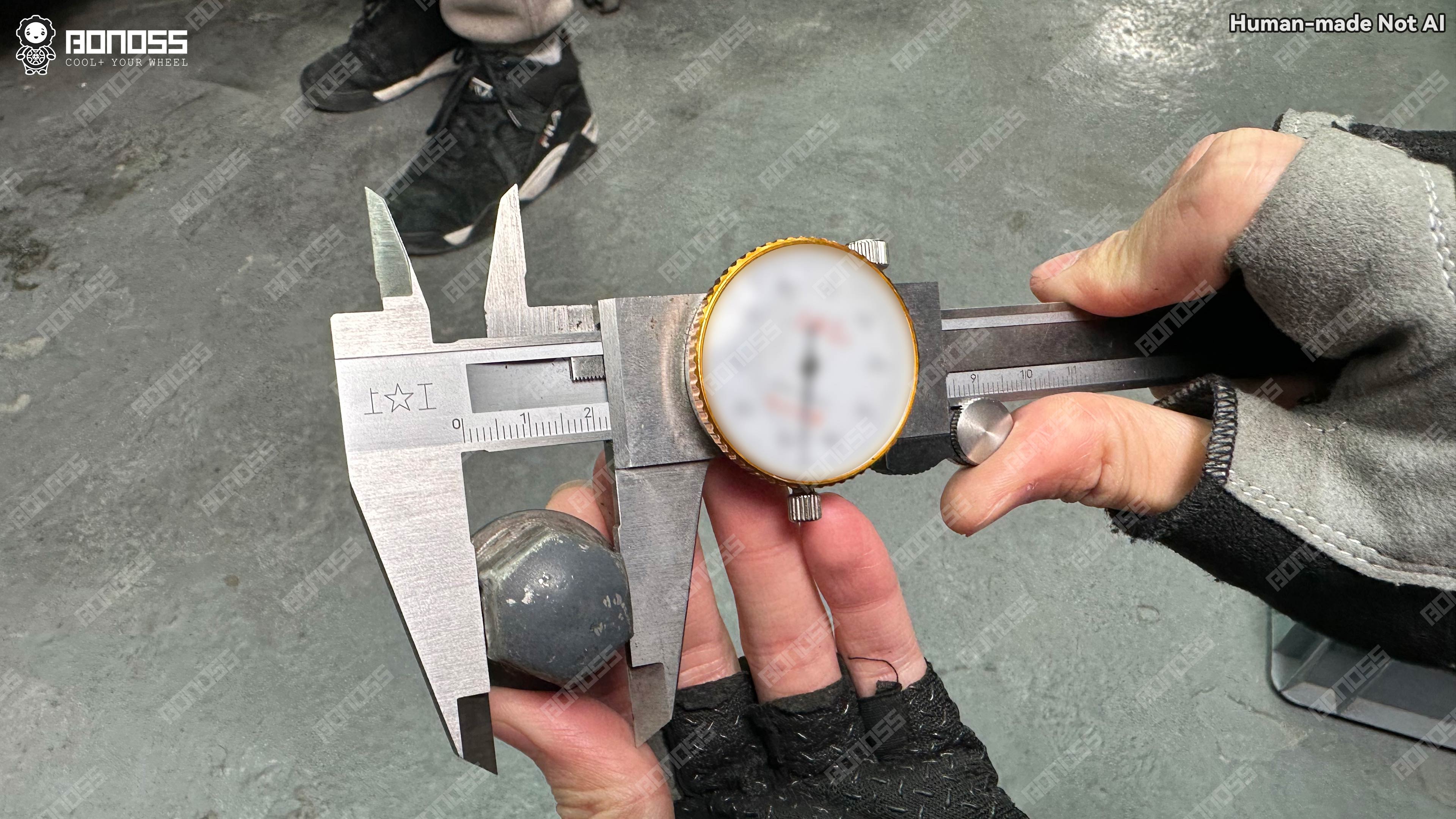
A vernier caliper confirms the 64.1mm hub seat in about thirty seconds, and it’s worth doing — M14x1.5 wheel spacers for a Tesla Model S live or die on that number.
Three notes before you scroll on:
The torque column. 129 ft-lb (175 Nm) is the factory wheel-nut torque per the owner’s manual, and it applies to the wheel-to-spacer stage. The spacer-to-hub stage uses different hardware and a different figure — the installation section lays out both, because conflating them is the most common mistake in any spacer job.
2022–2027 offsets. Refresh and Plaid-era cars shipped with ET40 or ET45 wheels depending on the option chosen. ET45 tucks the wheel 5mm deeper and pushes you toward the top of the suggested range — one more reason your own fender-gap measurement outranks any chart.
The 5×120 trap. BMW also uses a 5×120 bolt pattern, but its hub bore is a much larger 66.5mm or 72.5mm. A spacer machined for BMW will bolt onto a Model S hub pattern-wise and center on nothing — that gap around the hub is where steering-wheel vibration is born. Buy spacers machined for the 64.1mm Tesla hub, full stop. (Spacers vs adapters, since it comes up: adapters exist to change bolt patterns. Every Model S ever built shares one pattern, so a straight spacer — not an adapter — is the correct tool.)
Step One: Measure Your Fender Gap Before Spending a Dime
No chart can see your car. Tire brand, tire width, wheel width, ride height — each of them moves the fender gap, which is why two identical trims can genuinely need different thicknesses. Five minutes with a straightedge prevents a 20mm surprise.
1. Park on level ground, tires straight, suspension settled. If your Model S rides on air suspension, measure at the height you actually drive at — measuring at Low while daily-driving at Standard hands you the wrong number.
2. Hold a straightedge against the tire’s outer sidewall, parallel to the ground, and measure from the fender lip to the straightedge. That distance is your gap, and it’s roughly the spacer thickness that puts the tire edge level with the fender.
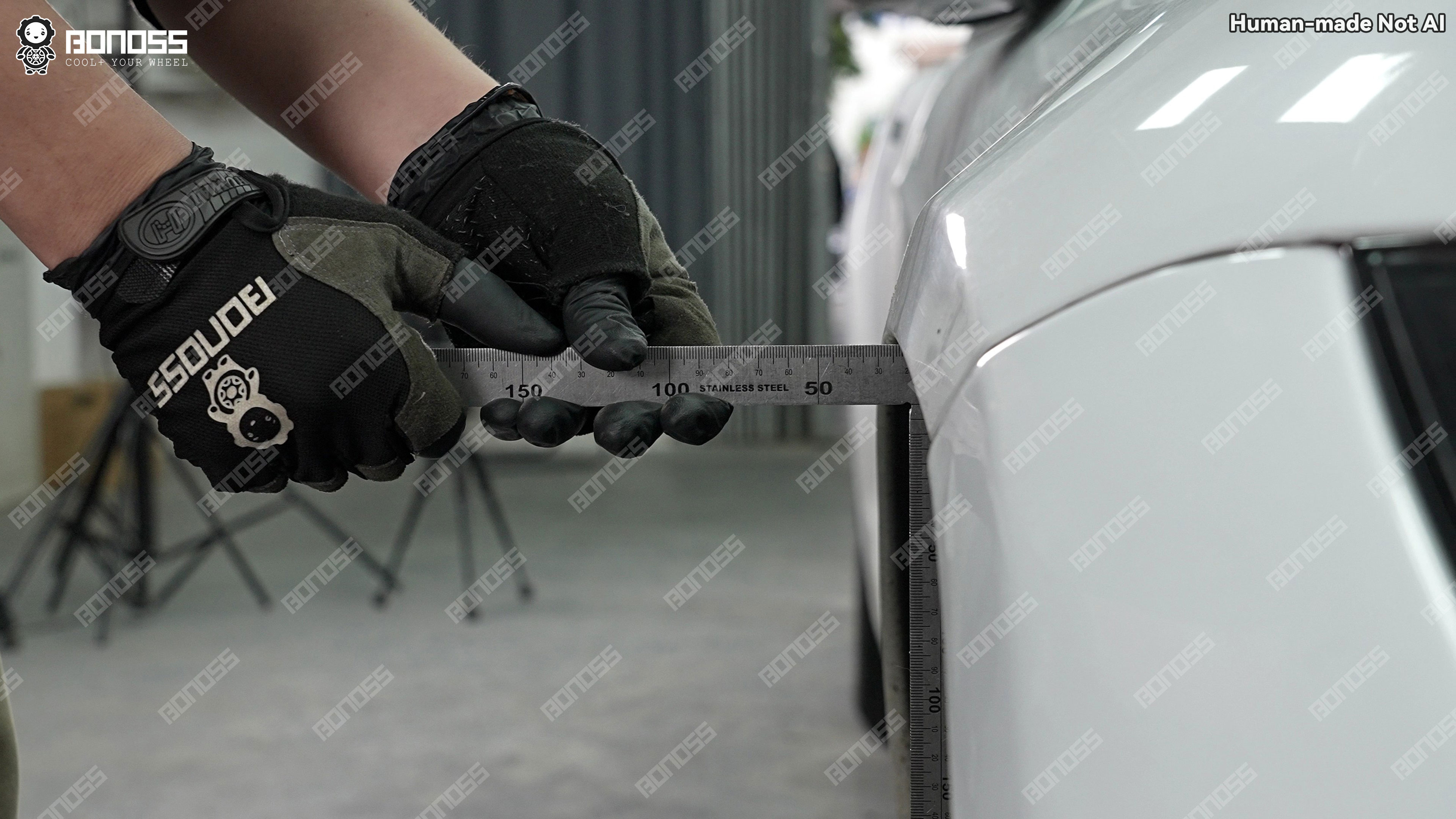
3. Measure all four corners. Front and rear rarely match on a Model S, and corner-to-corner differences show up on cars that have lived a hard life.
4. Round down a few millimeters. A 22mm gap with a 20mm spacer leaves a hair of margin; a 22mm gap with a 22mm spacer leaves none. Margins age well. Optimism doesn’t.
Stock, the wheels sit noticeably inside the arches. Fine for range, forgettable in a parking lot. Now pick your goal.
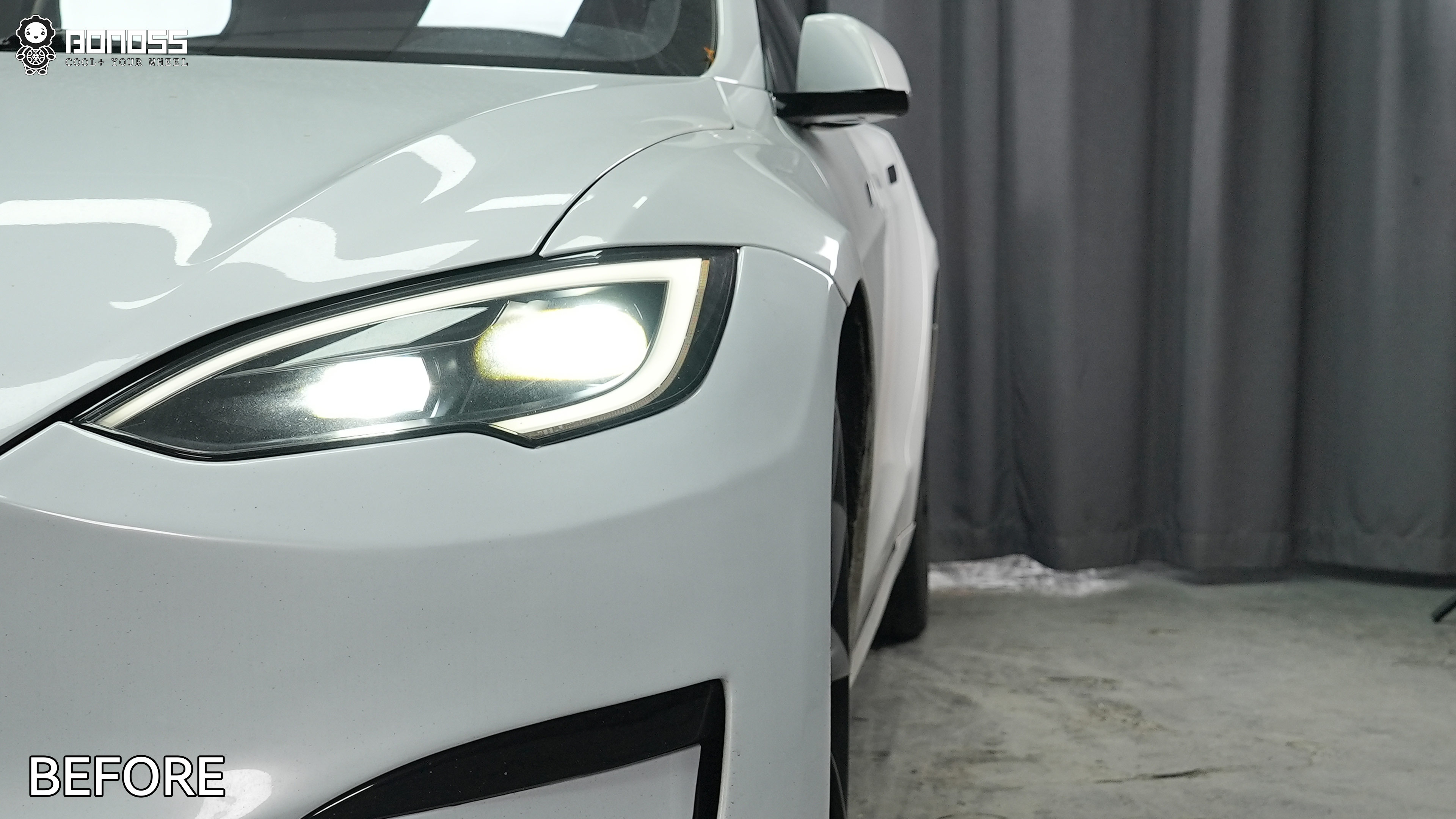
Goal 1: Perfectly Flush — 15 to 25mm on Most Trims
Flush means the tire’s outer edge lines up with the fender line: the wheel fills the arch without poking past it. It’s the look most Model S owners are chasing, and every trim supports it in some form.
| Generation | Trims and flush spacer range |
|---|---|
| 2012–2016 (original nose-cone body) | 40, 60, 70, 70D, 85, 85D, P90D: 15–25mm · P85: 20–25mm · P85D: 20–30mm |
| 2017–2021 (facelift) | 60, 60D, P100D, Long Range, Standard Range: 15–25mm · 100D, 75D: 20–25mm · 75, 90D, Performance: 15–30mm |
| 2022–2027 (Refresh / Plaid) | Long Range, Plaid: 15–25mm — ET45 wheels sit at the top of the range |
Strip away the trim noise and the 15mm vs 20mm vs 25mm Model S spacer comparison is just arithmetic: your gap measurement picks the number. A 15mm gap wants 15mm. A 22mm gap wants 20mm with margin to spare. A full 25mm gap wants 25mm. The table gives the typical window per trim; your ruler gives the actual answer.
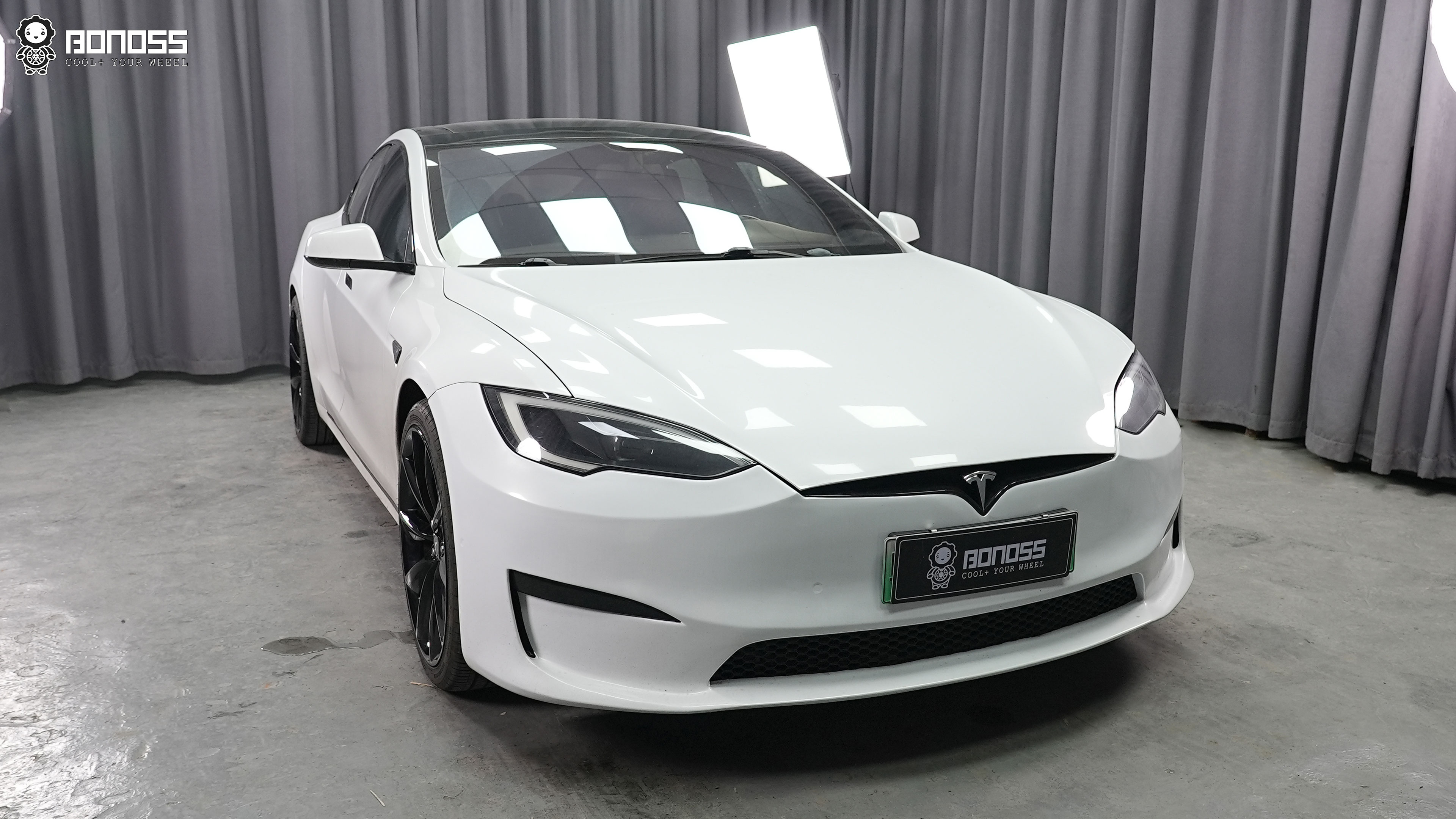
For reference, we documented a 2014 Model S that went from sunken to flush on 20mm spacers — same 5×120 pattern and 64.1mm hub bore as every other year — and the Tesla Model S wheel spacers before and after photos show better than adjectives can what 20mm does to an arch.
One wrinkle the tables can’t cover: aftermarket wheels. Wider wheels, or ones with lower offset than stock, already sit further out, so the spacer size drops accordingly — sometimes to zero. The fender-gap method absorbs this automatically, which is one more reason it beats copying someone else’s build list. The ranges above assume factory wheels.
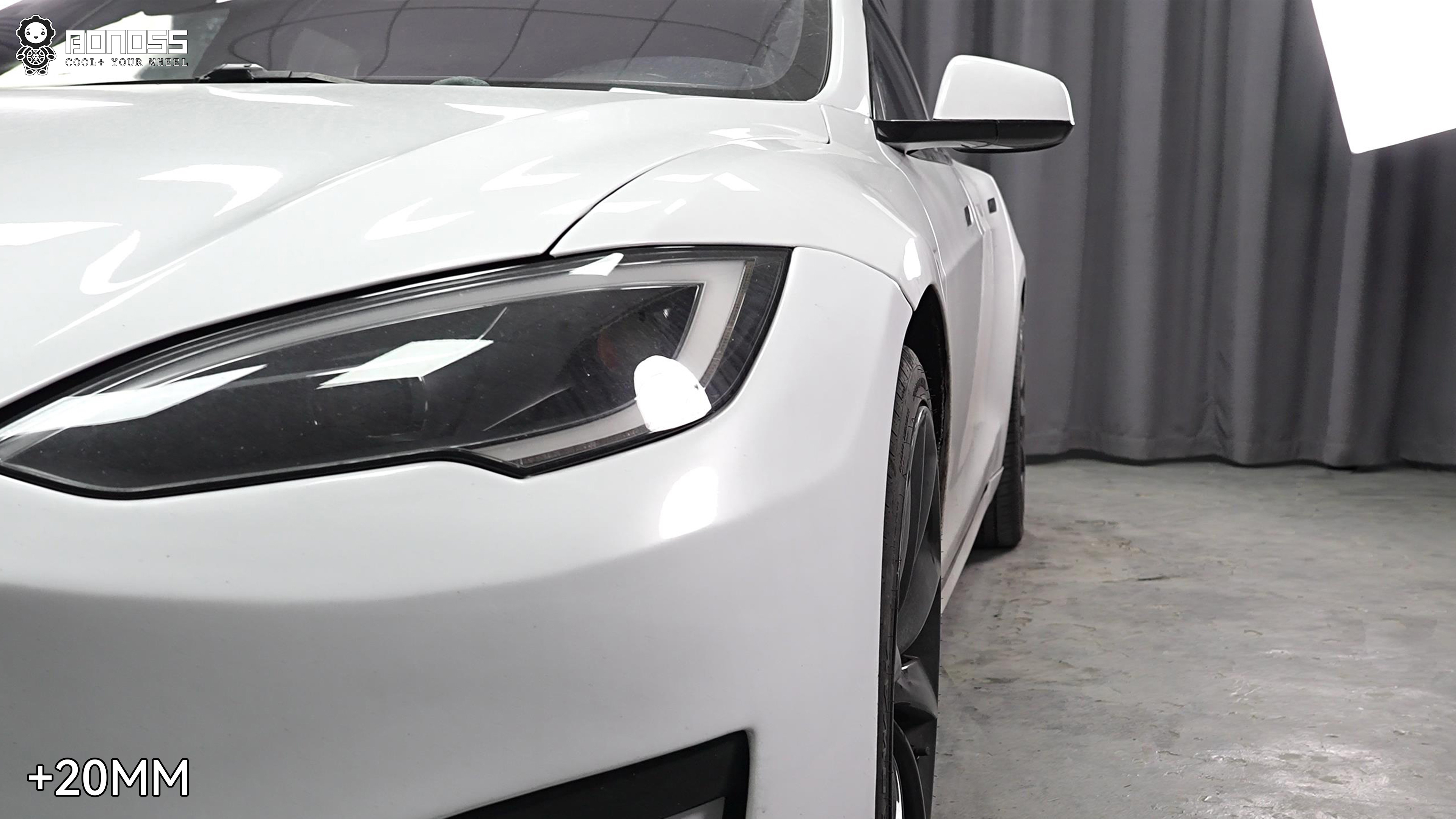
Goal 2: Stance — 25 to 30mm, With Your Eyes Open
Some owners want flush. Some want the wheels to announce themselves. If that’s you, this is 25–30mm territory: Tesla Model S 25mm spacers put the tire edge right at or fractionally past the fender line on most trims, and 30mm spacers for a Tesla Model S push clearly beyond it. The table above tells you which trims have the fender clearance for 30mm — and it is not all of them.
Two honest caveats. Past flush, rubbing becomes tire-specific: tread pattern, shoulder squareness, and section width all move the contact point, so a setup that clears on one 245-width tire can kiss the liner on another. And the margins are thinnest at full suspension compression and full steering lock — the exact moments nobody thinks about. Start at 25mm unless your measurements argue otherwise. It’s also completely normal to run different thicknesses front and rear — the gaps differ, so the spacers can too. Want to see the look on a real car first? This forged Model S spacer photo gallery is worth two minutes.
Goal 3: Clearance Fixes — 15 to 20mm When Something Is Rubbing
Flush is cosmetic. Clearance is mechanical, and there are three distinct problems spacers solve here.
Brake caliper clearance. Upsized brakes? Measure the straight-line distance from the caliper’s outer edge to the back of the nearest wheel spoke. A spacer moves the spokes out by exactly its own thickness, so a 12mm gap plus 15mm spacers leaves 27mm of daylight.
Wider tires. Extra section width eats the inner clearance between tire and suspension. Pushing the wheel outboard restores it — just remember you’re paying for it with fender clearance on the other side.
The classic one: newer wheels on an older car. Refresh-era wheels run a wider J than the originals, and when pre-refresh owners upgrade, the rear rim’s inner edge can end up against the rear damper body. Left alone, that contact polishes the finish off the damper and worsens from there. A spacer cuts the wheel’s effective offset — 20mm of spacer turns ET40 into ET20 — moving the rim outboard and off the damper.
This is a real upgrade path, not a hypothetical, and it’s where 15mm spacers earn their keep on a Model S: enough push to clear, not so much that the fender becomes the new problem. Whatever thickness solves your case, re-check the outer edge afterward. You moved the wheel; both edges moved with it.
Goal 4: Micro-Adjustment — 3mm to 10mm
Sometimes the gap is genuinely small. A 6mm tuck after a wheel change. One corner sitting 4mm deeper than the others. A stance that’s almost there. 3mm wheel spacers in 5×120 and 5mm spacers for a 5×120 Model S exist for exactly these corrections.
Here’s the catch—and it’s a big one: 3–5 mm thin spacers are mostly lug-centric, and every millimeter of spacer thickness reduces the exposed factory hub lip by one millimeter relative to the wheel mounting face. To verify this, use a vernier caliper to measure the factory hub protrusion, then subtract the spacer thickness (3 mm or 5 mm) to calculate the remaining hub protrusion after installation. The remaining factory hub protrusion must be at least 8 mm.
Check the wheel’s center-bore edge: look at the backside of the wheel and see whether there is a chamfer around the center bore. If there is, note that the effective engagement length will be shorter than the measured hub protrusion height. Extra caution is required when pairing chamfered wheels with lug-centric thin spacers.
Run the math in the installation section before ordering anything under 10mm — especially when they are lug-centric.
Installation: Stud Math, One Rusted Screw, and Torque Done Right
The stud check — before anything else. Two measurements decide whether your factory studs need shortening: how far the studs protrude from the hub face, and how deep the pockets on the back of the wheel are.
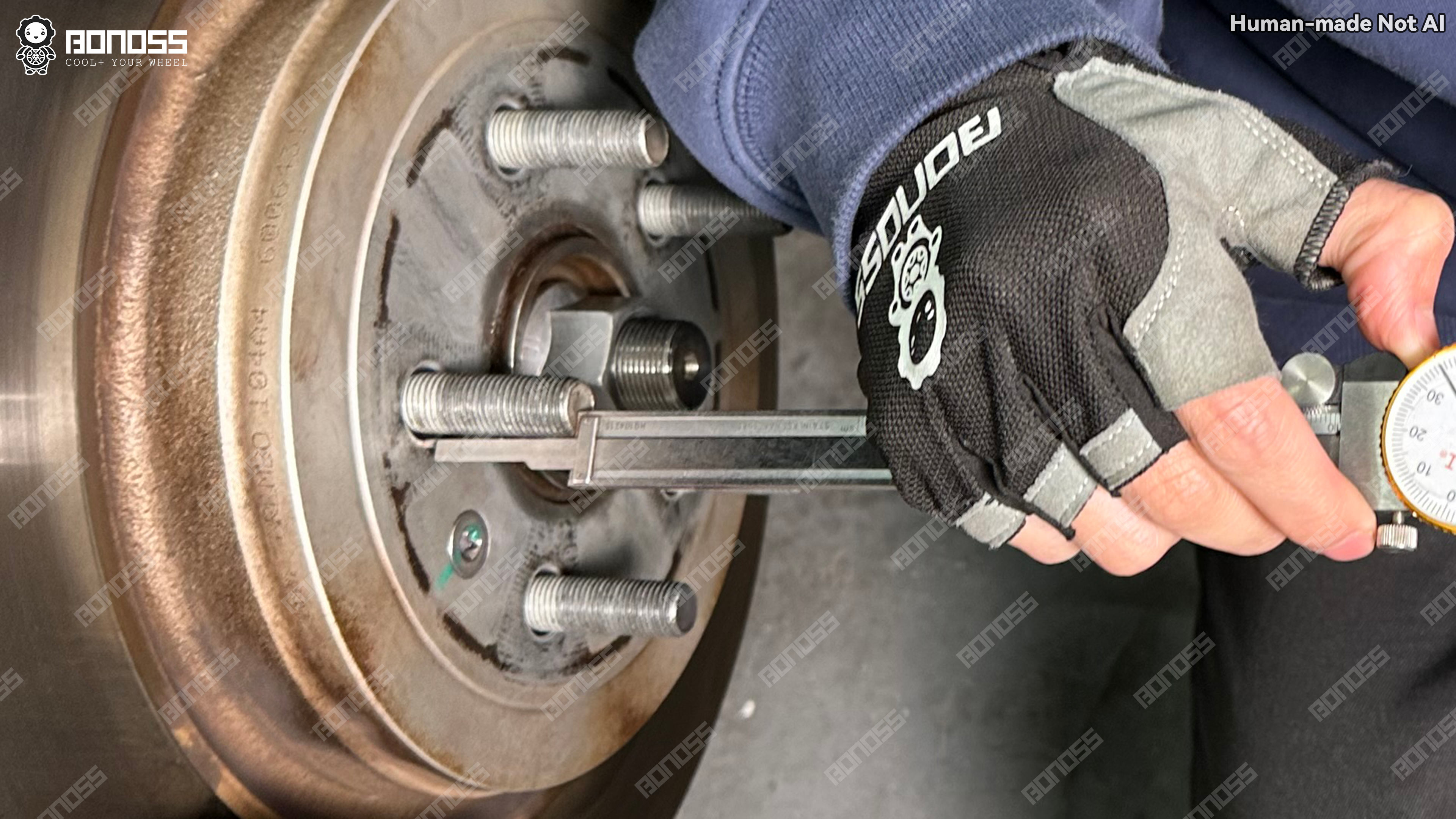
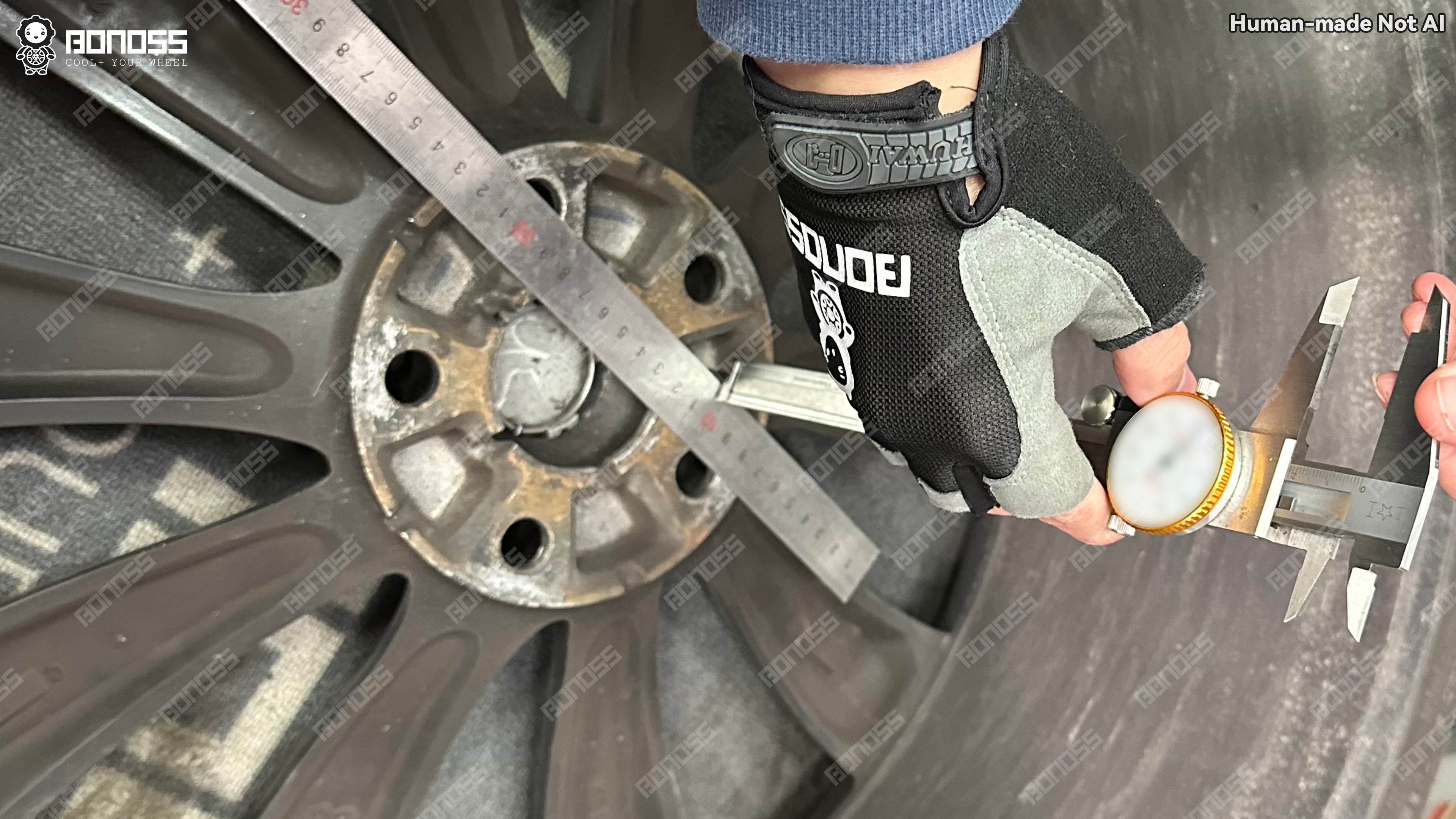
The rule: if pocket depth plus spacer thickness is greater than stud protrusion, the wheel seats flat and the studs stay stock. If not, they need trimming or shorter replacement hardware. Newer-style Model S wheels have notably shallow pockets — 15mm spacers often require cut studs on those, while 20mm and up usually clears. “Usually” is not a spec. Measure.
That little disc screw. Tesla fits a small retaining screw that pins the brake disc to the hub. Per Tesla’s Model S service manual, it takes a 10mm socket and a modest 17 N·m — a locating part whose entire job is keeping the disc from wobbling off before the wheel goes on. Once the wheel is torqued, it’s structurally unemployed.
Two issues for spacer owners: the screw head can sit proud of the disc face and stop a spacer from seating flat against the rotor, and in salt-belt states it rusts itself solid, turning your next brake job into a swearing session. Our recommendation: remove it during the install. It has no work to do once the wheel is on, and future-you will send a thank-you note.
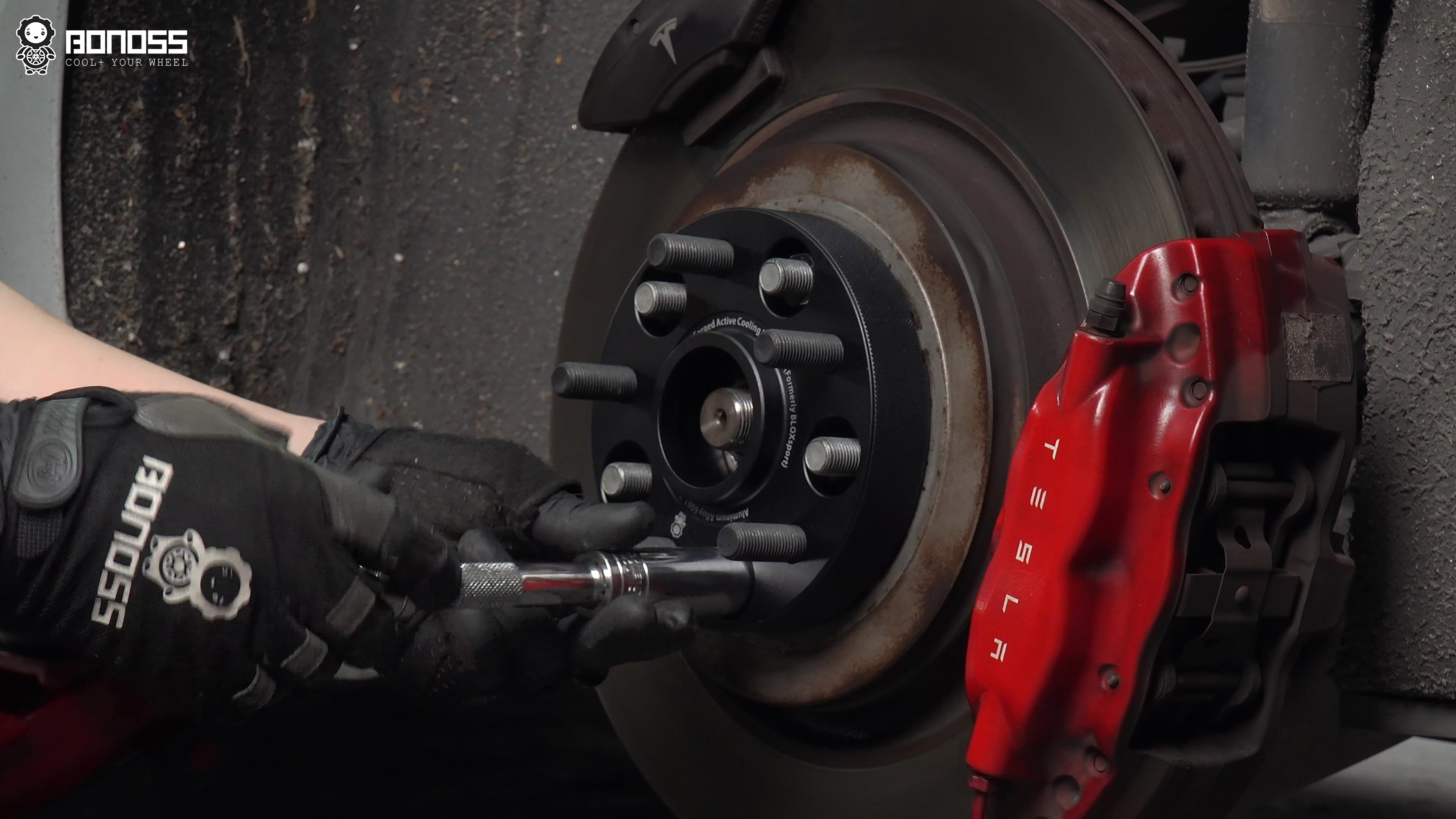
The mounting sequence.
- Clean the hub face down to bare metal. Corrosion buildup there is a classic cause of runout that later gets blamed on the spacers.
- Slide the spacer over the studs and seat it fully on the hub. Hand-thread the BONOSS nuts, then torque to 103.5 ft-lb (140 Nm) per BONOSS installation instructions, working in a crisscross sequence.
- Mount the wheel on the spacer’s studs with your factory conical-seat nuts and torque to 129 ft-lb (175 Nm) per the owner’s manual, same crisscross.
- Re-torque both stages after the first 50–100 miles. Spacers settle.
One tool note before the table: the final pass on both stages belongs to a torque wrench, never an impact gun. Impacts overshoot in ways you can’t hear and the threads can’t forgive.
| What you’re tightening | Hardware | Torque | Spec source |
|---|---|---|---|
| Spacer to hub | BONOSS nuts | 103.5 ft-lb (140 Nm) | BONOSS installation instructions |
| Wheel to spacer | Factory Tesla nuts | 129 ft-lb (175 Nm) | The owner’s manual |
One fastener, one number: each stage uses a single torque value matched to the hardware being tightened, and both figures above are correct for their own stage. Never blend them, never average them, and if you’re unsure which applies, use the more conservative value and confirm hardware compatibility first.
6061-T6 or 7075-T6: Picking the Alloy That Matches How You Drive
Material isn’t a marketing line here — it decides how the spacers handle the pothole you didn’t see.
Daily driving: forged 6061-T6 aluminum. For a car that lives on paved roads, 6061-T6 has the toughness to absorb incidental impacts without cracking. That’s the whole requirement for a street car, and 6061-T6 meets it with room to spare.
Hard driving: forged 7075-T6 aluminum. If the car sees track days or regular hard use, step up. The lab numbers make the gap plain: TÜV hardness testing (test method ISO 6506-1:2014) measured BONOSS 6061-T6 spacers at 101–103 HBW and the 7075-T6 parts at 146 HBW 5/250 — roughly 40 percent harder, which in this context means meaningfully more resistant to the loads hard driving imposes (6061-T6 TÜV report, 7075-T6 TÜV report). Neither number is ours; both come from TÜV Rheinland test reports.
Winter matters too. The same 6061-T6 spacers went through a 240-hour neutral salt spray test (ISO 9227:2022+Amd 1:2024) with no defects — the lab version of years of road-salt exposure, and 240 hours leaving nothing to show is exactly what you want if your state salts its highways (TÜV salt spray report).
The hardware gets the same scrutiny. BONOSS presses ISO grade 12.9 studs into every Model S spacer. SGS testing measured the M14x1.5 studs at a tensile strength of 1268 MPa (ISO 898-1:2013) with a proof load of 121 kN, and hardness of 391–401 HV10 (ISO 6507-1:2018). TÜV’s own testing of the same stud spec returned 1233 MPa tensile and 386–390 HV10. Slightly different numbers — which is normal, and honestly reassuring: different labs, different sample batches, small measurement variance, same conclusion. The matching ISO grade 10 nuts passed a proof load of 138.8 kN (ISO 898-2:2012) at 358–362 HV0.5. Every report is public: SGS stud tensile · SGS stud proof load · SGS stud hardness · TÜV stud tensile · TÜV stud hardness · SGS nut proof load · SGS nut hardness.
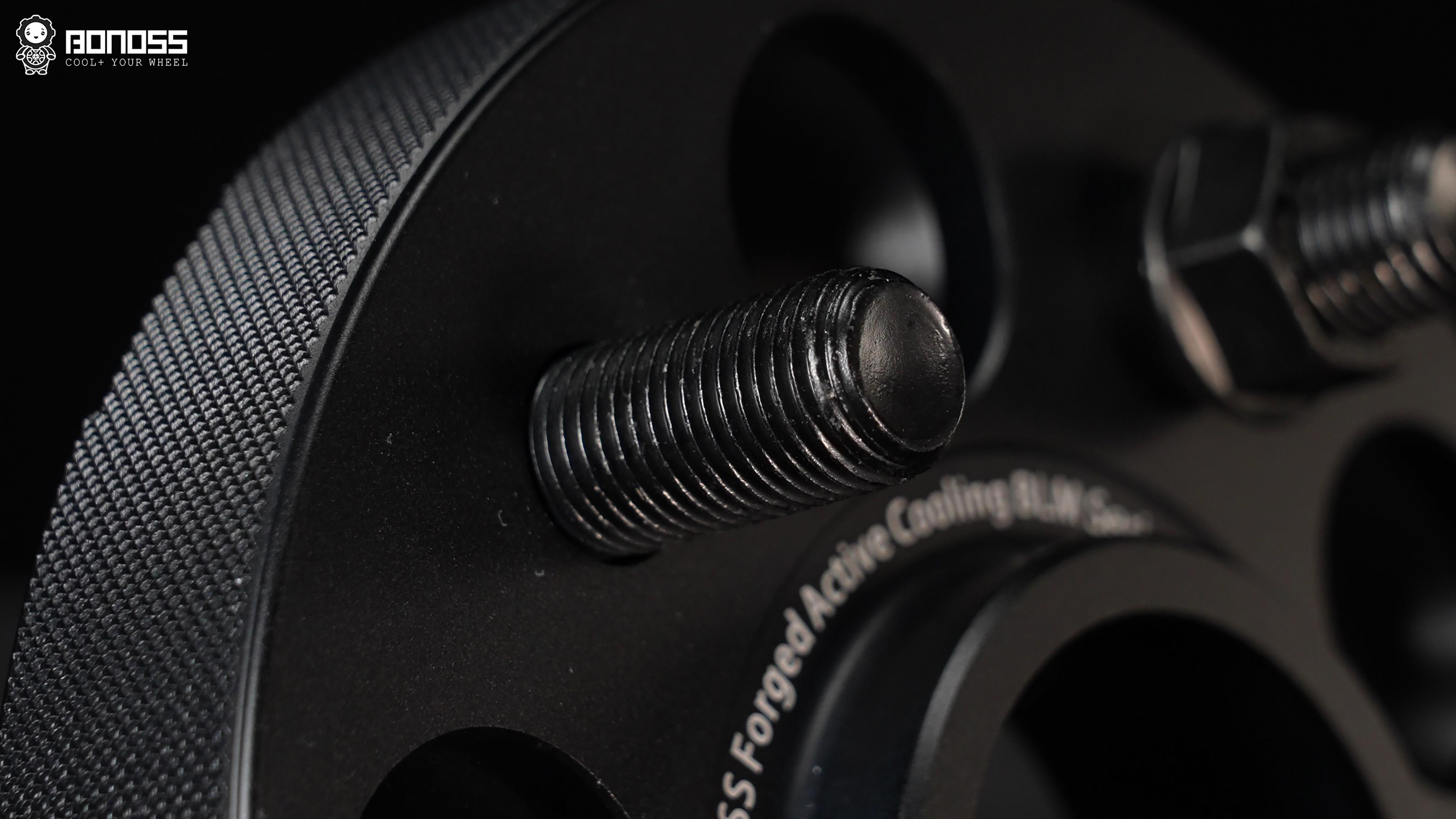
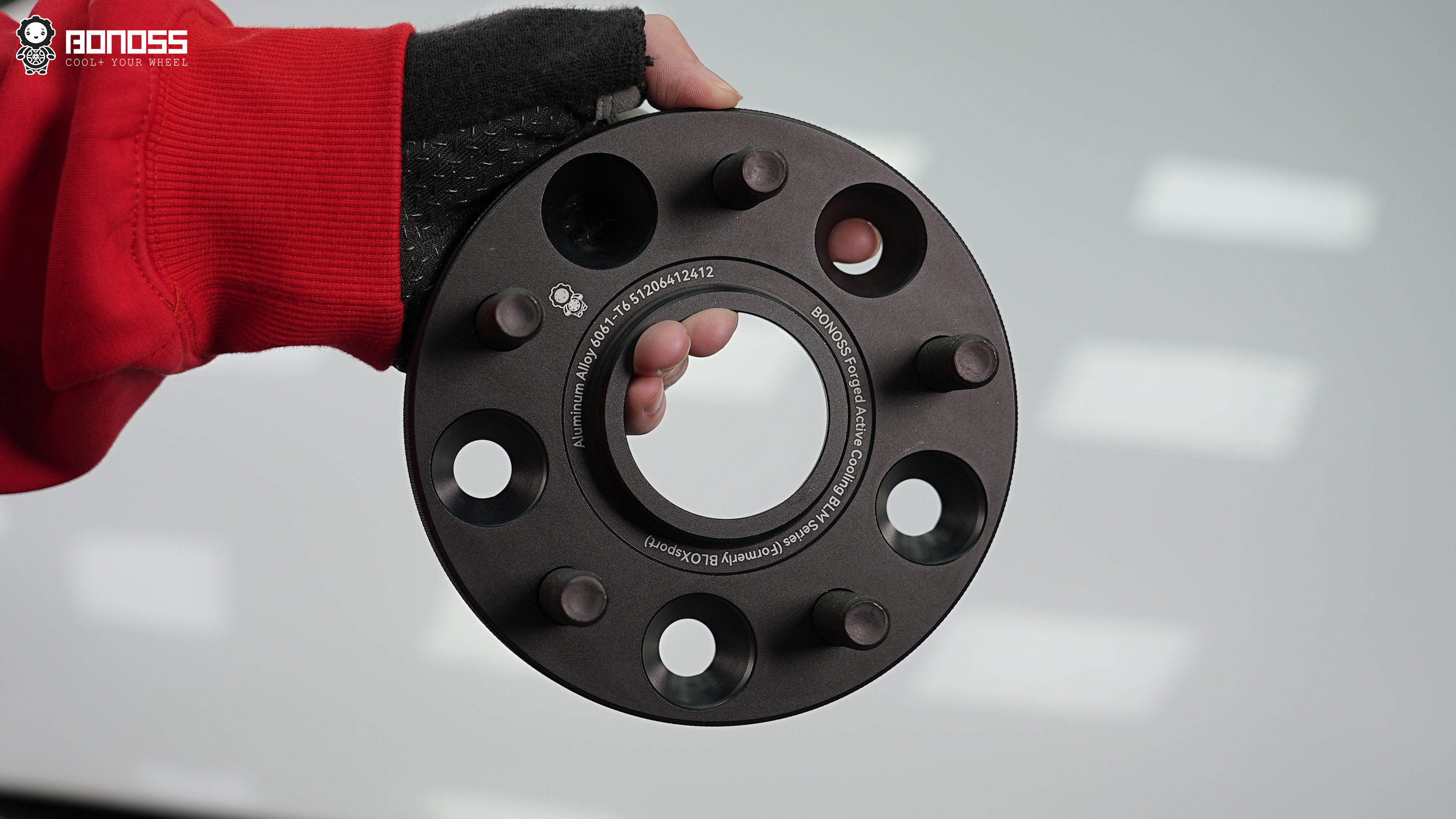
Why BONOSS, in one honest paragraph. The BONOSS forged active cooling wheel spacers for the Tesla Model S in 6061-T6 and the 7075-T6 version are CNC-machined to a 0.02mm tolerance, use a multi-stage hub-centric design that locks onto the 64.1mm hub seat, and carry the active cooling grooves — channels cut into the spacer body that circulate air and help dissipate brake heat as the wheel spins. Hub-centric vs lug-centric is the whole ballgame on a heavy sedan: a lug-centric spacer hangs the car’s weight on the studs, while a hub-centric one carries it on the hub. That’s the difference between a smooth 80 mph and a steering wheel that buzzes.
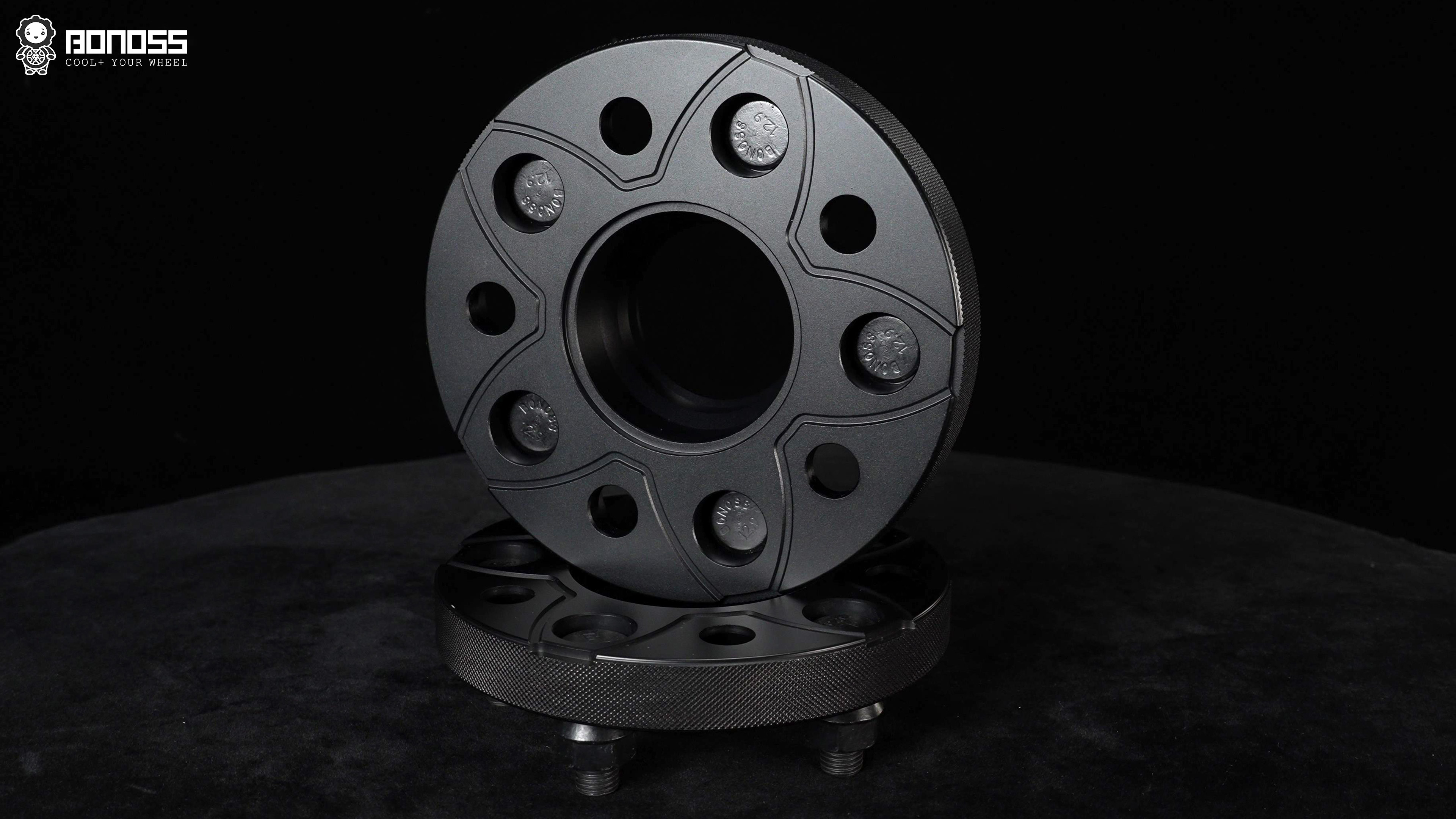
The active cooling grooves are the feature we wouldn’t give up. An EV’s brakes already work differently thanks to regen — when you do lean on the friction brakes hard, they tend to be heat-soaked from sitting against a warm hub. The grooved petal design actively pumps air through that interface as the wheel turns. Combined with the knurled sidewalls, it’s a spacer that behaves like a heat sink rather than a heat dam.
Everything ships with ISO grade 12.9 studs and ISO grade 10 nuts, carries a 10-year warranty, and sits behind more than 75 SGS and TÜV test reports. If you’re shopping for the best wheel spacers for a Tesla Model S — ours or anyone else’s — three things separate the good ones: hub-centric precision, certified hardware, and real material reports. Check for all three.
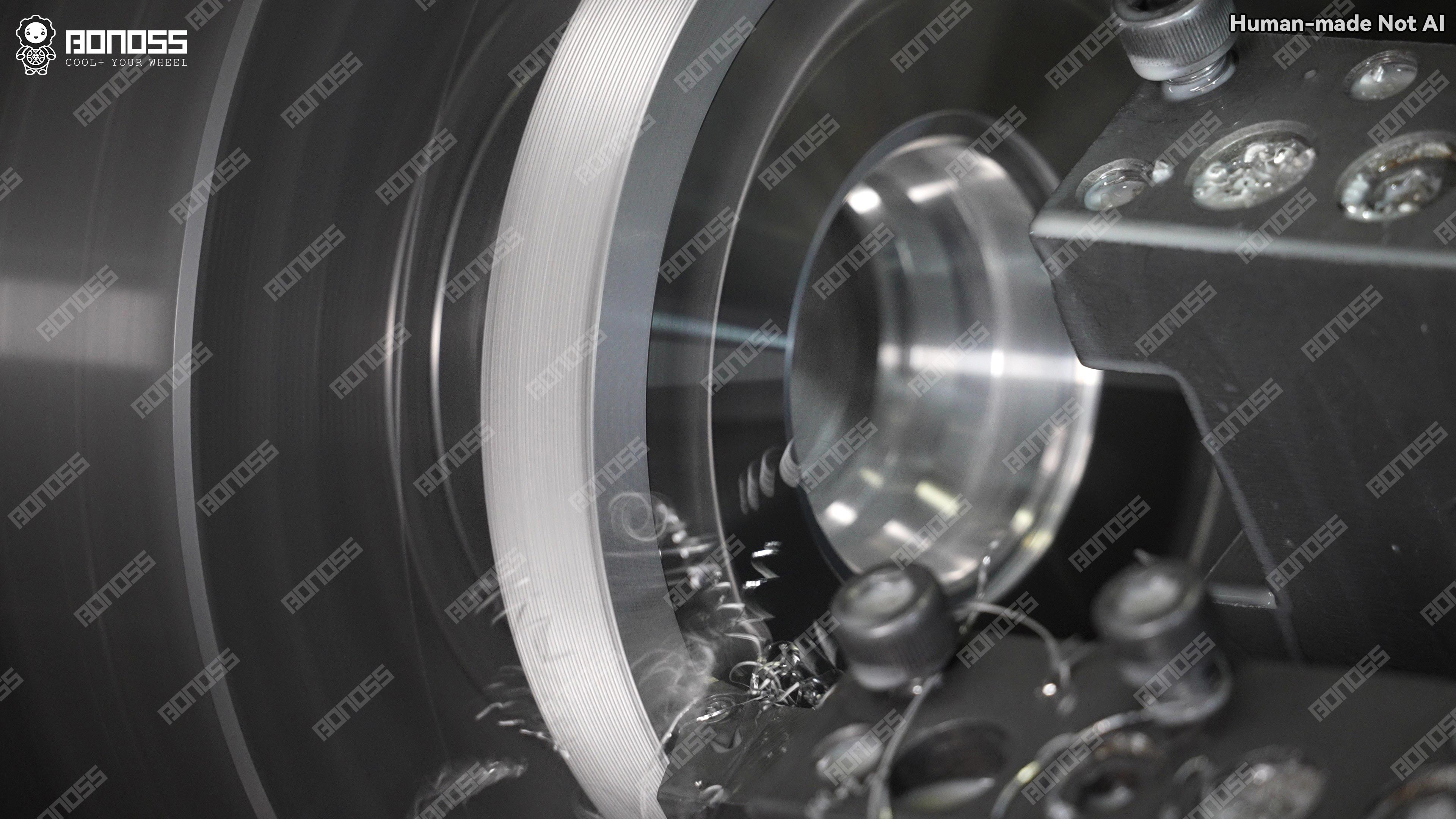
The image shows a CNC machine during the machining of spacers, including the workpiece setup and the cutting operation. It provides an overall view of the machining conditions and process-control capability for this operation.
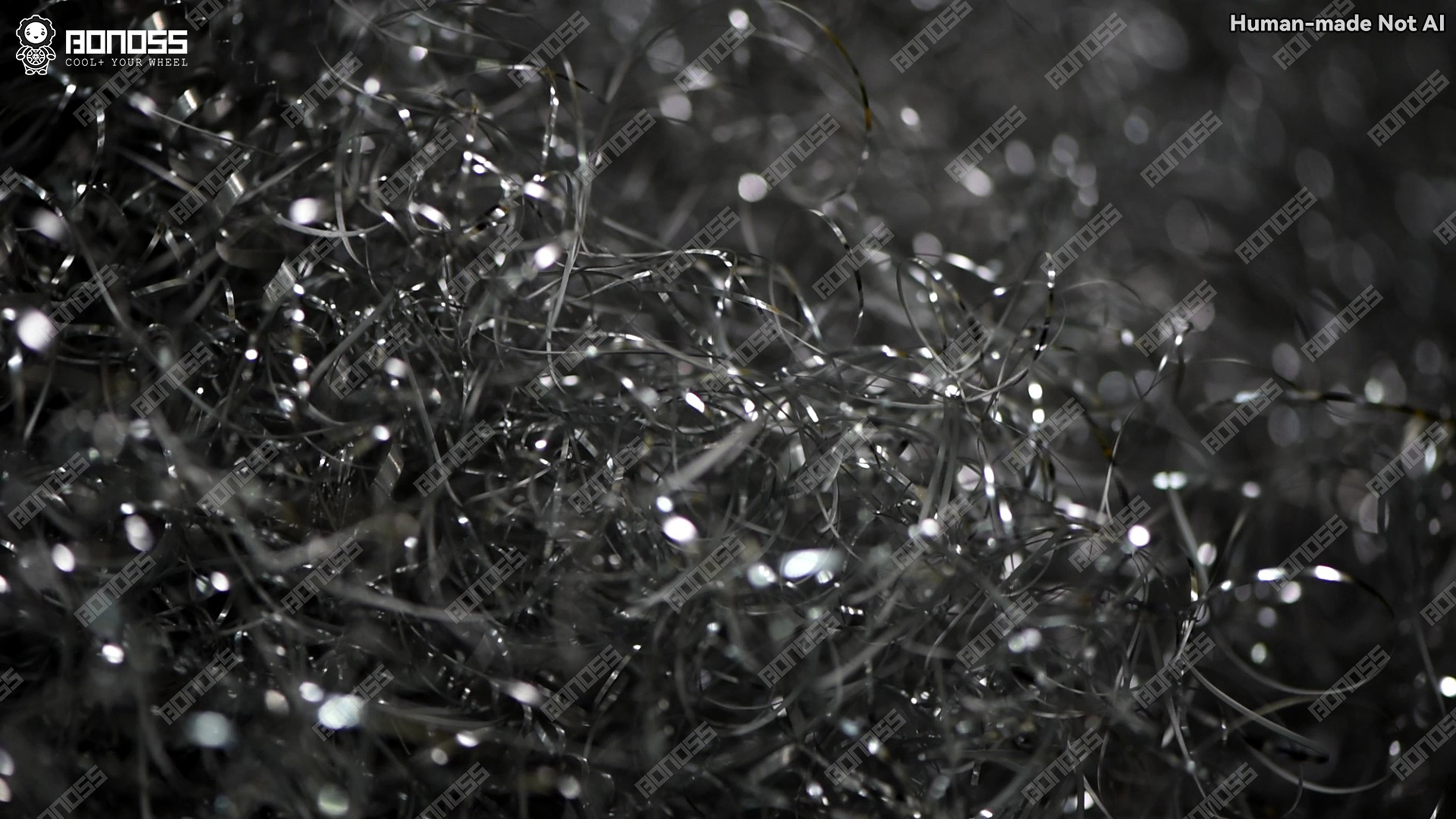
Close-up of the continuous stringy chips formed during the machining operation shown above. The chips are thin and unbroken, indicating a light chip load, finely controlled feed and depth of cut, a sharp cutting edge, and stable, continuous material removal. This gives a clear visual indication of the fine machining quality and precision control achieved in this operation.
Frequently Asked Questions
What bolt pattern do Tesla Model S wheel spacers need?
Every Model S from 2012 through 2027 uses a 5×120 bolt pattern, a 64.1mm hub bore, and M14x1.5 threads — one spec across all three body generations. Only the suggested spacer thickness varies, by trim and wheel offset.
Do I need to cut my factory studs for 15mm spacers?
Measure first, because the answer is maybe. If the wheel’s back-pocket depth plus the spacer thickness exceeds the stud protrusion, no cutting is needed. Newer Model S wheels have shallow pockets, so 15mm spacers on those often require shortened studs, while 20mm and thicker usually clear.
What torque do Tesla Model S wheel spacers take?
Two stages, two values: BONOSS spacer nuts go to 103.5 ft-lb (140 Nm) per BONOSS installation instructions, and the factory wheel nuts go to 129 ft-lb (175 Nm) per the owner’s manual. Each fastener gets exactly one figure matched to its hardware — never mix them.
Are wheel spacers safe on a Tesla Model S?
Yes, when four conditions are met: hub-centric 64.1mm fitment, forged aluminum construction, correct two-stage torque, and a re-torque after the first 50–100 miles. The multi-stage hub-centric design carries the car’s weight on the hub rather than the studs, and the hardware is certified through SGS and TÜV testing. The horror stories you see online usually involve lug-centric universal spacers or skipped re-torques, not hub-centric parts installed to spec.
Will Model 3 or Model X spacers fit my Model S?
Model 3 spacers won’t fit — the Model 3 uses a 5×114.3 pattern, not 5×120. Model X spacers share the S’s 5×120 pattern, 64.1mm bore, and M14x1.5 threads, but the X’s fenders have different clearance, so thicknesses don’t transfer blindly. Buy for your exact car.
Do wheel spacers affect Model S alignment?
No — camber, toe, and caster readings don’t move when you space the wheels out. Spacers widen the track by twice the thickness per axle and subtly change steering feel, but an alignment printout taken before and after will read identically.
The Short Version: Pick the Goal, Then the Millimeters
Choosing Tesla Model S wheel spacers comes down to three moves. Measure your fender gap. Name your goal — flush at 15–25mm, stance at 25–30mm, clearance fixes at 15–20mm, micro-adjustments at 5–10mm. Then confirm the constants that never changed across fifteen model years: 5×120, 64.1mm hub bore, M14x1.5, two-stage torque, re-torque after 50–100 miles.
When you’re ready to buy Tesla Model S wheel spacers, the BONOSS forged active cooling range is machined for this exact hub, documented by SGS and TÜV testing, and backed by a 10-year warranty — current price and options are on the product pages. Your fender gap already did the hard part. The rest is picking the number.

About Jack Miller
Jack Miller is a certified automotive technician specializing in wheel and tire systems, with over a decade of hands-on repair experience. He has served as a senior technical specialist at BONOSS for the past 7 years, advising on wheel spacer fitment, wheel bolt & wheel nut selection for thousands of customer builds. Jack’s technical guides on BONOSS are grounded in real customer cases — not theory.