
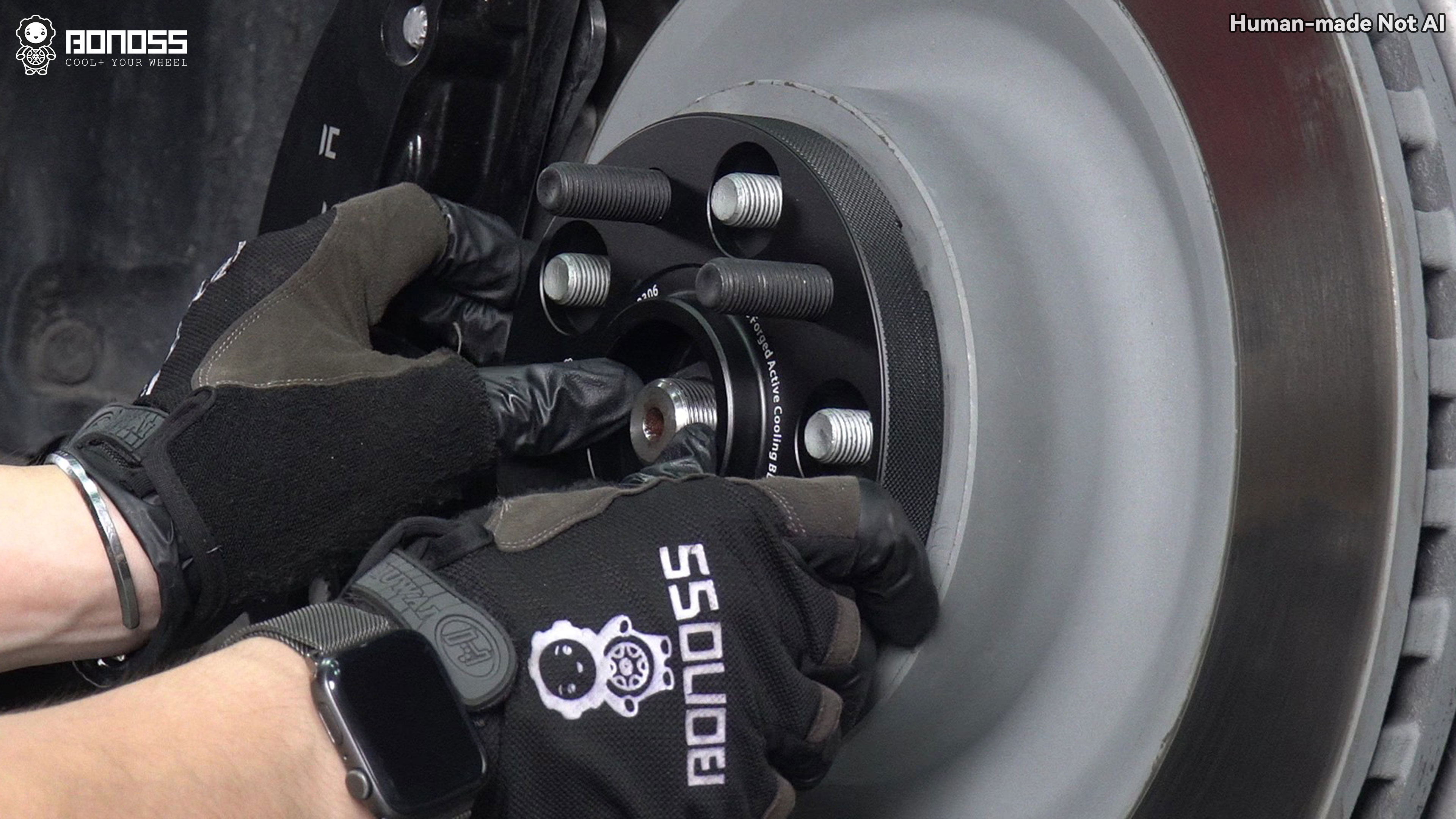
Every Tesla Model X delivered since late 2015 — first 60D to current Plaid — runs the same three numbers that decide which Tesla Model X wheel spacers fit your car: a 5×120 bolt pattern, a 64.1mm hub-centric center bore, and M14x1.5 wheel nuts. The only real decision is thickness. 15–25mm covers every trim: 15–20mm is the usual window on ET35/ET40 stock offsets, and 20–25mm is common on Performance and Plaid cars. Tightening happens in two steps — 140 Nm (103.5 ft-lb) for the BONOSS hardware that clamps the spacer to the hub, per BONOSS installation instructions, and 175 Nm (129 ft-lb) for the factory nuts that clamp the wheel, per the owner’s manual. Measure your fender gaps before ordering; front and rear rarely match.
Specification Summary — Quick Reference
| Generation / Year | Bolt Pattern | Center Bore | Thread Pitch | Wheel Offset | Suggested Spacer Sizes | Factory Lug Nut Torque |
|---|---|---|---|---|---|---|
| 2015-2016 Model X 60D | 5x120mm | 64.1mm | M14x1.5 | ET35 / ET40 | 15mm to 20mm | 129 ft-lb / 175 Nm |
| 2015 Model X 70D | 5x120mm | 64.1mm | M14x1.5 | ET35 / ET40 | 15mm to 25mm | 129 ft-lb / 175 Nm |
| 2015-2017 Model X 90D | 5x120mm | 64.1mm | M14x1.5 | ET35 / ET40 | 15mm to 20mm | 129 ft-lb / 175 Nm |
| 2015-2016 Model X P90D | 5x120mm | 64.1mm | M14x1.5 | ET35 | 20mm to 25mm | 129 ft-lb / 175 Nm |
| 2016-2021 Model X 75D | 5x120mm | 64.1mm | M14x1.5 | ET35 / ET40 | 15mm to 25mm | 129 ft-lb / 175 Nm |
| 2016-2021 Model X P100D | 5x120mm | 64.1mm | M14x1.5 | ET35 / ET40 | 15mm to 25mm | 129 ft-lb / 175 Nm |
| 2017-2020 Model X 100D | 5x120mm | 64.1mm | M14x1.5 | ET35 / ET40 | 15mm to 20mm | 129 ft-lb / 175 Nm |
| 2019-2021 Model X Long Range | 5x120mm | 64.1mm | M14x1.5 | ET35 / ET40 | 15mm to 20mm | 129 ft-lb / 175 Nm |
| 2019-2021 Model X Performance | 5x120mm | 64.1mm | M14x1.5 | ET35 | 15mm to 25mm | 129 ft-lb / 175 Nm |
| 2019-2021 Model X Standard Range | 5x120mm | 64.1mm | M14x1.5 | ET35 / ET40 | 15mm to 20mm | 129 ft-lb / 175 Nm |
| 2020-2021 Model X Long Range Plus | 5x120mm | 64.1mm | M14x1.5 | ET35 / ET40 | 15mm to 25mm | 129 ft-lb / 175 Nm |
| 2022-2027 Model X Plaid | 5x120mm | 64.1mm | M14x1.5 | ET40 / ET35 | 15mm to 25mm | 129 ft-lb / 175 Nm |
| 2022-2027 Model X Standard Range | 5x120mm | 64.1mm | M14x1.5 | ET40 / ET35 | 15mm to 20mm | 129 ft-lb / 175 Nm |
Nine years, two body styles, one spec set — Tesla never touched the wheel-side geometry. Your variant only shifts the thickness window, and that comes from stock offset and wheel width, not hardware. The two torque values below are the fastening standard:
| Fastening step | Hardware | Torque | Source |
|---|---|---|---|
| Spacer to hub | BONOSS-supplied nuts | 140 Nm (103.5 ft-lb) | per BONOSS installation instructions |
| Wheel to spacer | Factory nuts | 175 Nm (129 ft-lb) | per the owner’s manual |
Use ONE torque value per fastening step, matched to the hardware you are actually turning. Both values above are acceptable, each within its own step, never interchangeable mid-job. Unsure which applies? Take the more conservative value and confirm compatibility first.
Scope of Applicability
The original body ran from first customer deliveries in late 2015 through the 2021 model year: 60D, 70D, 90D, P90D, 75D, 100D, P100D, Long Range, Long Range Plus, Performance, and Standard Range. The refreshed car — the program Tesla itself labels “Palladium” in its service documentation — reached US buyers from October 2021 and covers the 2022–2027 Plaid and Standard Range.
One quirk: 2021 is a split model year — early builds are the original design, cars from October 2021 onward are the refresh. It changes nothing for spacers, since both share the identical 5×120 / 64.1mm / M14x1.5 hardware, but it matters when ordering parts by body style.
What this guide does not cover:
- Model S. It shares the 5×120 pattern, the 64.1mm bore, and the M14x1.5 thread, so the hardware matches — but the fender arches and factory offsets differ, so thickness numbers do not transfer.
- Model 3 and Model Y. Both run 5×114.3 — a different bolt circle entirely. Can I use Model X wheel spacers on a Model 3 or Model Y? The answer is no.
- Aftermarket wheels. Different offsets and pocket depths change the math in thickness selection criteria. Re-measure.
Specification Definitions
Bolt Pattern: 5×120, Five Studs
Five wheel studs on a 120mm bolt circle. That’s the whole pattern, and it’s why 5×120 spacers for the Tesla Model X bolt straight on — adapters convert between bolt patterns, and yours doesn’t change. The pattern is shared with the Model S, which is exactly why people assume size recommendations transfer between the two cars. They don’t.
Center Bore: 64.1mm, Hub-Centric or Nothing
The axle hub ends in a 64.1mm pilot. Tesla Model X hub-centric wheel spacers copy that 64.1mm into their center ring, so the wheel’s weight rides on the spacer’s pilot instead of hanging on five studs loaded in shear. Lug-centric spacers skip the ring and let the studs do the locating — on a 5,000-plus-pound SUV, that’s the corner I don’t cut. Hub-centric vs lug-centric is the difference between the wheel being carried and the wheel being hung.
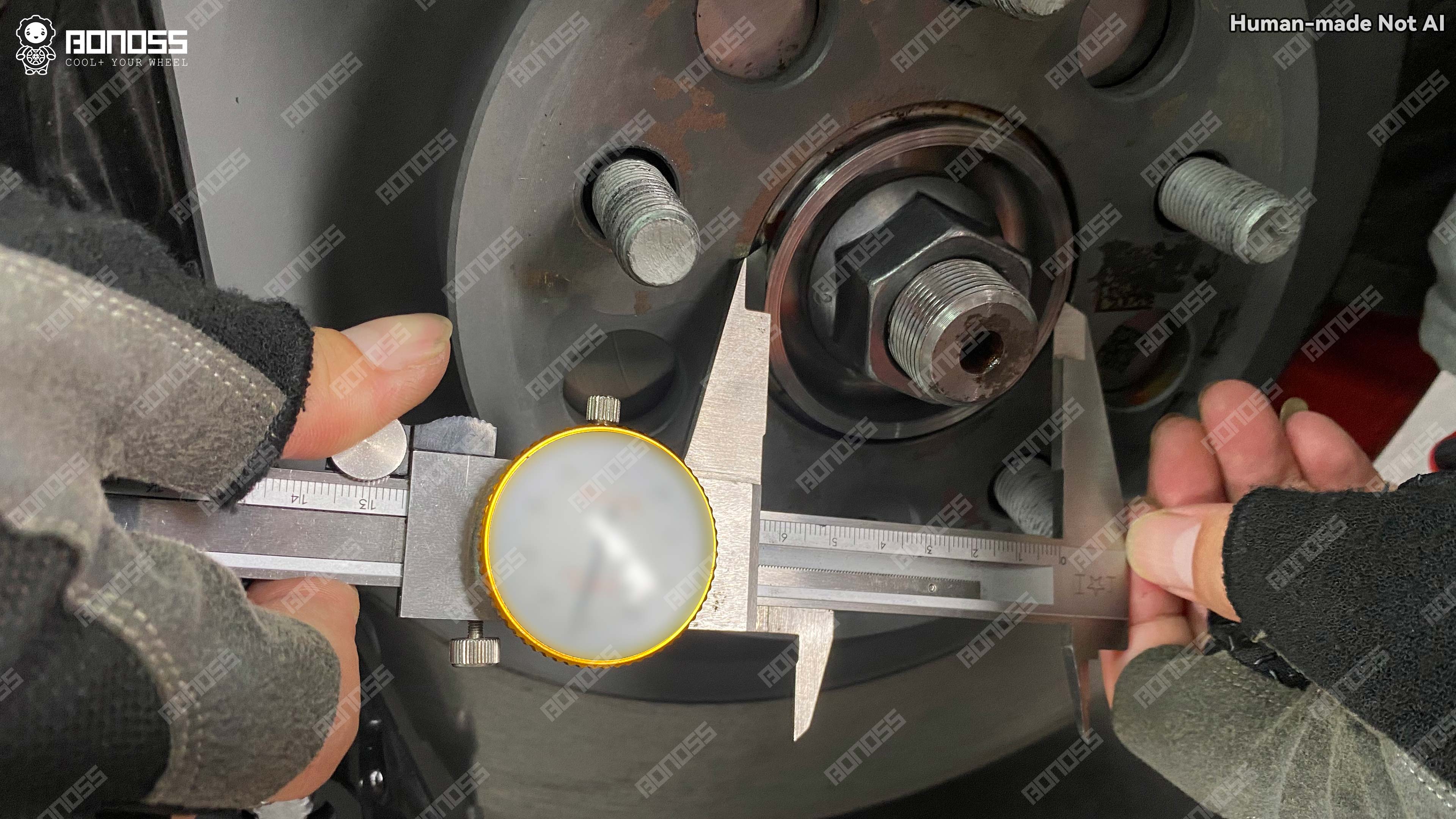
Measure rather than trust. A vernier caliper across the hub confirms the 64.1mm figure — the dimension 64.1mm hub bore spacers for the Model X have to match.
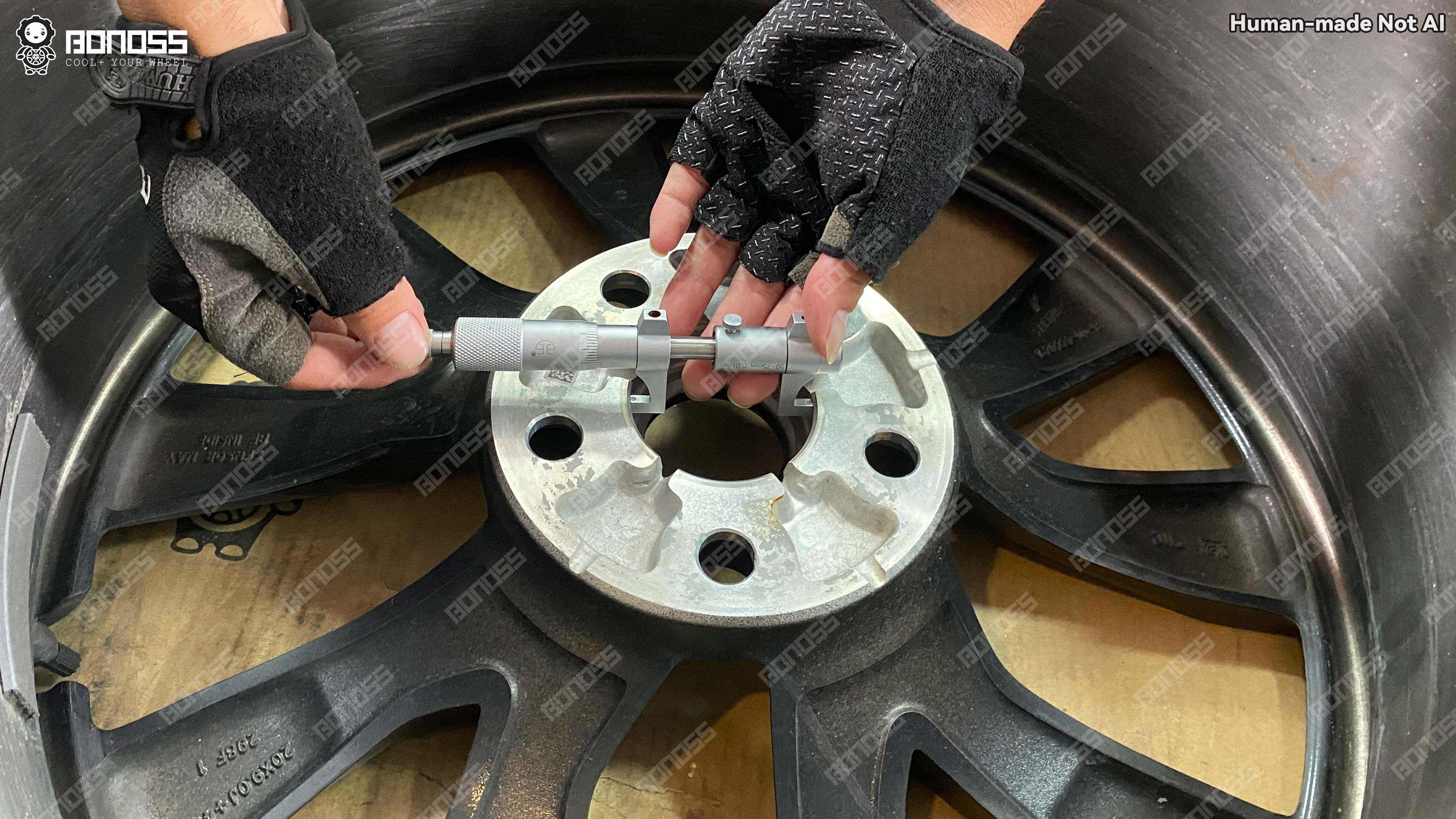
A micrometer across the wheel’s own bore confirms the wheel side.
Thread Pitch: M14x1.5 With a Conical Seat
M14x1.5 means 14mm-diameter threads with 1.5mm between crests. Factory nuts ride a conical seat and take a 21mm socket — both straight from Tesla’s owner’s manual. The thread matters more than it looks: torque values are only valid for the hardware they were written for. M14x1.5 wheel spacers for the Tesla Model X keep the factory fastening logic intact — spacer studs match the factory thread, factory nuts keep their seat, both torque numbers stay meaningful.
Thickness Selection Criteria
Measuring for a Flush Stance
The method is one step: hold a straightedge or high-accuracy ruler across the fender lip and measure from the tire’s outer sidewall to the lip. That reading is the spacer thickness that brings that wheel flush. Do it per corner — the Model X doesn’t even leave the factory with matched offsets, and the 20-inch packages alone mix ET35 and ET40 between axles:
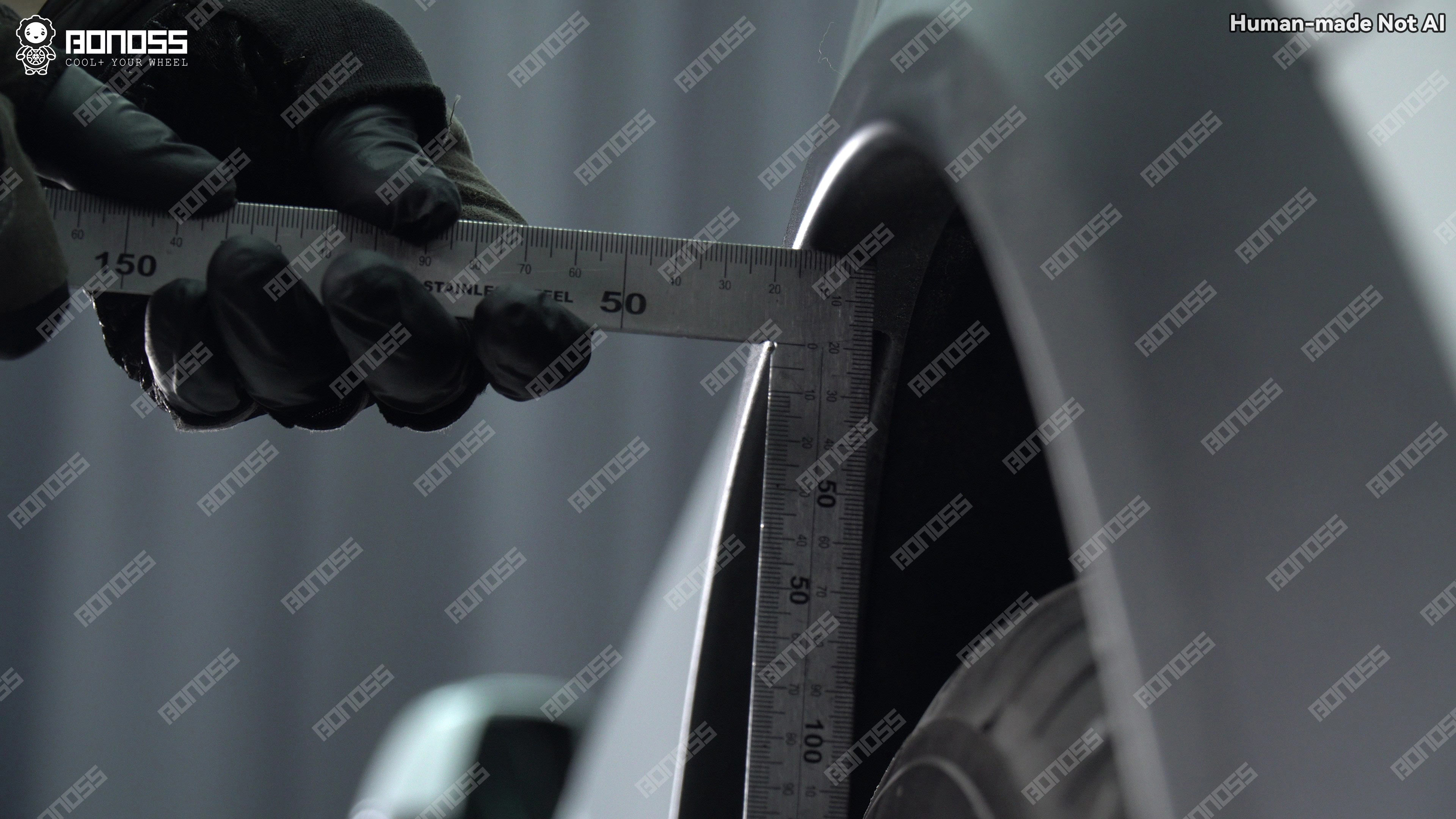
Leave a few millimeters of margin. Suspension compression moves the tire, and a wheel that’s flush at rest can touch the lip mid-corner. If the gap reads 22mm, order 20mm — not 25mm.
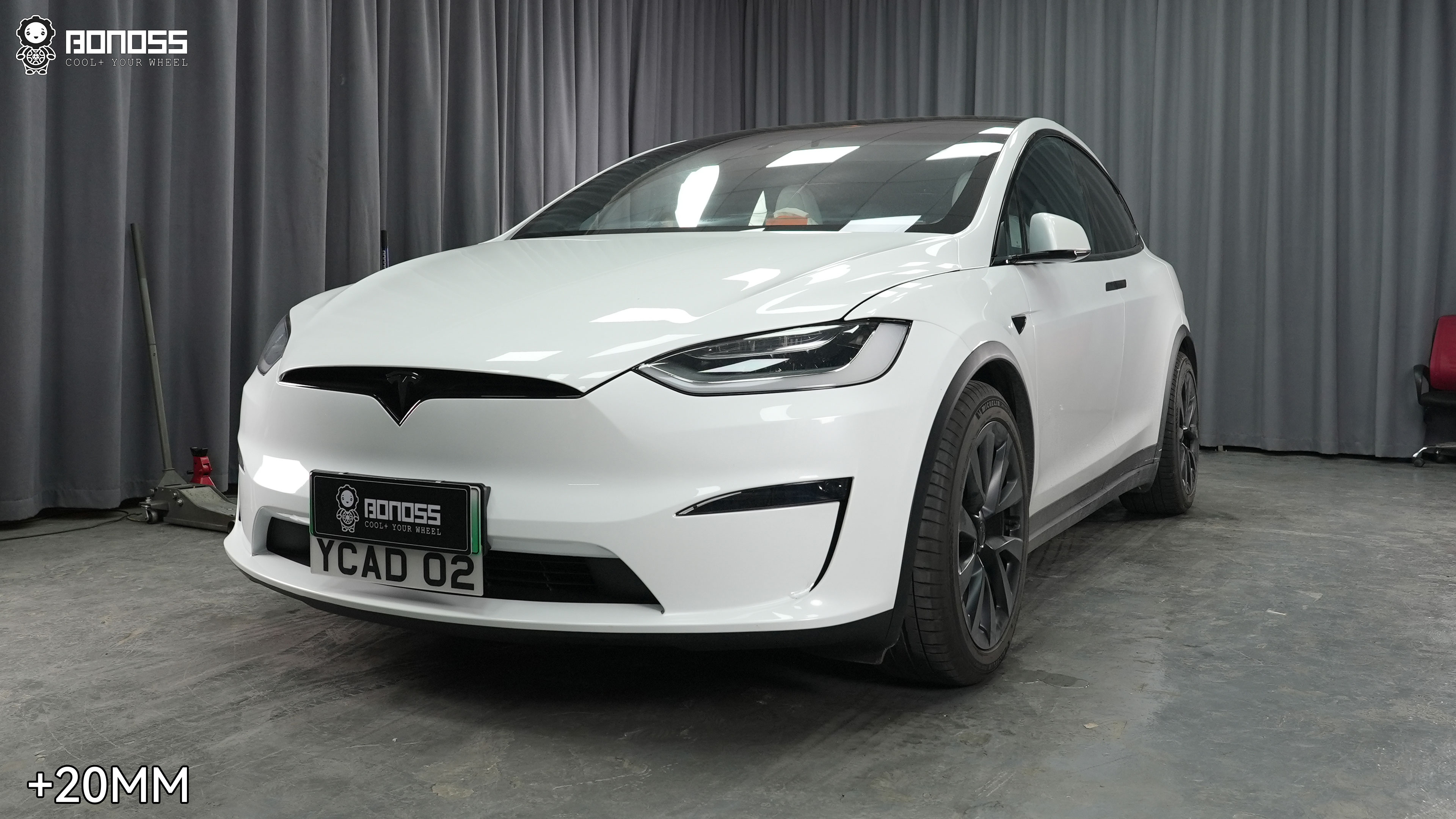
Here’s the same right rear corner before and after a 20mm set:
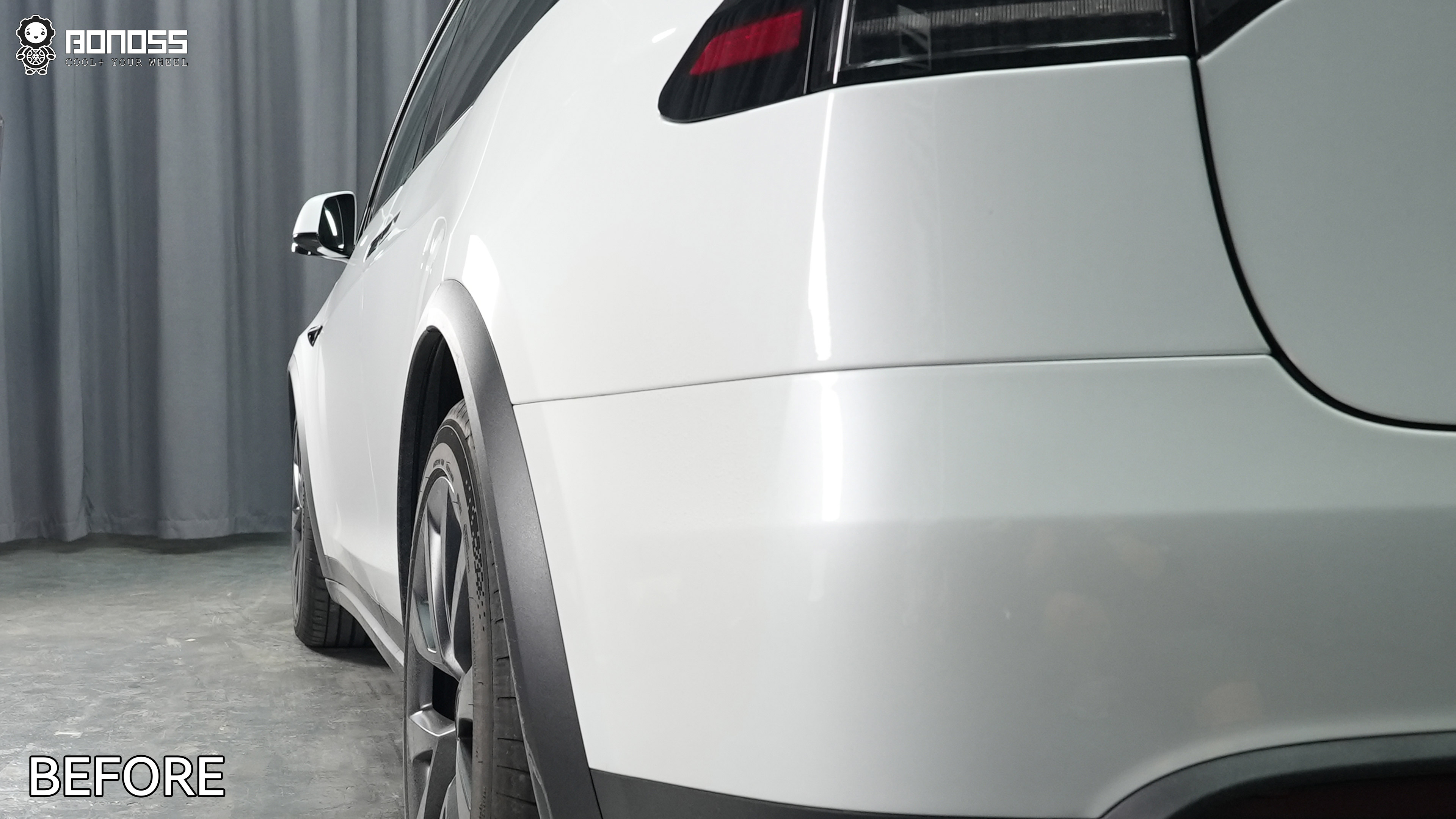
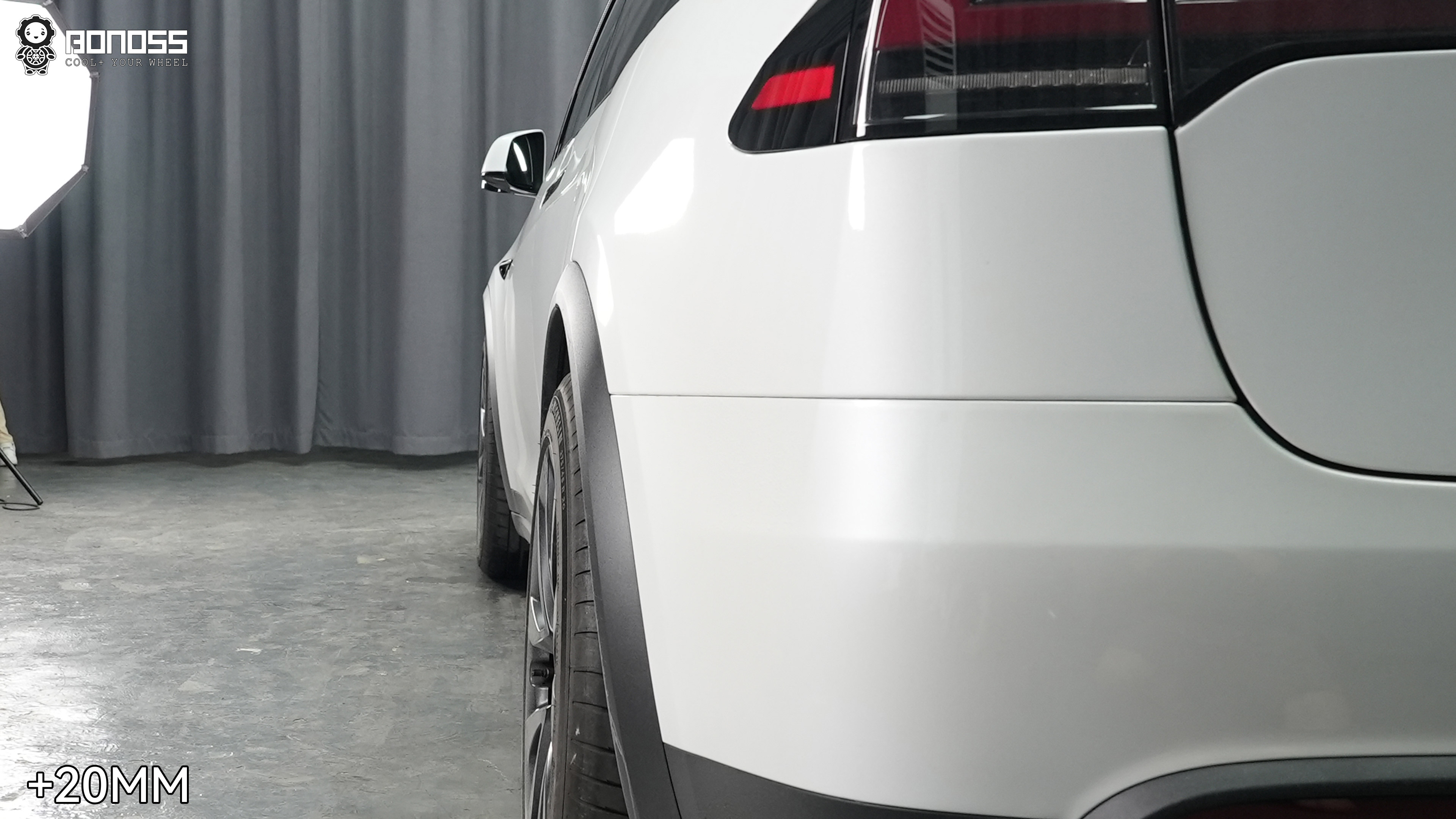
There’s a full Tesla Model X wheel spacers before-and-after write-up from this same install.
Stud Protrusion: The Trim-or-Not Test
Whether you trim factory studs comes down to one inequality:
wheel pocket depth + spacer thickness > stud protrusion = install without trimming
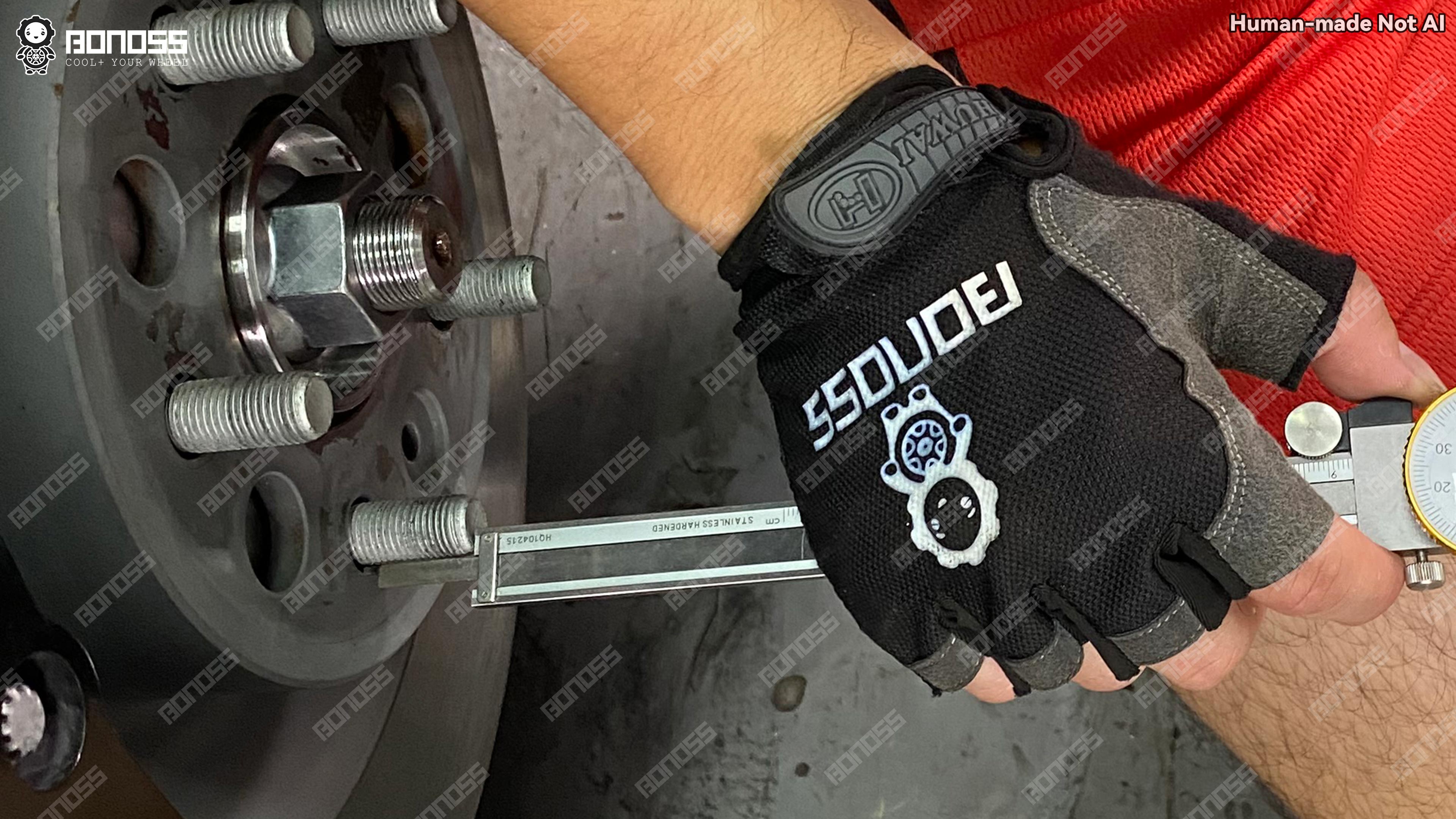
First, how far the factory studs stick out past the hub face.
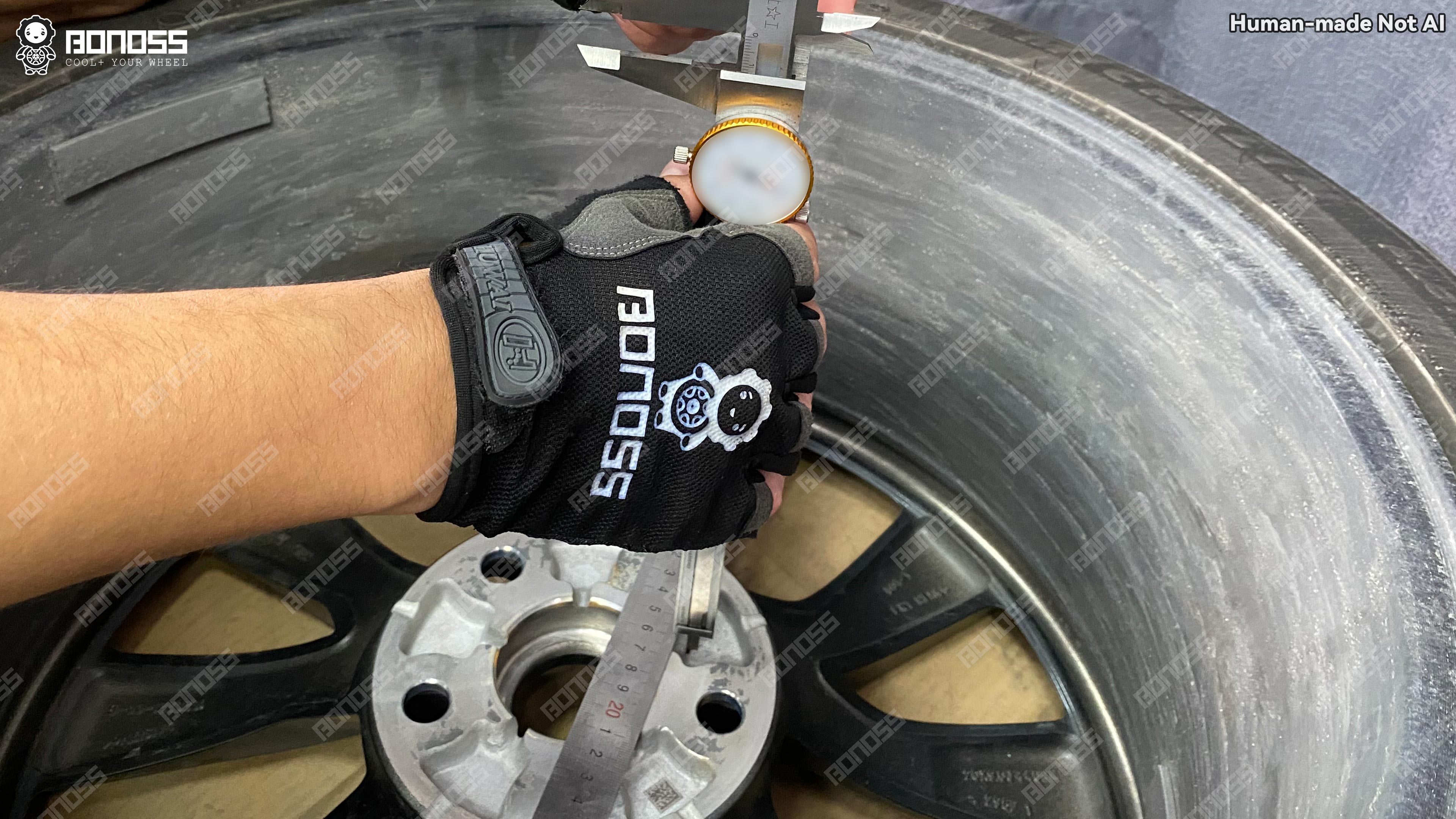
Second, how deep the pockets on the back of the wheel are, and whether their positions line up with the studs.
Third, the thickness you’re considering. If the pockets plus the spacer swallow the stud protrusion, bolt it on. If they don’t, your options are a thicker spacer, a wheel with deeper pockets, or shorter studs — in that order. Cutting studs is permanent; the other two aren’t.
15mm vs 20mm vs 25mm Wheel Spacers
| Fitment goal | Thickness | What to expect |
|---|---|---|
| Near-stock look, mild push | 15mm | Usually clears studs with factory pockets; subtle from most angles |
| Flush with the fender line | 20mm | The most common Model X choice; fills the arch evenly |
| Maximum stance, wider track | 25mm | Typical on ET35 Performance and Plaid wheels; verify tire coverage |
Two cautions from the 15mm vs 20mm vs 25mm Model X spacer comparison: past flush, you’re into tire-coverage rules — check before going wider — and thicker is not automatically safer. Plaid Model X wheel spacers usually land at 20–25mm because ET35 wheels sit deeper in the arch, not because thicker is better. One side benefit: moving the wheel outboard opens brake caliper clearance, which is why spacer-and-big-brake combos are common.
Material Standard: Forged 6061-T6 or 7075-T6
Both alloys arrive as forged billet, not cast. The honest version of “which is better” starts with hardness numbers measured by third-party labs:
- 6061-T6: hardness 101–103 on the Brinell scale, test method ISO 6506-1:2014 — TÜV Test Report for BONOSS 6061-T6 Wheel Spacers Hardness Test, No. 01 220 CHN-T-2500961+
- 7075-T6: hardness 146 HBW 5/250, same test method — TÜV Test Report for BONOSS 7075-T6 Wheel Spacers Hardness Test, No. 01+220+CHN-T-2501547+
Same scale, same method: roughly 40 percent harder. In practice that buys crack resistance under the hammering of hard driving — track days, launches, rough roads. For a daily driver on pavement, 6061-T6 already takes impacts without cracking.
Corrosion has its own report: 240 hours of neutral salt spray with no defects, test method ISO 9227:2022+Amd 1:2024 — TÜV Test Report for BONOSS 6061-T6 Wheel Spacers Neutral Salt Spray Test, No. 01 220 CHN-T-2500958-1+. One caveat: different labs, samples, and measurement error produce different readings — treat these as ranges, not gospel.
Daily driving: forged 6061-T6 spacers. Hard use: forged 7075-T6 spacers for the Model X.
Fastening Standards
Torque: Two Steps, Two Values, No Mixing
Torque specs belong to hardware, not to cars. The 140 Nm (103.5 ft-lb) figure is per BONOSS installation instructions and applies to the BONOSS nuts clamping the spacer to the hub. The 175 Nm (129 ft-lb) figure is per the owner’s manual and applies to the factory nuts clamping the wheel to the spacer’s studs. Two steps, two values, one rule: use ONE torque value per step — both are acceptable, each within its own step, never blended. When in doubt, the more conservative value plus a compatibility check beats guessing.
Sequence matters as much as the number: five studs, crisscross order — 1, 3, 5, 2, 4 — hand-thread everything first, then torque in two passes. A single lazy pass with an impact gun is how wheels come back loose.
Hardware Grades and Thread Engagement
The studs in the spacer carry the whole corner. BONOSS kits use forged SCM440 steel studs to ISO grade 12.9, paired with ISO grade 10 nuts.
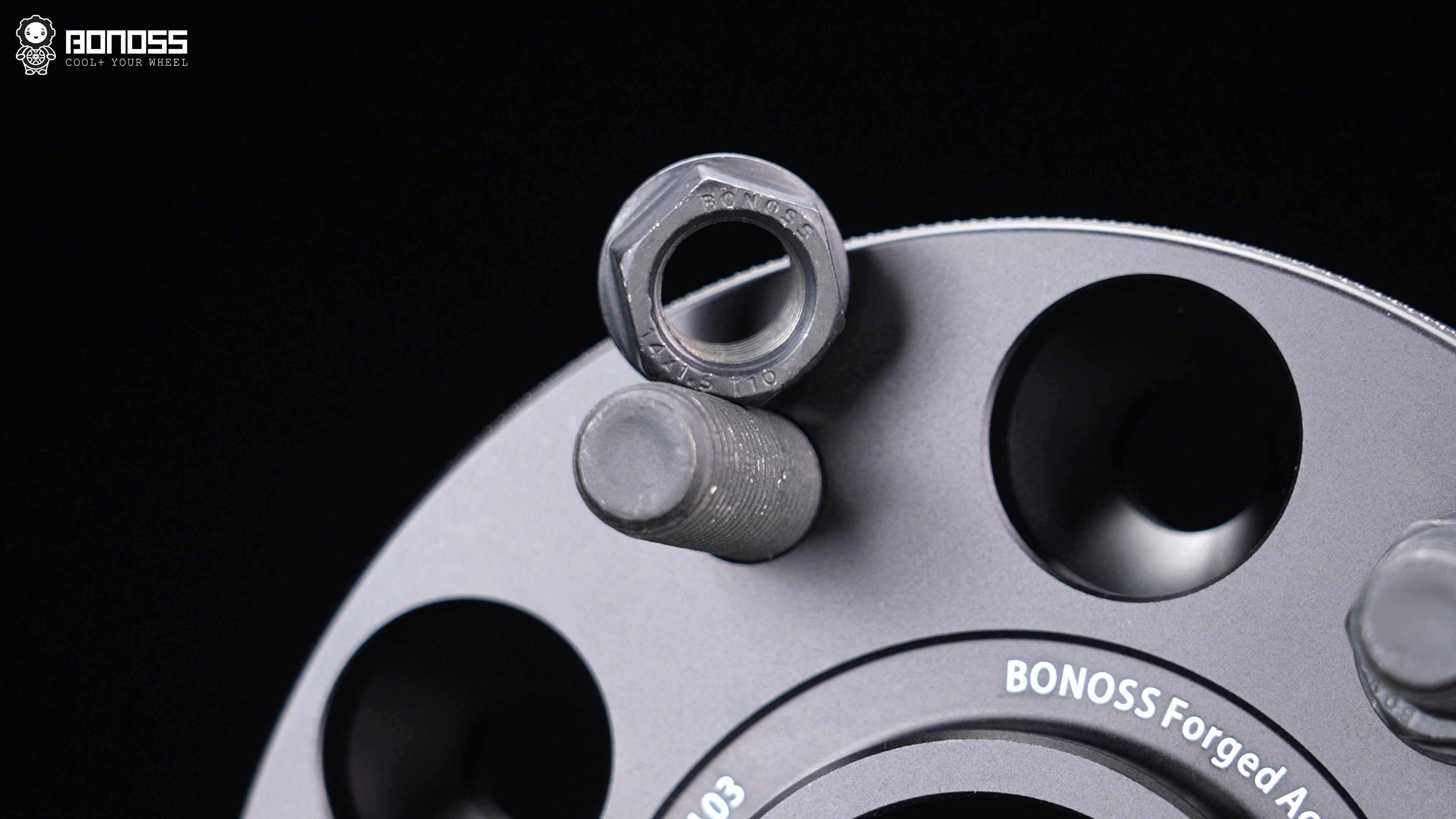
The numbers, all from third-party labs:
Studs (M14x1.5, ISO grade 12.9):
- Tensile strength 1268 MPa, ISO 898-1:2013+Cor-1:2013 — SGS Test Report for BONOSS Wheel Studs M14x1.5 Tensile Test, No. GZIN1911061611ML
- Tensile strength 1233 MPa, ISO 898-1:2013+Cor-1:2013 — TÜV Test Report for BONOSS Wheel Studs M14x1.5 Tensile Test, No. 01 220 CHN/T-2000114
- Proof load 121 kN, ISO 898-1:2013+Cor-1:2013 — SGS Test Report for BONOSS Wheel Studs M14x1.5 Proof Load Test, No. GZIN1911061612ML
- Hardness 391–401 HV10, ISO 6507-1:2018 — SGS Test Report for BONOSS Wheel Studs M14x1.5 Hardness Test, No. GZIN1911061613ML
- Hardness 386–390 HV10, ISO 6507-1:2018 — TÜV Test Report for BONOSS Wheel Studs M14x1.5 Hardness Test, No. 01 220 CHN/T-2000115
Nuts (M14x1.5, ISO grade 10):
- Proof load 138.8 kN, ISO 898-2:2012 — SGS Test Report for BONOSS Wheel Spacer Nuts M14x1.5 Proof Load Test, No. GZIN1911064031ML-01
- Hardness 358–362 HV0.5, ISO 6507-1:2018 — SGS Test Report for BONOSS Wheel Spacer Nuts M14x1.5 Hardness Test, No. GZIN1911064032ML-01
Plain English: tensile strength is the pull at which a stud breaks — both labs measured well above 1,200 MPa. Proof load is the pull a fastener takes without permanently stretching — 121 kN per stud is about 27,000 pounds before the metal takes a set. The nut must also run the full usable thread depth of the stud — if it doesn’t, the fastener is wrong for the stack. Fix the parts, not the torque.
Installation Procedure
Step 0 — Jack Mode, before anything else. The Model X has self-leveling air suspension. Lift it without enabling Jack Mode and the system tries to correct its “sagging” height while the car is in the air — it can move under the wrench. Enable it in the service menu first.
Step 1 — break torque on the ground. Crack the factory nuts loose with the wheel loaded, then lift and remove the wheel.
Step 2 — remove the brake disc locating screw. This small screw holds the rotor to the hub. Its entire job is keeping the rotor seated while the caliper and wheel are off — once the wheel is mounted, it has no structural role. Tesla’s service documentation calls for a 13mm socket and states reinstalling it is not necessary; some cars leave the factory without it. For spacers it has to go: the head protrudes past the rotor face, and a spacer needs a flat, full-contact seat. Removing it now also spares you a rusted-solid extraction later — anyone in a salt state knows that pain.
Step 3 — clean the hub face. Wire brush, clean rag, inspect. Corrosion on the mounting face is the number-one cause of spacer runout and the vibration complaints that follow.
Step 4 — verify the numbers. Stud protrusion, pocket depth, thickness. If the inequality fails, stop here.
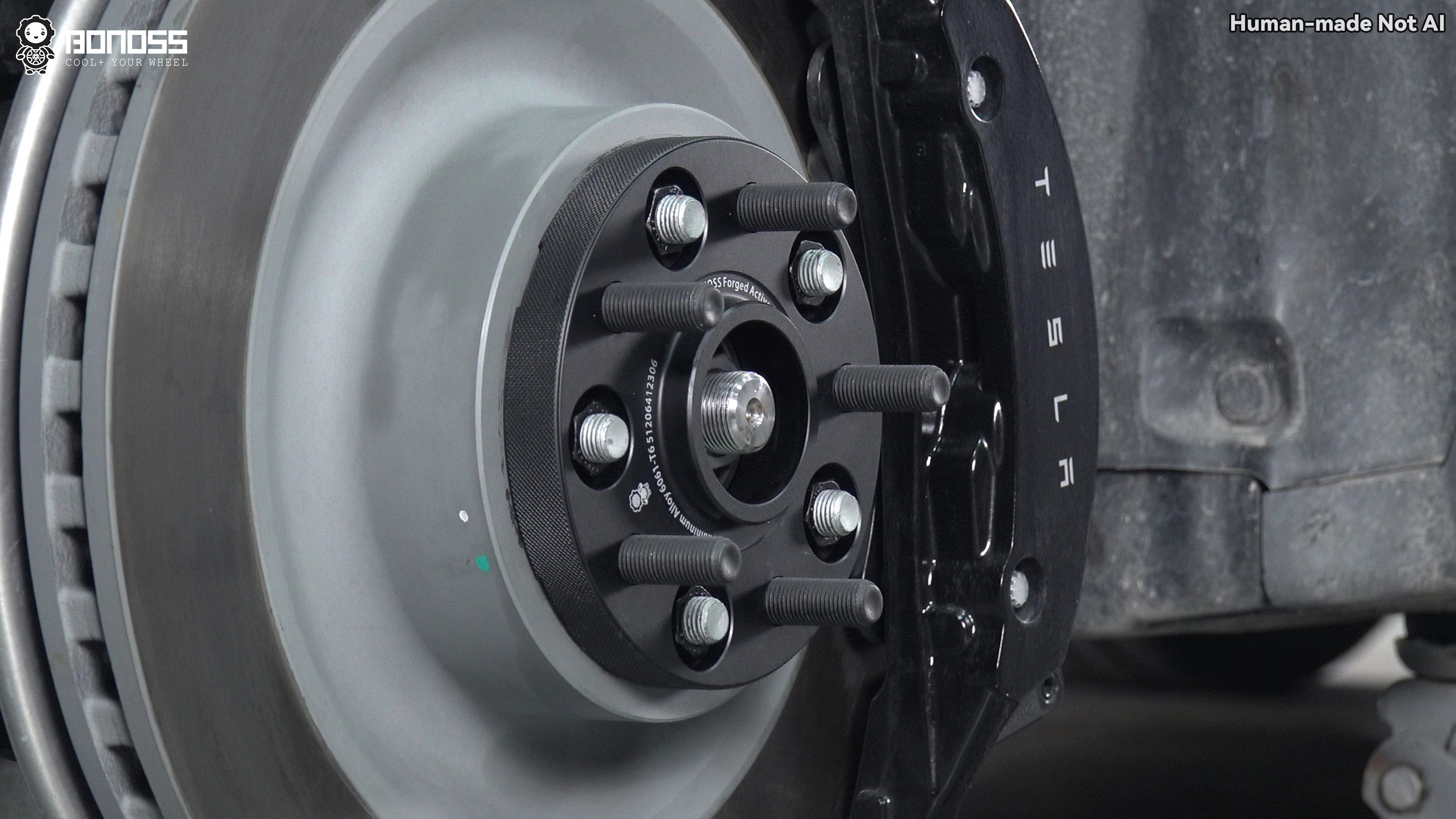
Step 5 — mount the spacer. Slide it over the factory studs and start the BONOSS nuts by hand. Torque the BONOSS nuts to 140 Nm (103.5 ft-lb) in the crisscross pattern, per BONOSS installation instructions.
Step 6 — mount the wheel. Factory nuts onto the spacer studs, hand-threaded, then 175 Nm (129 ft-lb) in the same crisscross pattern, per the owner’s manual.
Step 7 — down and double-check. Lower the car, disable Jack Mode, take a short drive, and re-torque both steps after the first 50–100 miles.
Re-Check and Maintenance Periods
Fresh hardware settles. Both fastening steps get a re-torque after the first 50–100 miles — surfaces bed in, clamp load drops, and a two-minute pass with the torque wrench restores it. After that, check at every tire rotation or season change. In a winter-salt state, pull a wheel once a year, clean the mating faces, and inspect the anodized finish — the one that held 240 hours of neutral salt spray in testing. Vibration after a spacer install is almost never the spacer itself: it’s a dirty hub face or an untorqued nut, and both take ten minutes to fix.
Risk and Limitation Statement
- Never stack spacers. Two spacers on one hub is not a thickness option — it’s a failure mode. If 25mm isn’t enough, buy the right thickness.
- Tire coverage laws vary by US state. Past-flush fitments can put the tire outside the fender line. Check before ordering 25mm.
- Air suspension cars: Jack Mode, every time, no exceptions.
- Aftermarket wheels void the defaults. Pockets, offsets, and bores all change the spacer thickness math.
- This guide covers fitment, not certification. Where your jurisdiction requires documented approval for wheel modifications, verify that your parts carry it.
Recommended Hardware
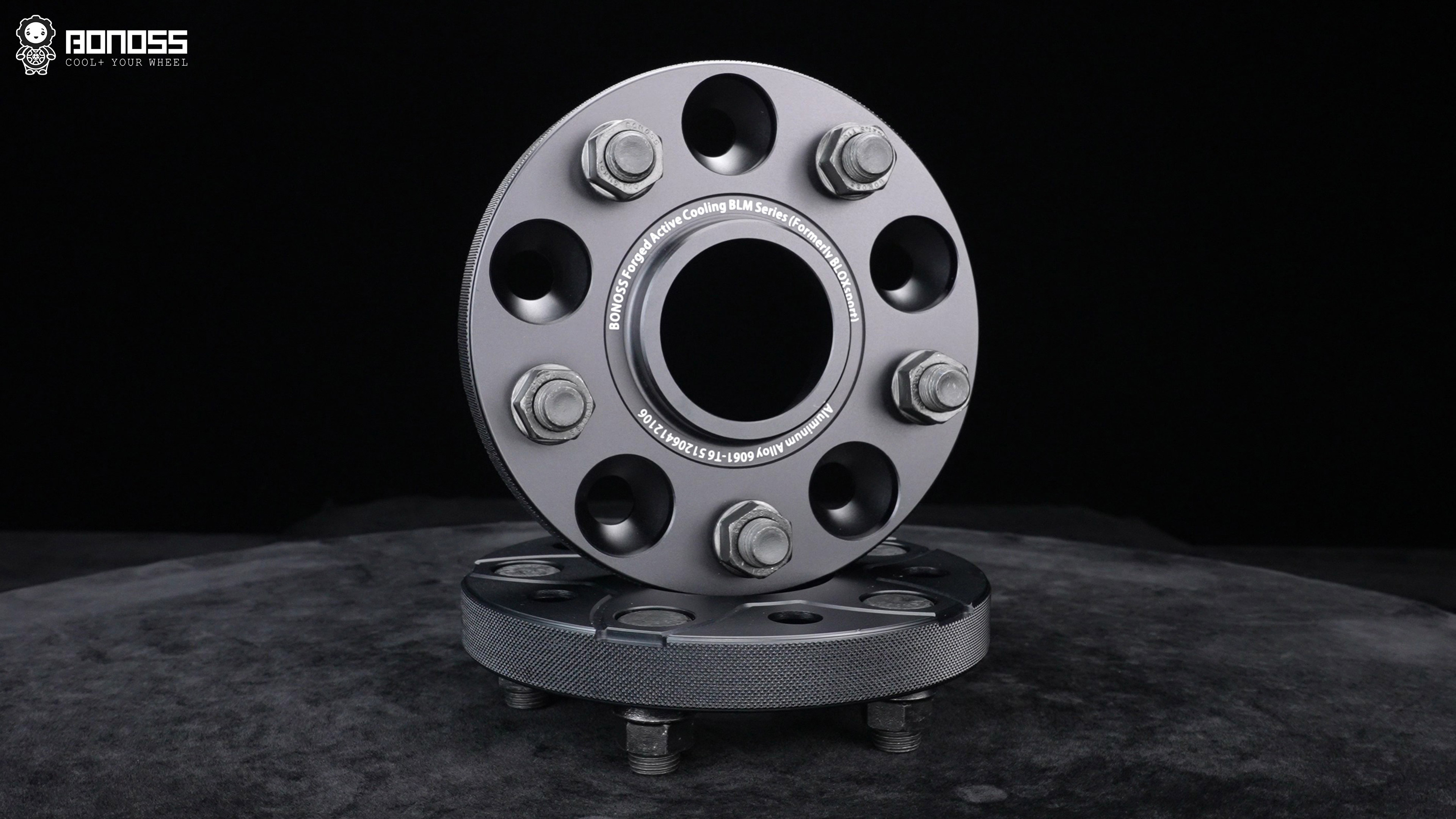
What to order: BONOSS forged active cooling wheel spacers — 6061-T6 for street cars, 7075-T6 for hard use — in 15mm to 50mm standard sizes, custom thicknesses from 3mm up. The features that earn their keep:
Active cooling. Grooves machined into the spacer face give brake heat an escape path instead of a dead-air pocket.
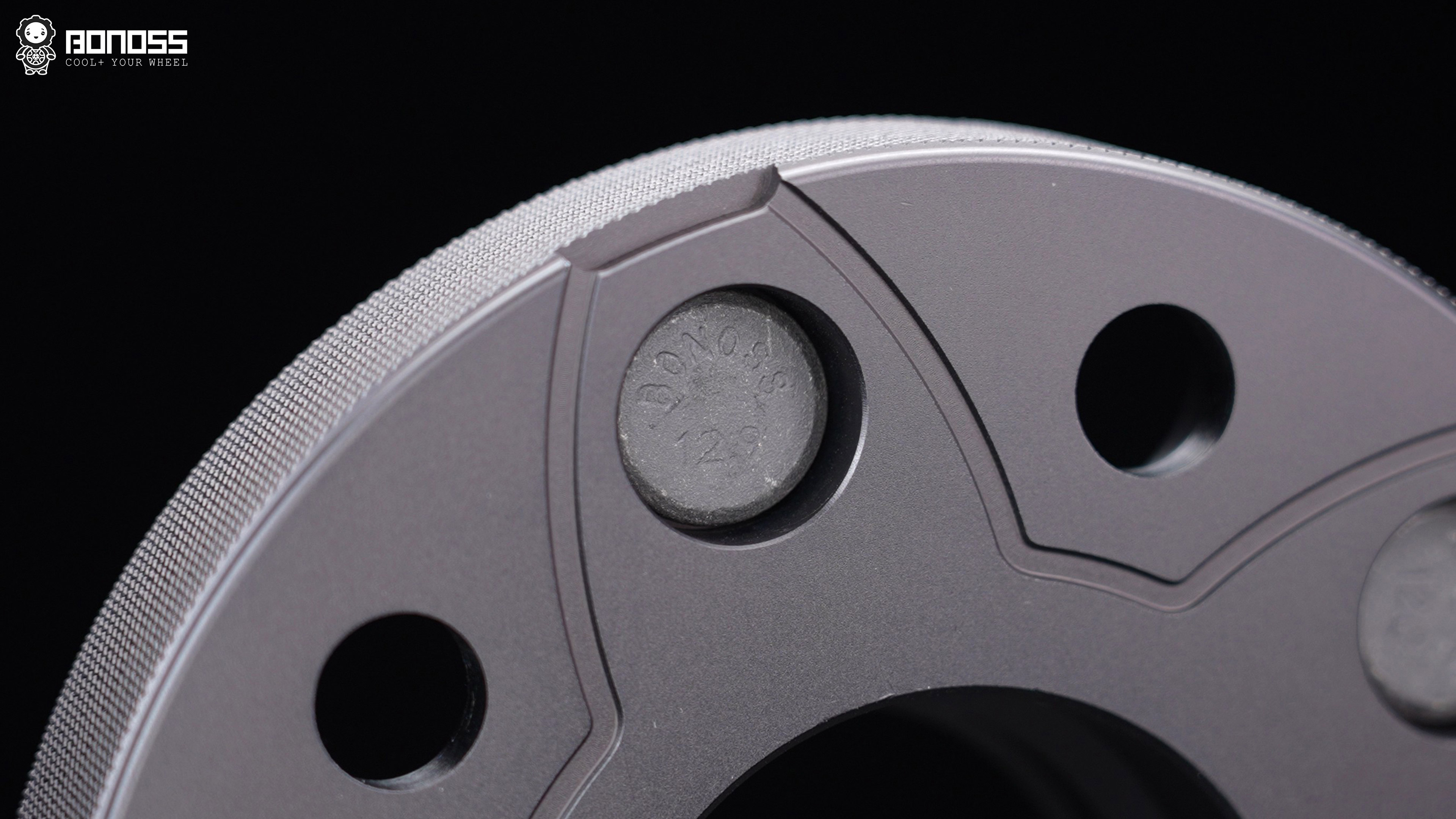
Multi-stage hub-centric with service details. The stepped ring pilots factory bores; knurled edges and disassembly grooves make removal a wrench job, not a mallet job:
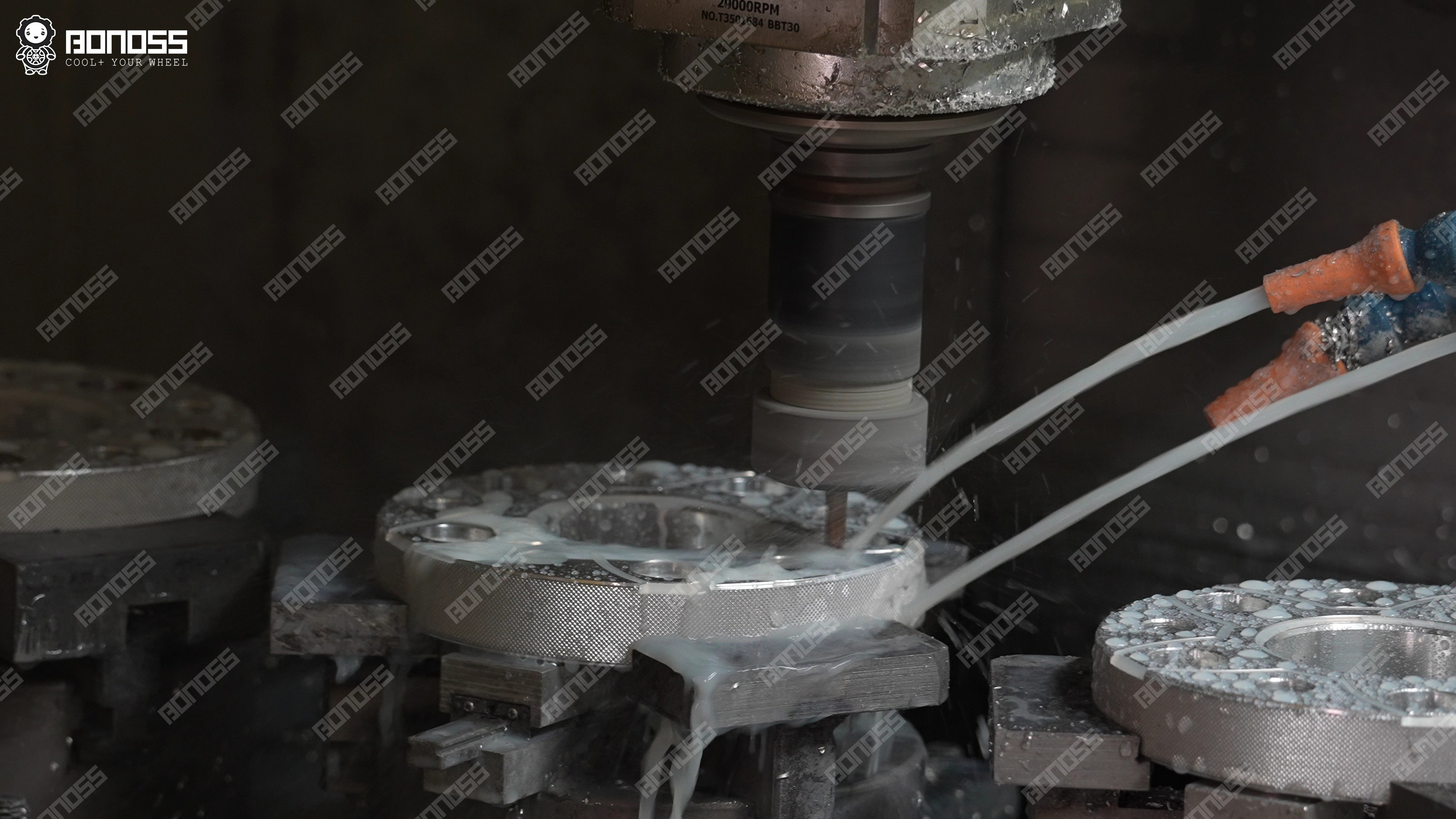
Tolerances you can measure. CNC machining holds mating surfaces within 0.02mm — runout you’d need a dial indicator to find:
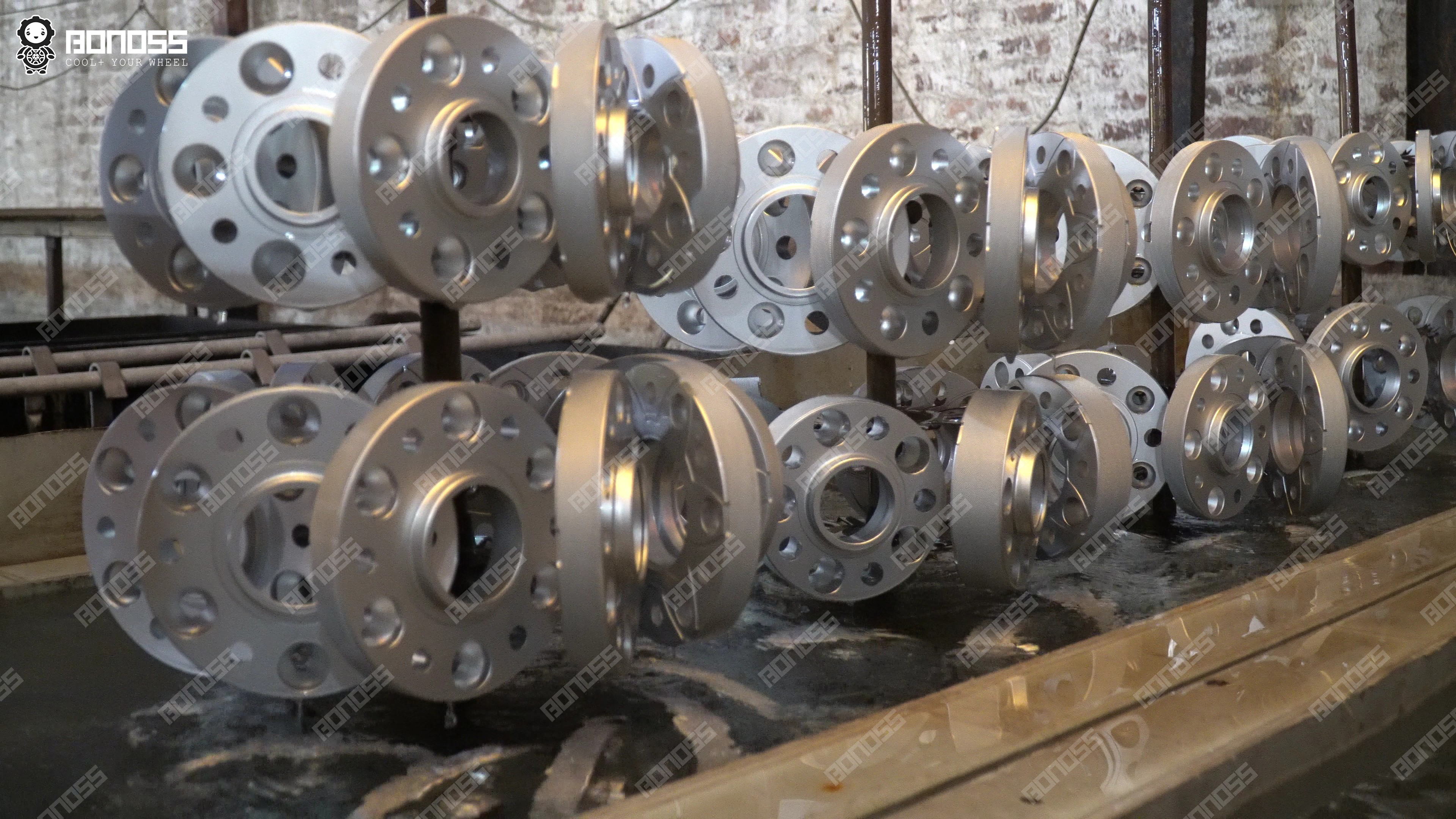
A finish that survives salt. The hard-anodized oxidation treatment is the layer behind the 240-hour salt spray result:
Every kit ships with the grade 12.9 studs and grade 10 nuts, engraved BONOSS markings for traceability, and a 10-year warranty. The 6061-T6 listing alone references more than 75 SGS and TÜV Rheinland test reports; current pricing is on the product pages. There’s also a gallery of real-world Tesla Model X installation photos.
FAQ — The Notice, in Plain English
What is the best wheel spacer size for a Tesla Model X?
Twenty millimeters is the most common answer for a flush fitment on factory wheels, with 15–25mm the working window depending on variant and offset. ET35 Performance and Plaid wheels typically take 20–25mm to reach flush; ET40 packages usually land at 15–20mm. The best wheel spacers for a Tesla Model X are still sized from a fender-gap measurement, not a chart.
Is 20mm safe on the front of a Model X?
Yes, provided three conditions hold: the spacer is hub-centric with the correct 64.1mm ring, both torque steps are done to spec with a torque wrench, and the stud protrusion test passes. Twenty millimeters sits well inside the arch space of every variant, and it’s the most-installed size on the platform. On air-suspension cars, remember Jack Mode before lifting.
Do I need to trim the factory studs for 15mm spacers on a Model X?
Sometimes — that’s the honest answer, and the stud protrusion test settles it. If the wheel’s pocket depth plus 15mm is greater than the stud protrusion, no trimming. Many factory wheels have pockets deep enough to clear; some don’t. Measure both numbers before ordering, because the fix for a failed test is a 20mm spacer, not a hacksaw.
What bolt pattern and torque apply to Model X wheel spacers?
The bolt pattern is 5×120 with a 64.1mm center bore and M14x1.5 threads. Torque is 140 Nm (103.5 ft-lb) for the BONOSS hardware fastening the spacer, per BONOSS installation instructions, and 175 Nm (129 ft-lb) for the factory nuts fastening the wheel, per the owner’s manual.
Do Model 3 spacers fit a Model X?
No. The Model 3 and Model Y use a 5×114.3 bolt pattern — a different bolt circle from the Model X’s 5×120. Nothing physically indexes. Buy parts listed for the Model X specifically.
Is 7075-T6 better than 6061-T6 for Model X spacers?
It’s harder — 146 versus 101–103 on the Brinell scale under the same test method — but “better” depends on the driver. Daily commuting on paved roads: 6061-T6 is more than sufficient. Frequent hard driving, launches, or track use: 7075-T6’s extra margin is worth the money.
Conclusion — What to Order
The Model X is one of the easiest platforms on the road to space correctly. Nine years, two generations, one set of hardware: 5×120, 64.1mm hub-centric, M14x1.5. The work is in the measuring — fender gap per corner, stud protrusion, pocket depth — and in respecting the two torque values that keep everything attached. Do that, and 20mm changes the stance without touching anything else.
If you’re ready to buy Tesla Model X wheel spacers, the quality Tesla Model X spacers in this guide are the BONOSS forged active cooling line — 10-year warranty, lab-verified hardware, sizes for every trim from 2015 to 2027.

About Daisy Harris
Daisy Harris has worked for 6 years at BONOSS as an automotive technician, installing and testing wheel spacers, wheel nuts, and wheel bolts. She has personally installed and verified more than 200 wheel-spacer setups across sport sedans, SUVs, and EVs. Her installation guides and reviews are built on real installs, measured clearances, and long-term wear notes — not on spec sheets.