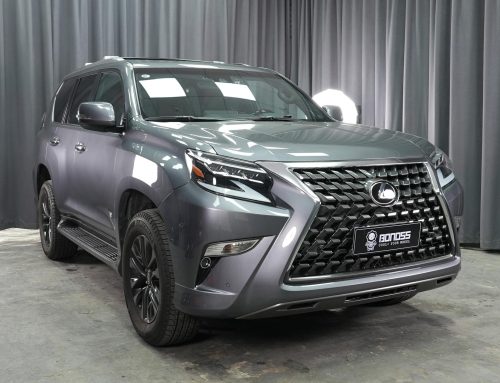
The short version: 2023 Tesla Model 3 18mm wheel spacers worked on this car because they were fitted only where the measurements supported them—the rear axle. Mr. Thomas wanted a flush stance without replacing his original wheels. The front wheels were already close to the fenders, so adding the usual spacer there would have been a mistake.
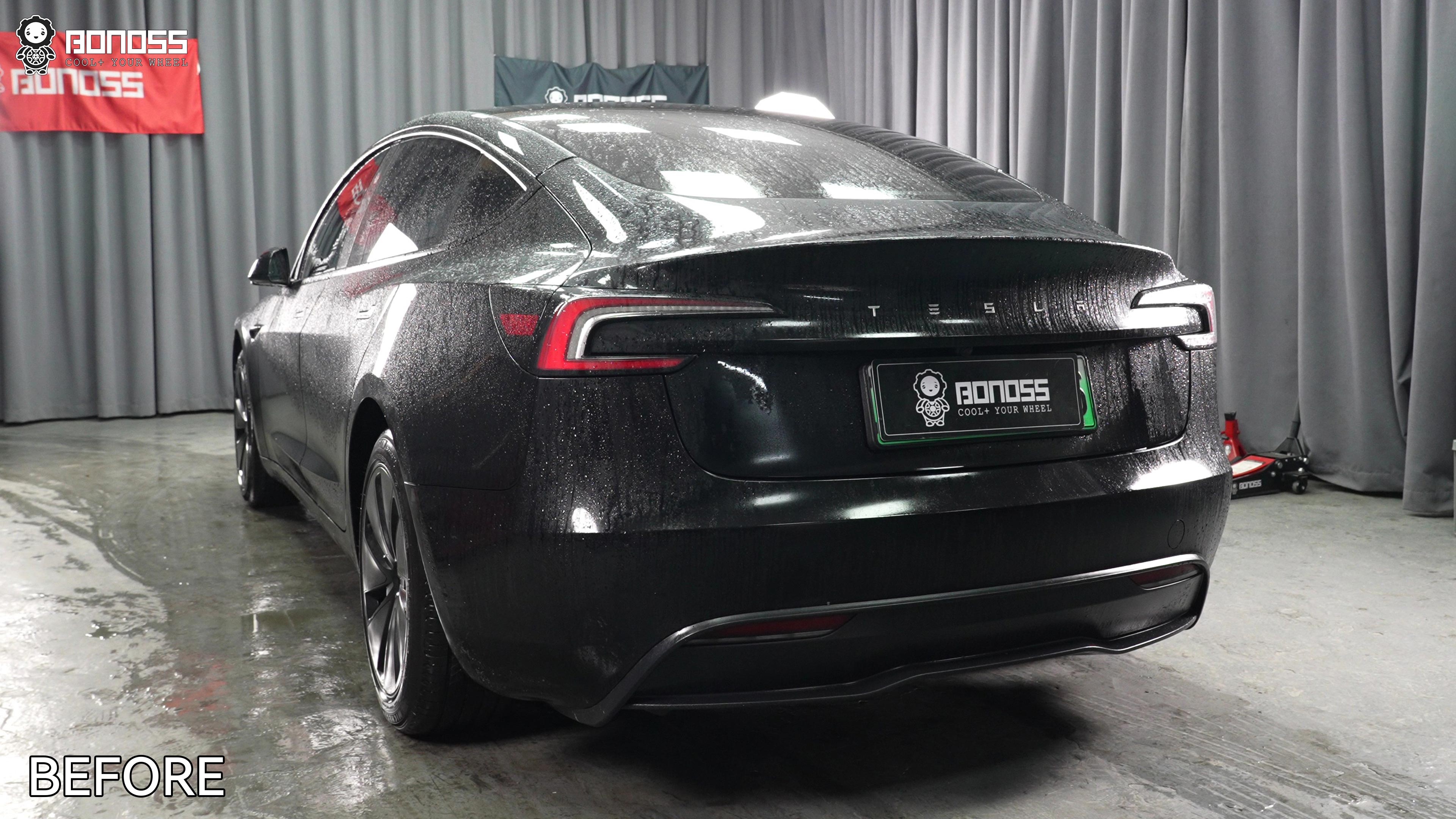
His Highland-generation 2023 Model 3 RWD remained otherwise stock. BONOSS measured the car and wheels, installed two 18 mm rear spacers on May 7, 2024, and later recorded his feedback after 25,000 miles. This is not a universal thickness prescription. It is a documented example of why measuring one actual car beats copying a forum setup.
| Item | This 2023 Tesla Model 3 RWD |
|---|---|
| Platform | Highland generation |
| Wheels and tires | Stock 18-inch wheels; 235/45ZR18 tires |
| Stock wheel offset | ET+38 mm |
| Rear spacer thickness | 18 mm |
| Effective rear offset calculation | ET+38 − 18 mm = ET+20 |
| Bolt pattern | 5×114.3 mm |
| Vehicle thread specification | M14x1.5 |
| Nominal spacer hub bore | 64.1 mm |
| Spacer material | Forged 6061-T6 aluminum |
| Spacer-to-hub fastening | 140 Nm (103.5 ft-lb) with BONOSS-supplied nuts, per BONOSS installation instructions |
| Wheel-to-spacer fastening | 175 Nm (129 ft-lb) with original equipment nuts, per the owner’s manual |
| Factory nut seat | Conical seat |
The two torque rows describe different joints. Use ONE torque value for each fastening step; do not mix the specifications. Both values are acceptable only for their designated hardware: BONOSS nuts securing the spacer to the hub use the BONOSS value, while original nuts securing the wheel to the spacer use the owner’s-manual value.
For readers checking hardware rather than looking for an owner story, the 5×114.3 hubcentric wheel spacers for Tesla Model 3 product page carries the component specifications. Here, the more useful question is why this particular car received nothing on the front axle.
Model 3 18mm Spacers for Flush Fender Fitment: Why the Front Stayed Stock
Older Model 3 owners often use front spacers to correct a visibly recessed wheel. That experience does not transfer cleanly to every Highland car. On Mr. Thomas’s vehicle, the our workshop’s high-accuracy ruler check showed that the front was already nearly flush.
The rear check produced the actionable number: 18 mm. A spacer on each rear wheel moves that wheel outward by 18 mm, increasing rear track width by 36 mm in total. It does not change the front track, and it does not alter the physical offset stamped into the original wheel.
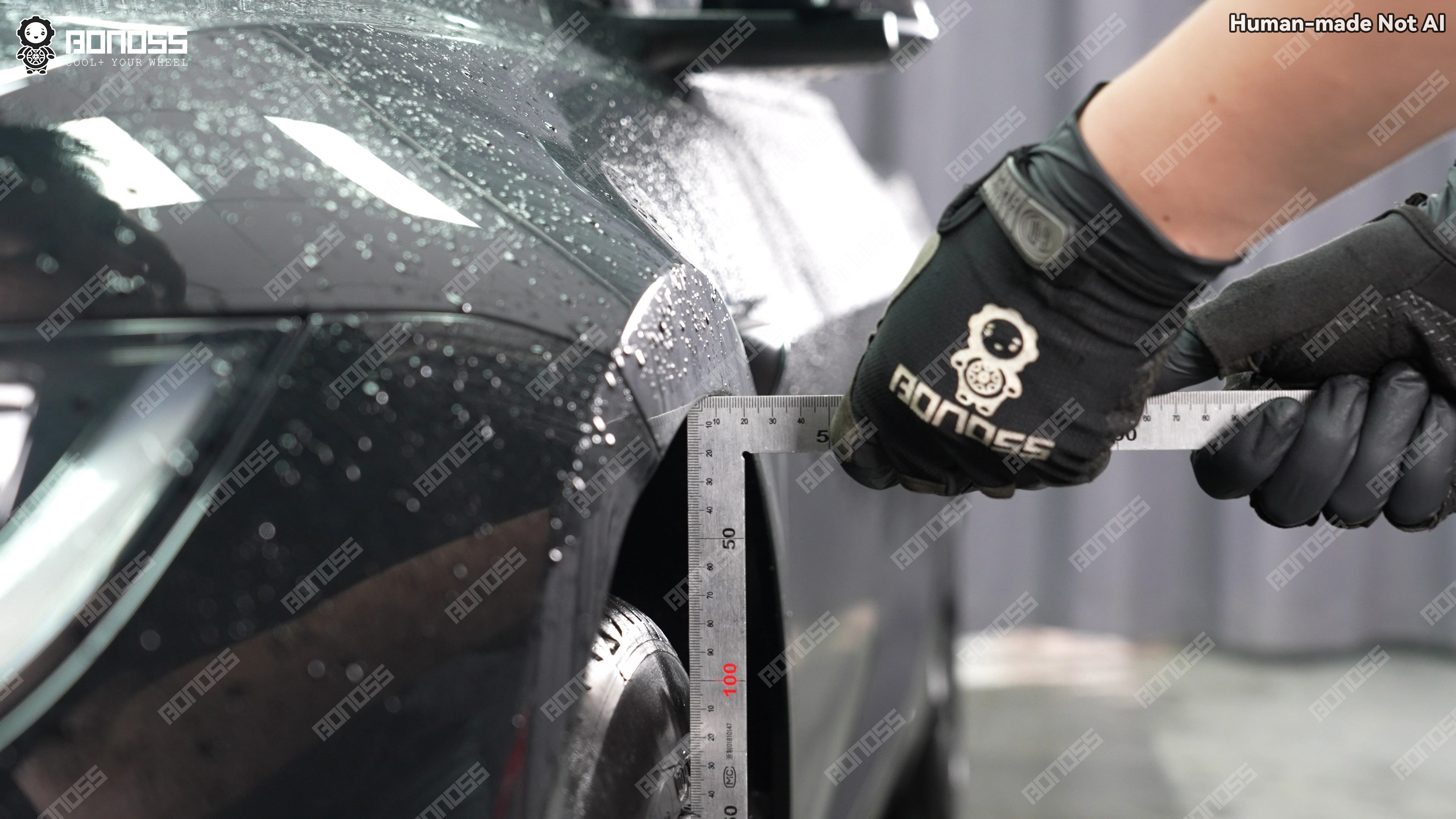
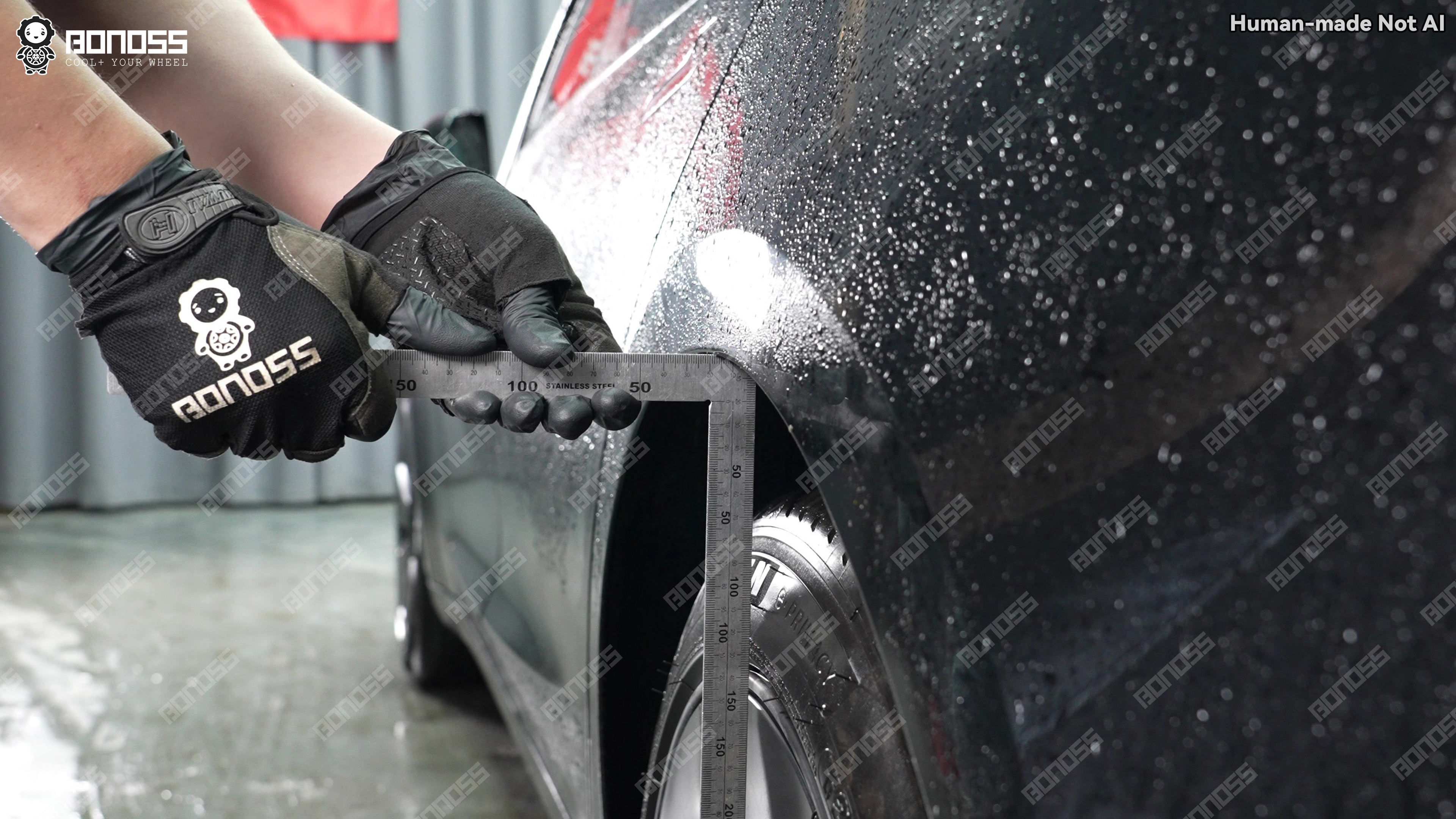
Our preference here is unusually simple: leave the front alone. A roughly 8 mm front spacer would be the more sensible starting point only if an owner insisted on fine-tuning the last bit of inset. Putting 15 mm on this already nearly flush front axle would push the wheel farther out than the older-car setups people often copy. “More aggressive” is not automatically better; sometimes it just means you failed to measure.
What ET38 to ET20 Actually Means
The rear calculation is straightforward: ET+38 mm minus an 18 mm spacer gives an effective ET+20. That is a fitment calculation, not a new manufactured wheel offset. It explains the outward movement without pretending that the original wheel changed.
For a fuller explanation of offset, thickness selection, and clearance, use the Tesla Model 3 wheel offset and spacer thickness guide. This case supplies the missing real-world context: a measured Highland front end, an 18 mm rear correction, and a satisfied owner rather than a theoretical fitment chart.
Tesla Model 3 18mm Spacers Before and After
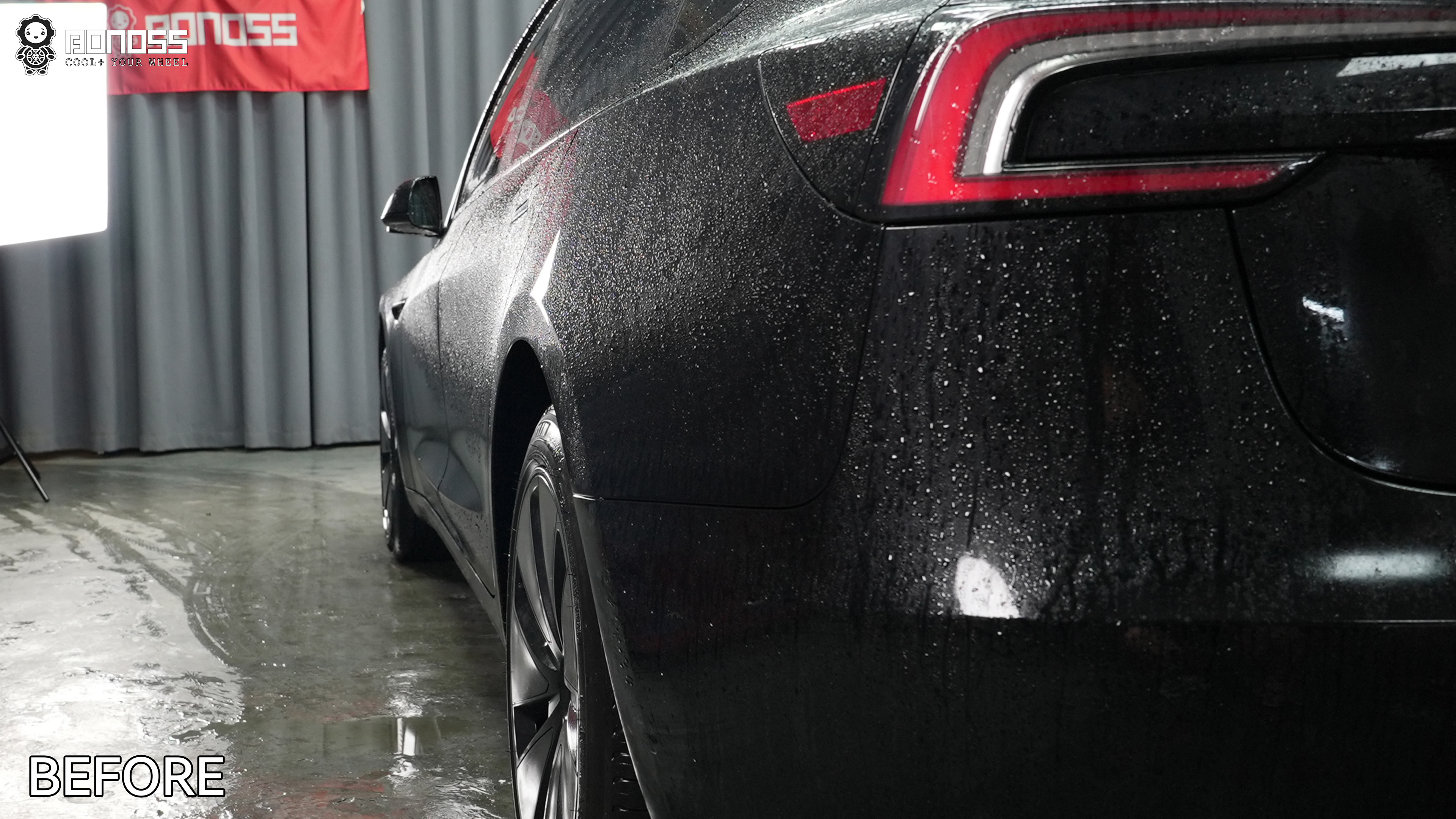
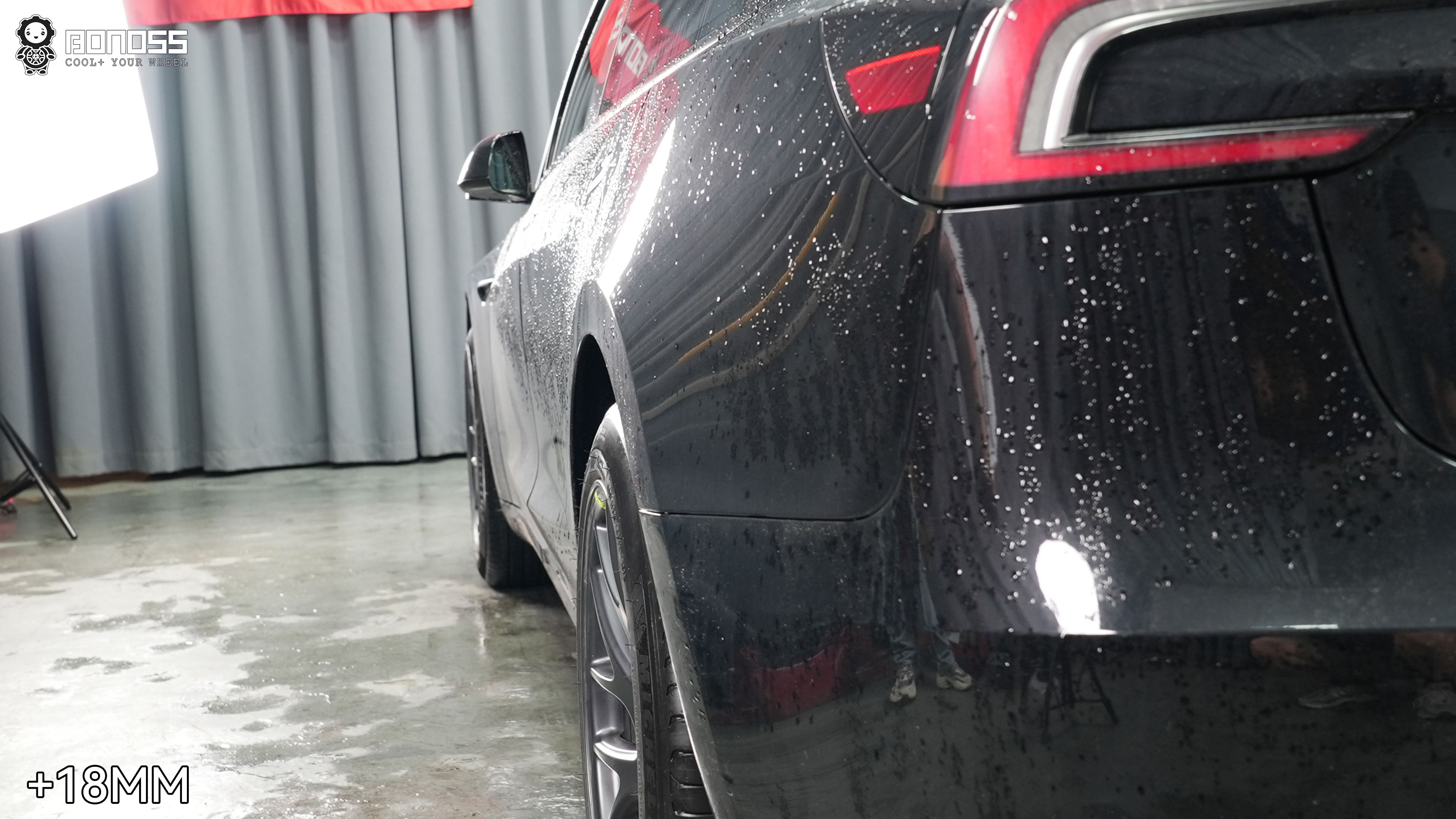
The left-rear photographs compare the same corner before and after installation. The change is easiest to read at the tire-and-fender relationship, not by staring at the spacer itself. After installation, the rear wheel sits farther outward and visually aligns with the fender opening.
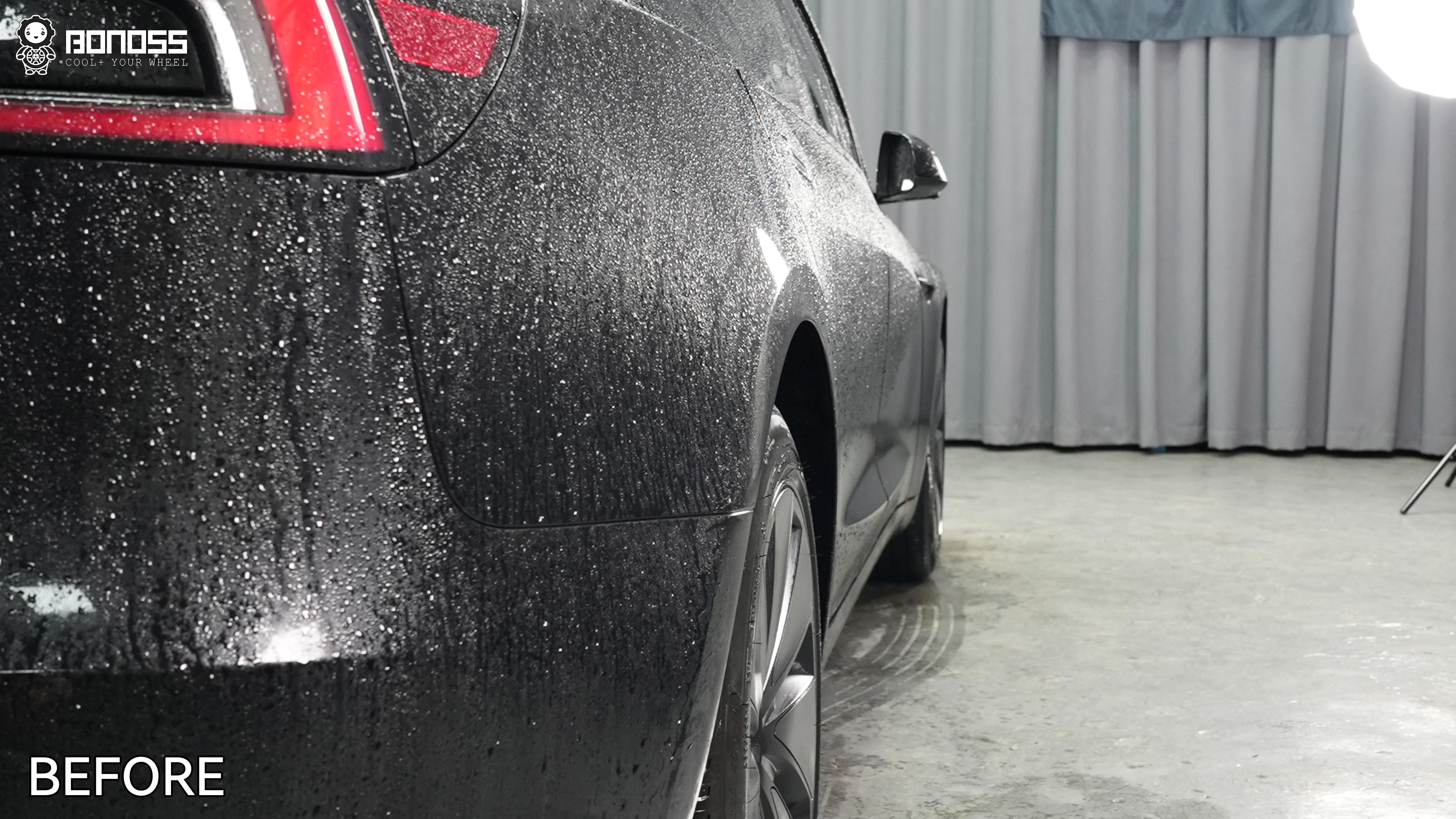
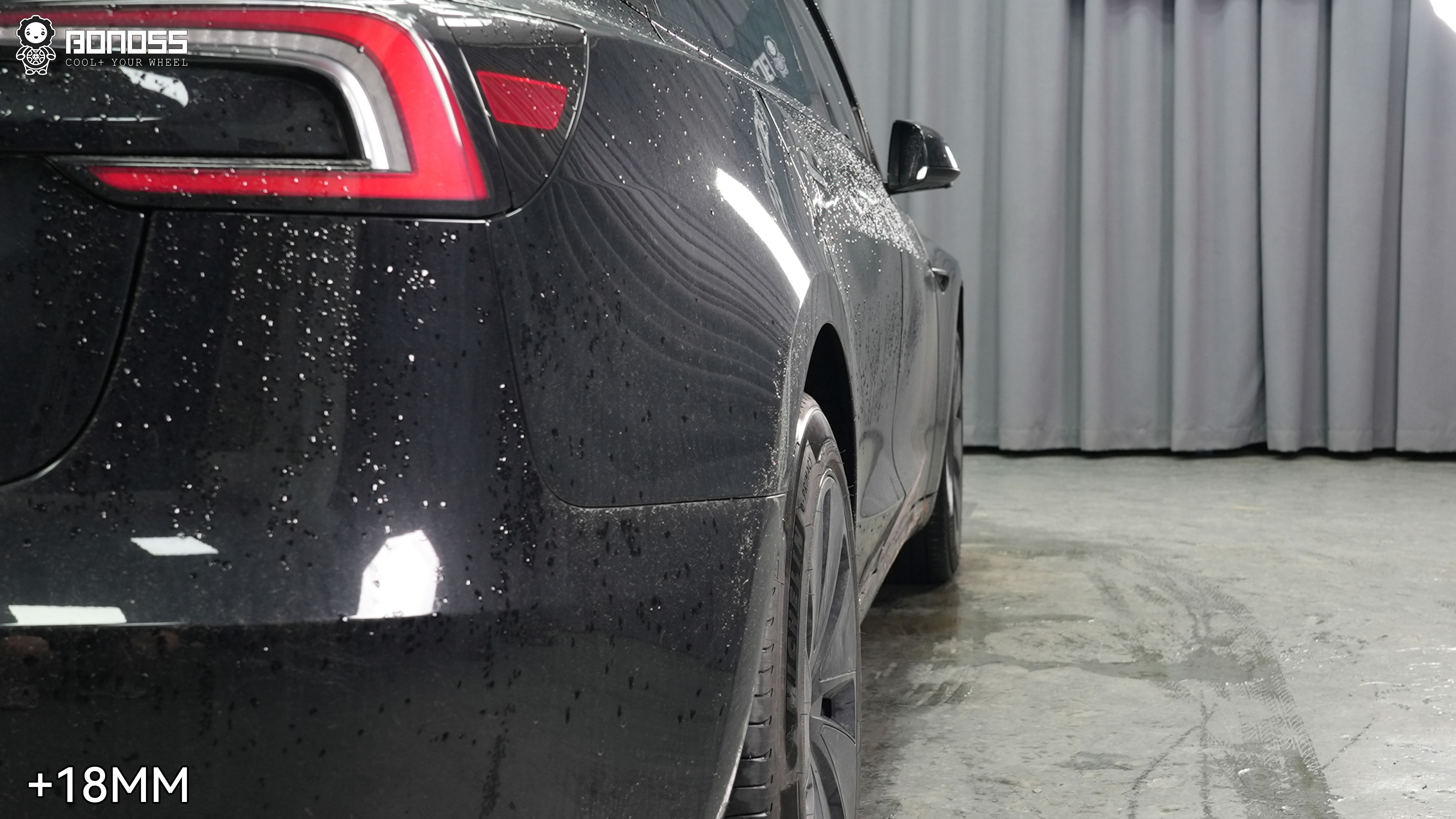
The right-rear pair confirms that the modification was not limited to one display side of the car. Both rear wheels received the same 18 mm thickness, while the original 235/45ZR18 tires and ET38 wheels remained in service.
Mr. Thomas’s reaction was direct: “Car looks perfect now, love the flush stance.” That is an aesthetic result, and it is exactly what he asked for.
2023 Tesla Model 3 Hubcentric Wheel Spacers: Measuring Two Different Fits
A bolt-on spacer has to locate against the vehicle on one side and the wheel on the other. Treating those interfaces as one generic “64 mm fit” hides the useful detail. The workshop measured them separately with a vernier caliper and micrometer.
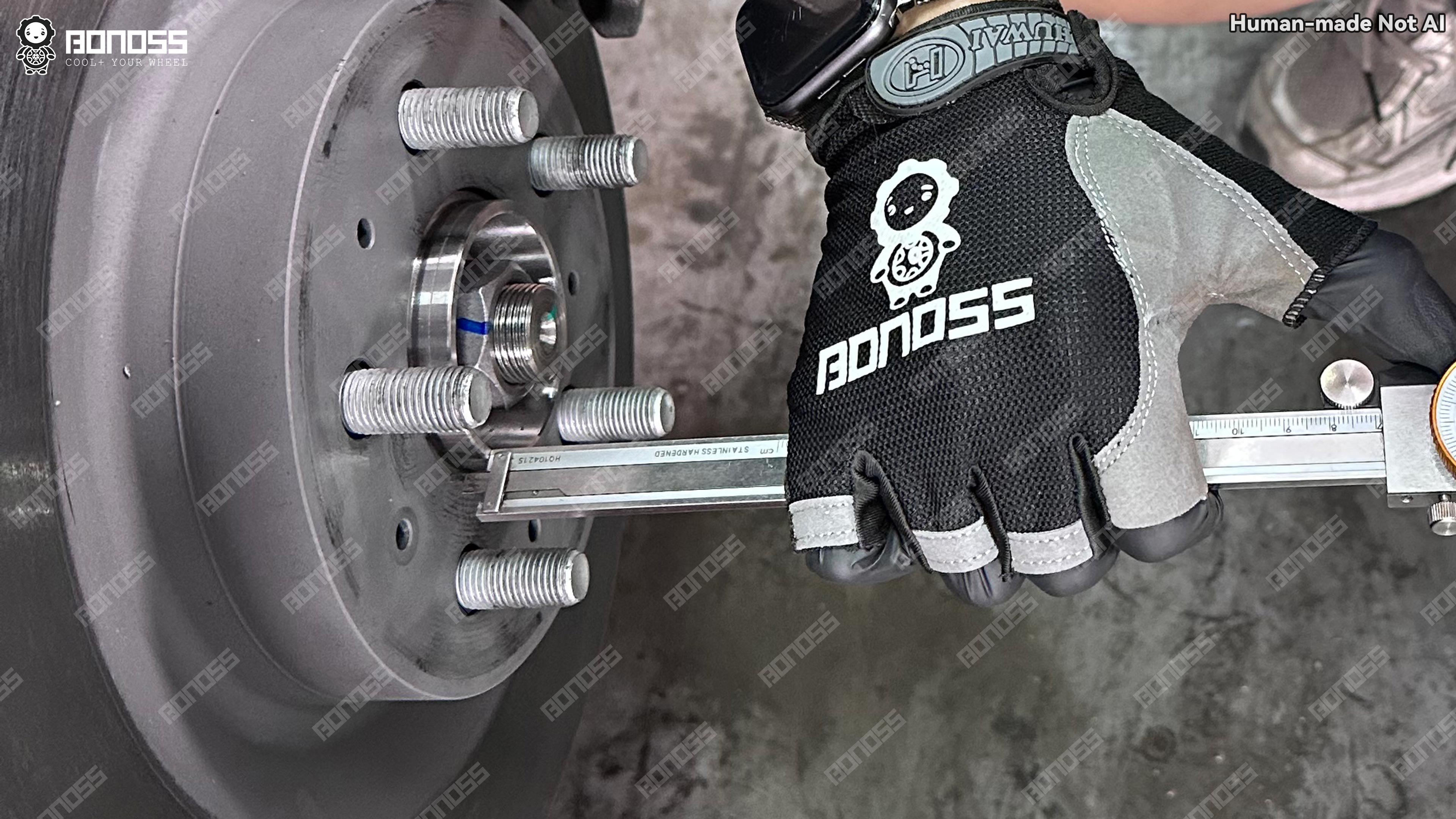
The vehicle’s hub lip measured 8.36 mm high. That dimension matters because the spacer must sit correctly over the existing hub geometry rather than merely clearing the wheel studs.
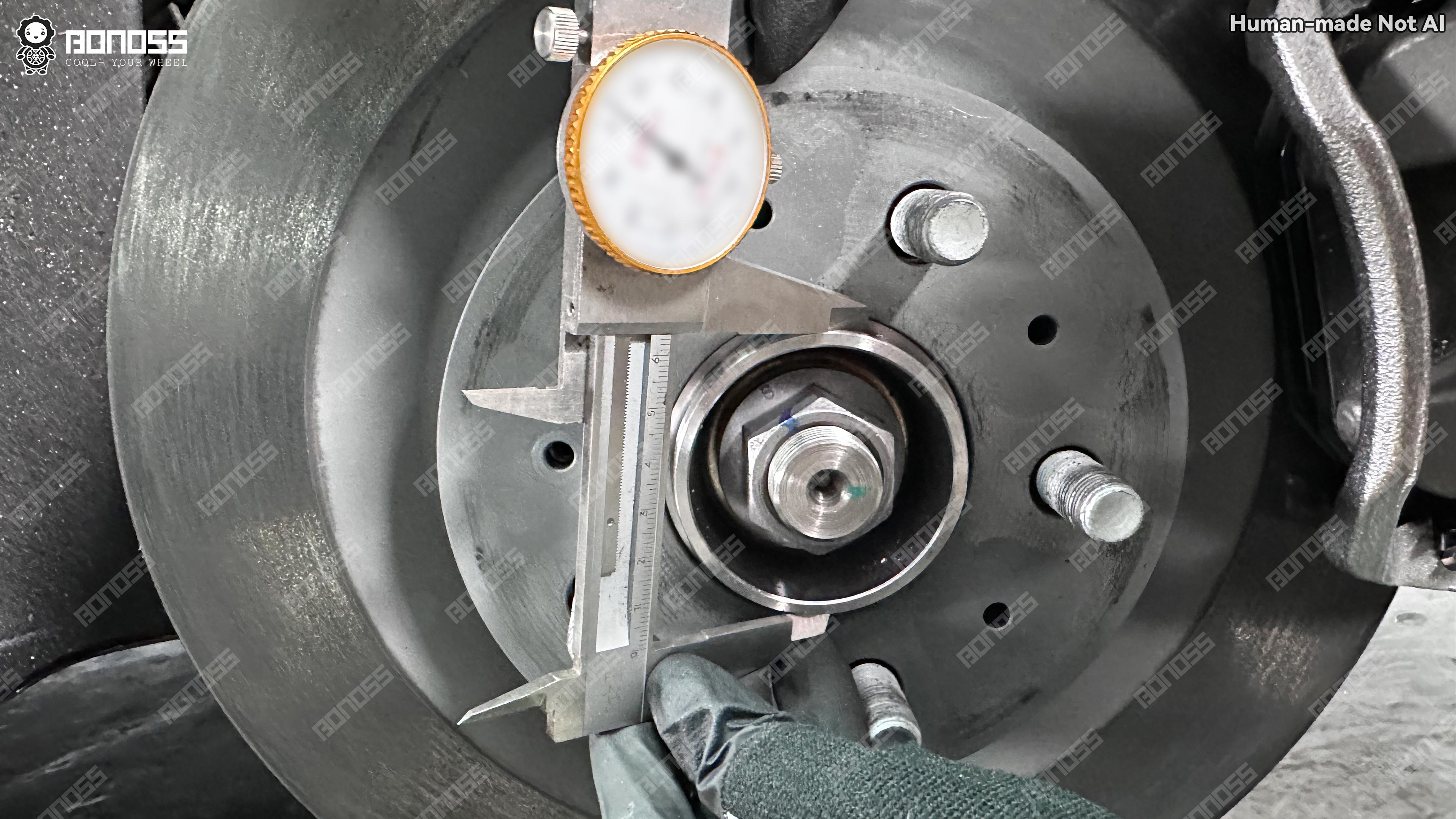
The original hub’s measured outside diameter was 64.05 mm. This is the vehicle-side locating dimension recorded on this car, not a rounded catalog label.
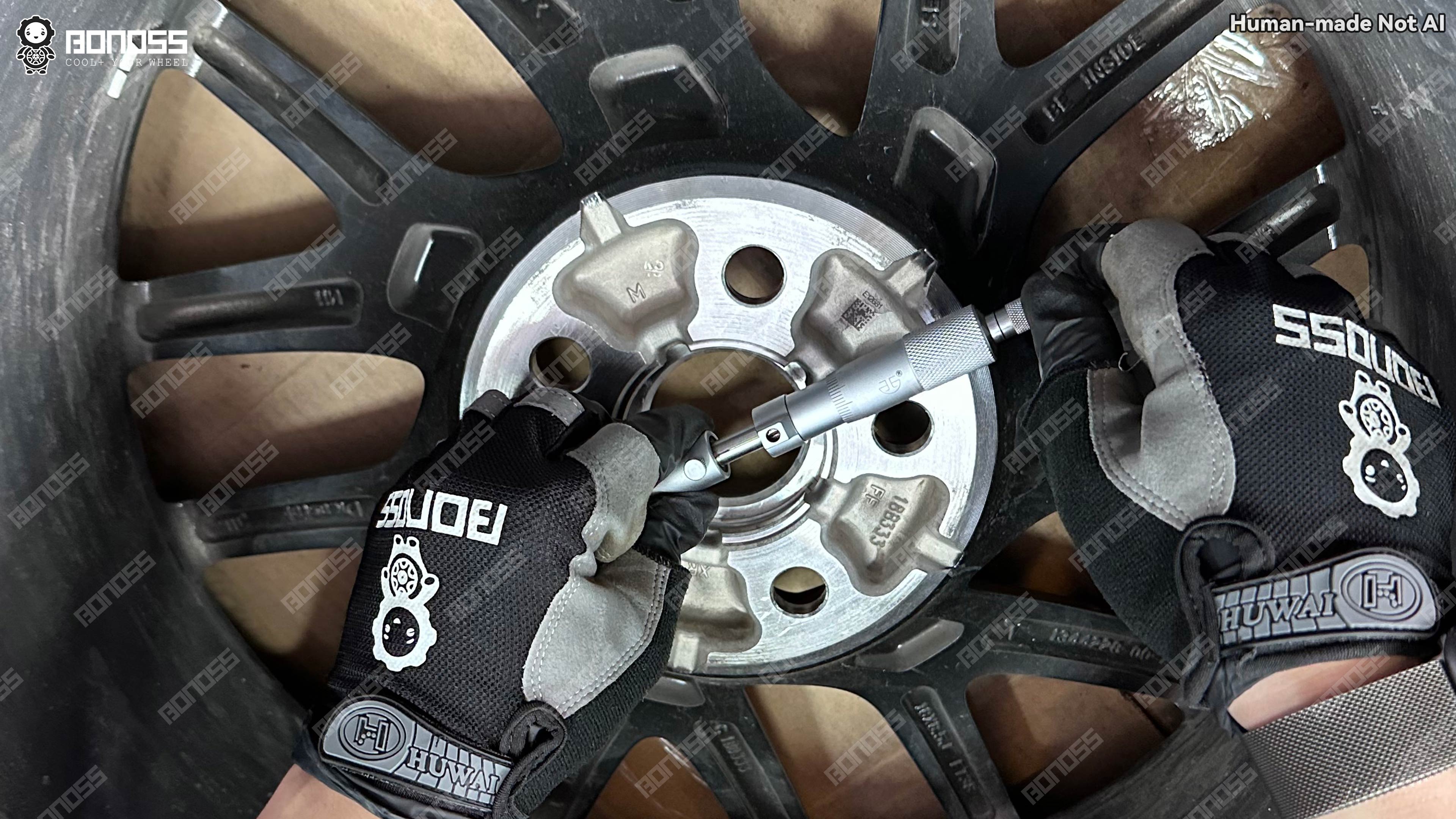
The original wheel’s center bore measured 64.18 mm with a micrometer. Already, the two original components tell us something important: the wheel bore was 0.13 mm larger in diameter than the measured hub. Factory fitment therefore did not mean literal zero diametral clearance.
Why 64.05, 64.1, and 64.18 mm Are Not Contradictions
These numbers describe different mating surfaces. The BONOSS spacer uses a multi-stage internal structure to match the 64.05 mm vehicle-side hub. Its wheel-side locating outside diameter is 64.1 mm, paired here with the measured 64.18 mm wheel bore.
That creates a calculated diametral clearance of 0.08 mm, or 0.04 mm per side when centered. It is tighter than the 0.13 mm original wheel-to-hub diametral difference, but the point is not a contest for the smallest number. The point is controlled location on both sides of the spacer.
BONOSS specifies CNC machining at the 0.02 mm level for these components. That manufacturing requirement matters because a spacer cannot simply be bored to one nominal diameter and expected to manage both interfaces. For broader checks and installation principles, the Tesla Model 3 wheel spacer safety and fitment guide is the appropriate reference. The measurements above belong specifically to Mr. Thomas’s car and original wheel set.
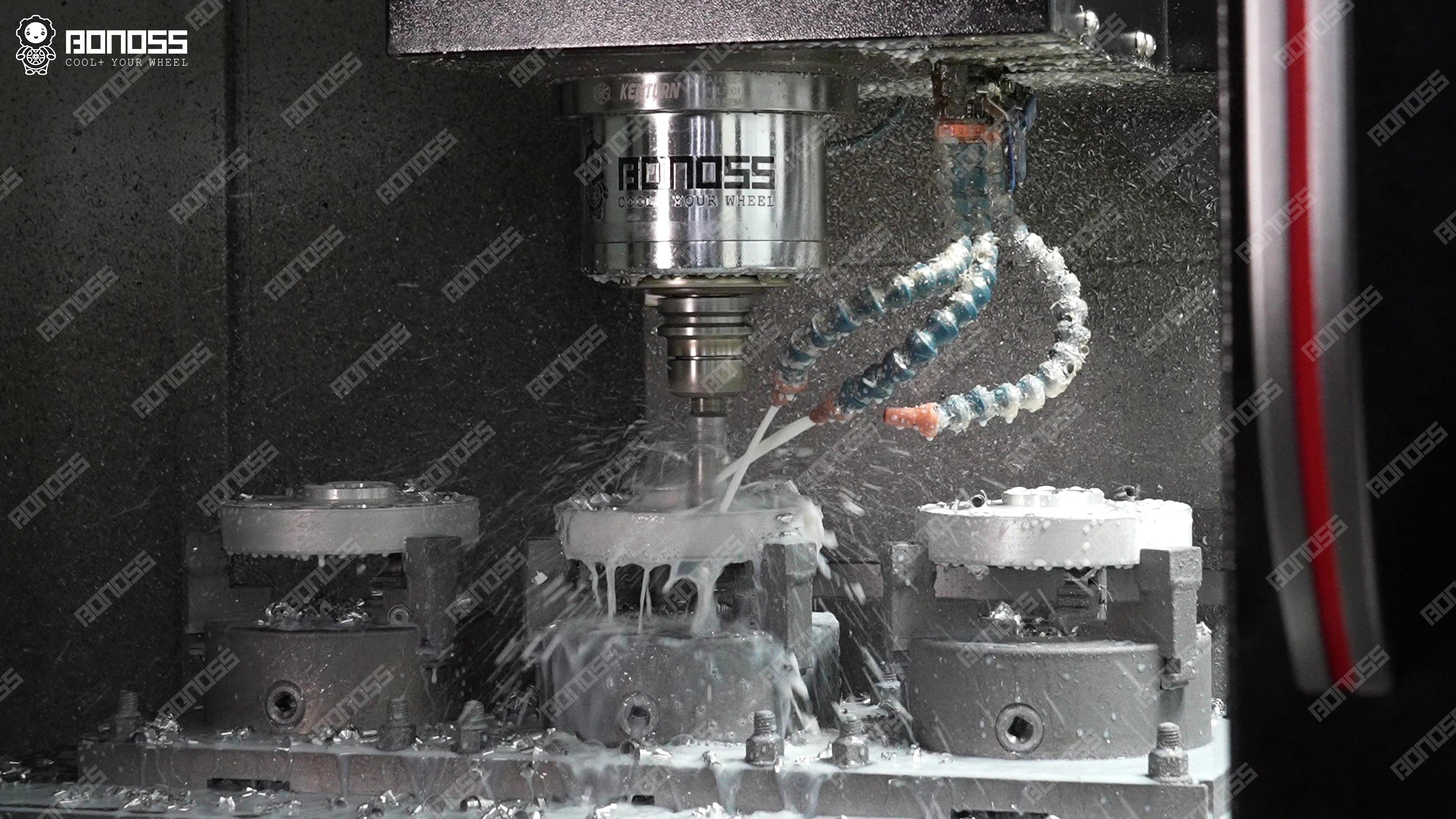
CNC 0.02mm machining in BONOSS factory
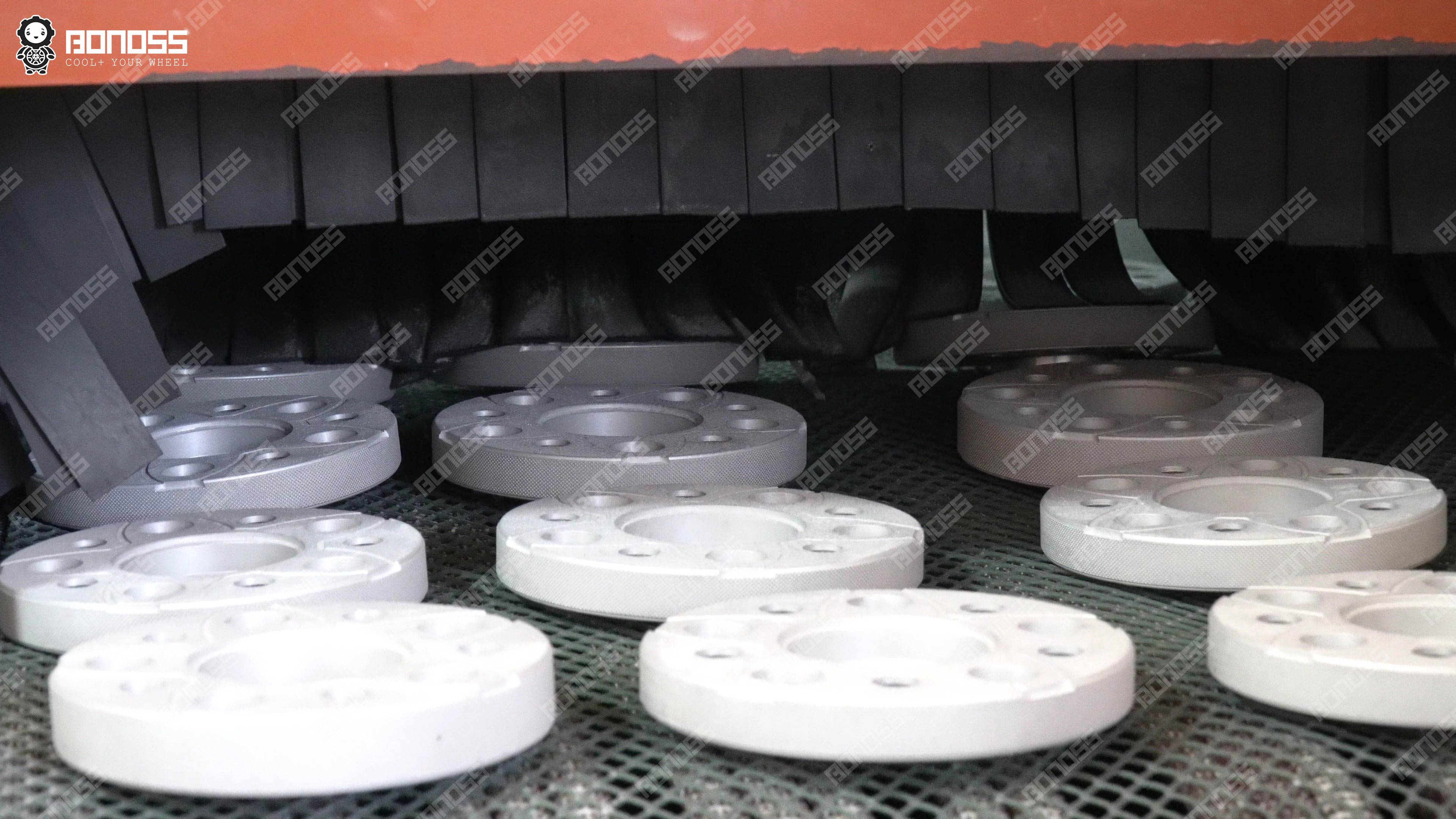
Oxidation process in BONOSS factory
Stud Length, Wheel Pockets, and the No-Cutting Result
The factory stud projection measured 26.13 mm. The wheel pockets measured 16.23 mm deep. Those two numbers, together with spacer thickness, answer the trimming question far better than a generic “18 mm usually works.”
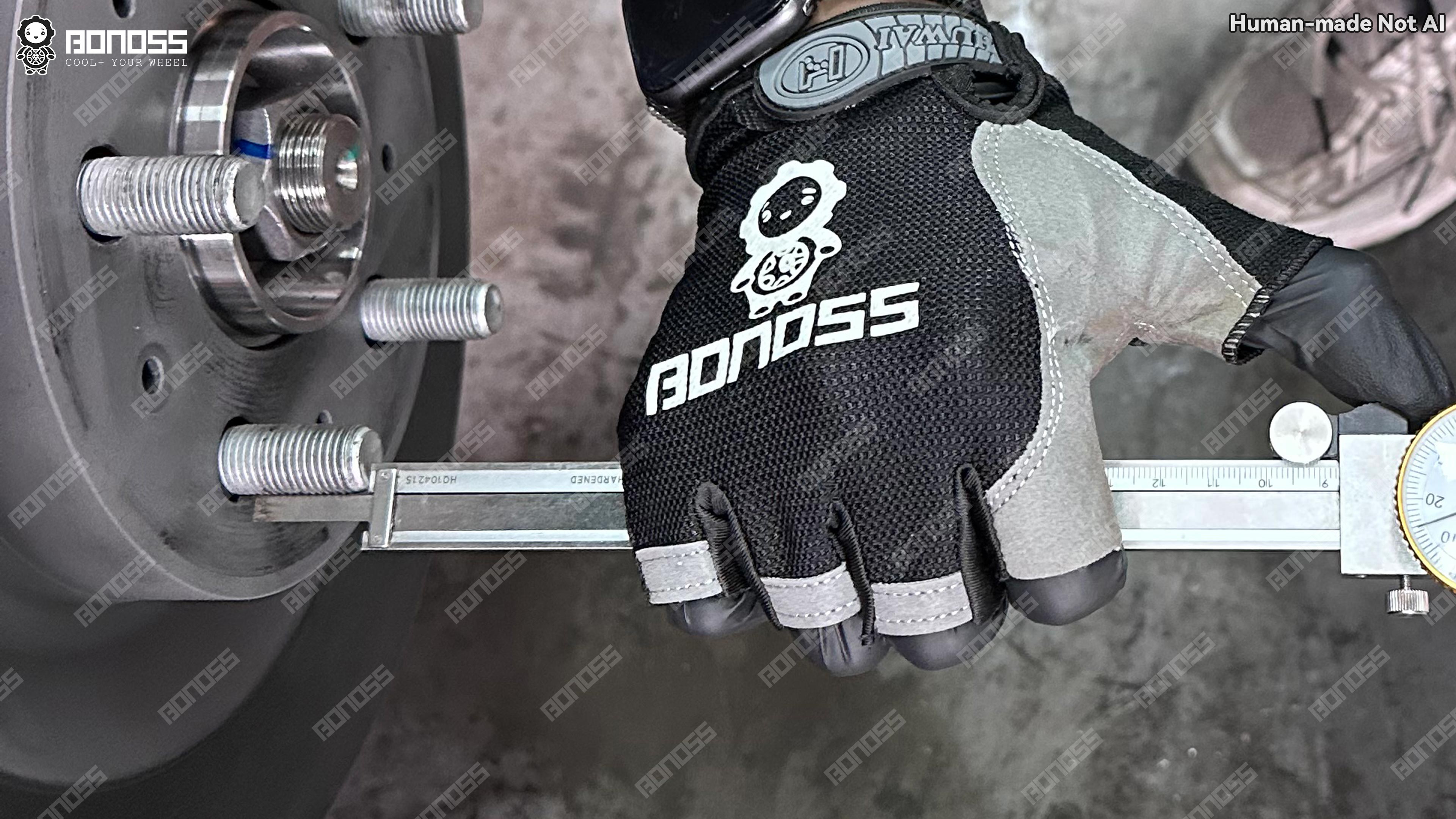
With an 18 mm spacer, the calculated stud projection beyond the spacer is 26.13 − 18 = 8.13 mm. The measured 16.23 mm pocket therefore provides 8.10 mm of calculated depth margin. With a 15 mm spacer, the remaining projection would be 11.13 mm, still below the pocket depth by 5.10 mm.
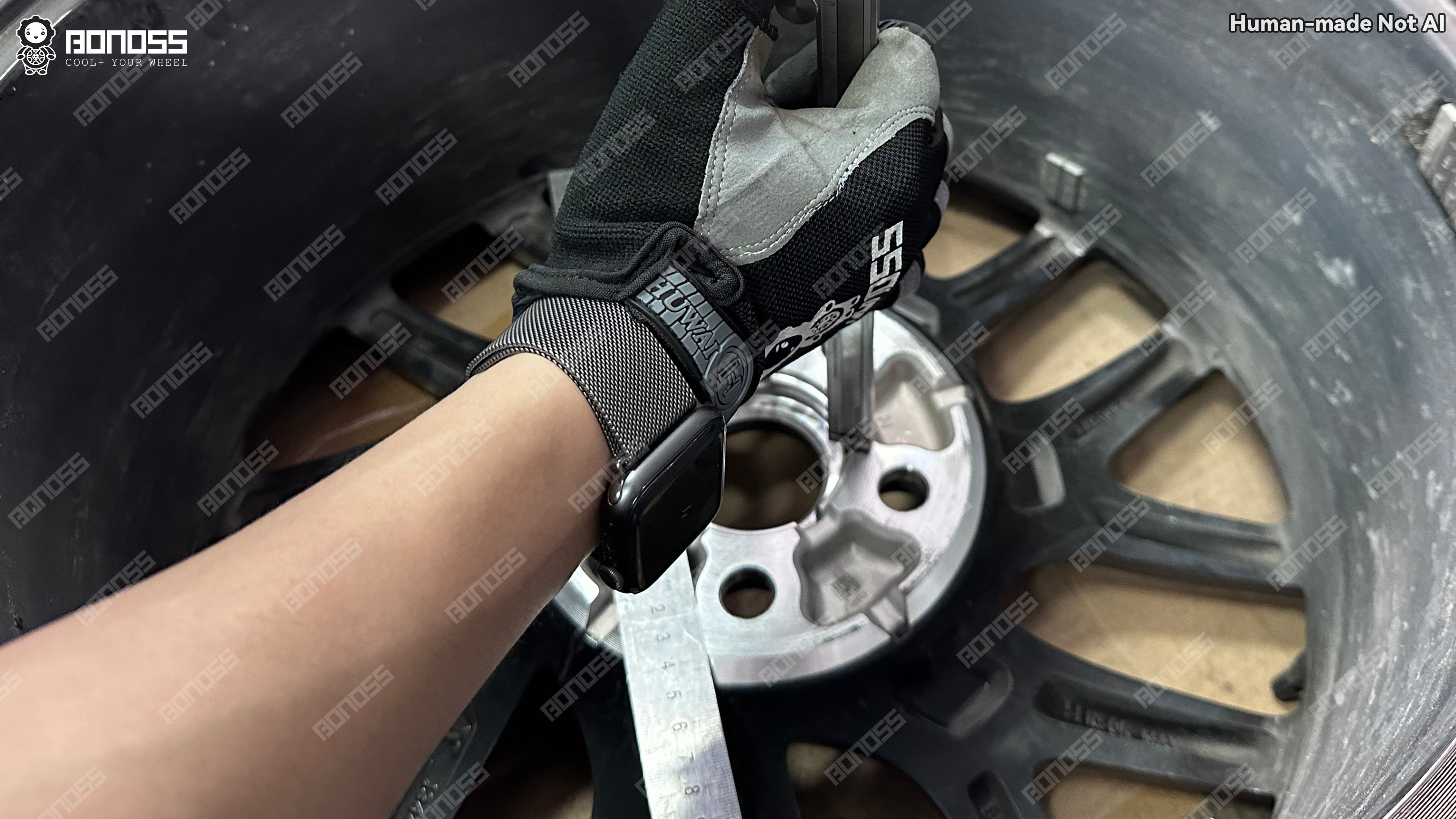
For this original wheel, neither 18 mm nor 15 mm requires cutting the factory studs on the supplied measurements. That conclusion should not be exported to another wheel with shallower pockets or a different rear-face shape. Before installing Model 3 bolt-on wheel spacers, check the actual wheel pockets and stud projection.
Why 5×114.3 Alone Could Not Approve This Order
A bolt pattern answers one question: whether five mounting points follow the required 114.3 mm pitch circle. It says nothing about how the spacer locates on the hub, whether the original studs will interfere with the wheel, or which torque belongs to each fastener. A listing that matches only 5×114.3 wheel spacers Tesla Model 3 is therefore a starting filter, not a fitment verdict.
This order passed through several separate checks. The PCD and M14x1.5 thread specification established hardware compatibility. The 8.36 mm hub-lip measurement documented the vehicle’s locating geometry. The 64.05 mm hub and 64.18 mm wheel bore defined two different centering interfaces. Finally, the 26.13 mm stud projection and 16.23 mm wheel pockets determined whether the original studs could remain untouched.
Each check removes a different assumption. Skipping one and compensating with a familiar thickness is how a supposedly simple modification turns into guesswork. No numerical brake-caliper clearance measurement was supplied for this job, so we also will not attach a clearance figure to that part of the assembly.
The Decision in One Measurement Chain
| Question | Case evidence | Resulting decision |
|---|---|---|
| Does the front need correction? | Ruler inspection found it nearly flush | Leave the front stock |
| How much rear movement was required? | Rear measurement indicated 18 mm | Fit one 18 mm spacer per rear side |
| Can the spacer locate on both interfaces? | 64.05 mm hub; 64.1 mm spacer outside diameter; 64.18 mm wheel bore | Use the multi-stage hub-centric design |
| Can the factory studs remain? | 26.13 mm projection; 16.23 mm pockets | No trimming for this wheel at 18 mm |
| Which torque applies? | BONOSS nuts and original nuts serve different joints | 140 Nm and 175 Nm respectively, from their separate sources |
The value of the 64.1mm hub bore spacers Model 3 specification is not that one number magically describes the whole installation. Its value appears only when the surrounding measurements agree.
Installation: One Rear Pair, Two Distinct Torque Steps
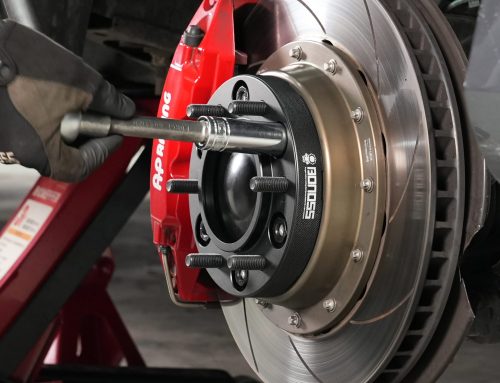
At the spacer-to-hub joint, the BONOSS-supplied M14x1.5 nuts are tightened to 140 Nm (103.5 ft-lb), per BONOSS installation instructions. At the wheel-to-spacer joint, the original conical-seat nuts use 175 Nm (129 ft-lb), per the owner’s manual. Those values are not interchangeable.
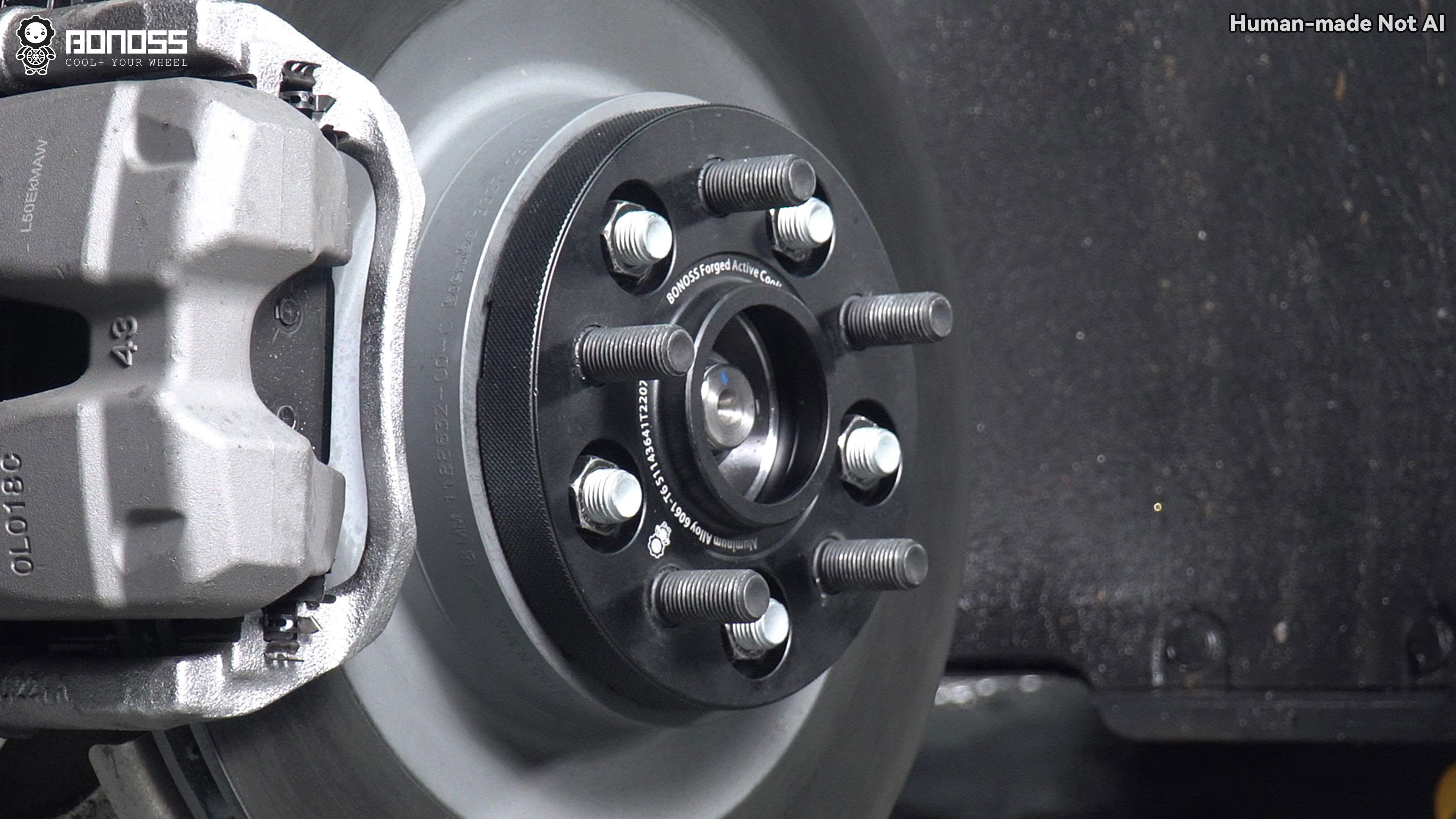
A correct installation also depends on clean, fully seated mating surfaces and compatible hardware. Follow the supplied instructions for inspection and any subsequent torque checks.
Active Cooling and Manufacturing Details, Without the Sales Fog
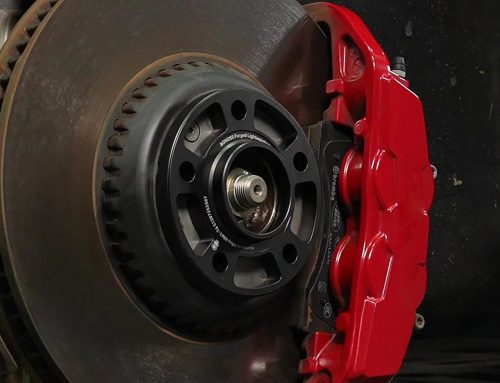
The installed product was the BONOSS forged active cooling wheel spacers design in 6061-T6 aluminum. Three details are visible in the supplied material: active-cooling passages, side knurling, and the multi-stage hub-centric machining already discussed.
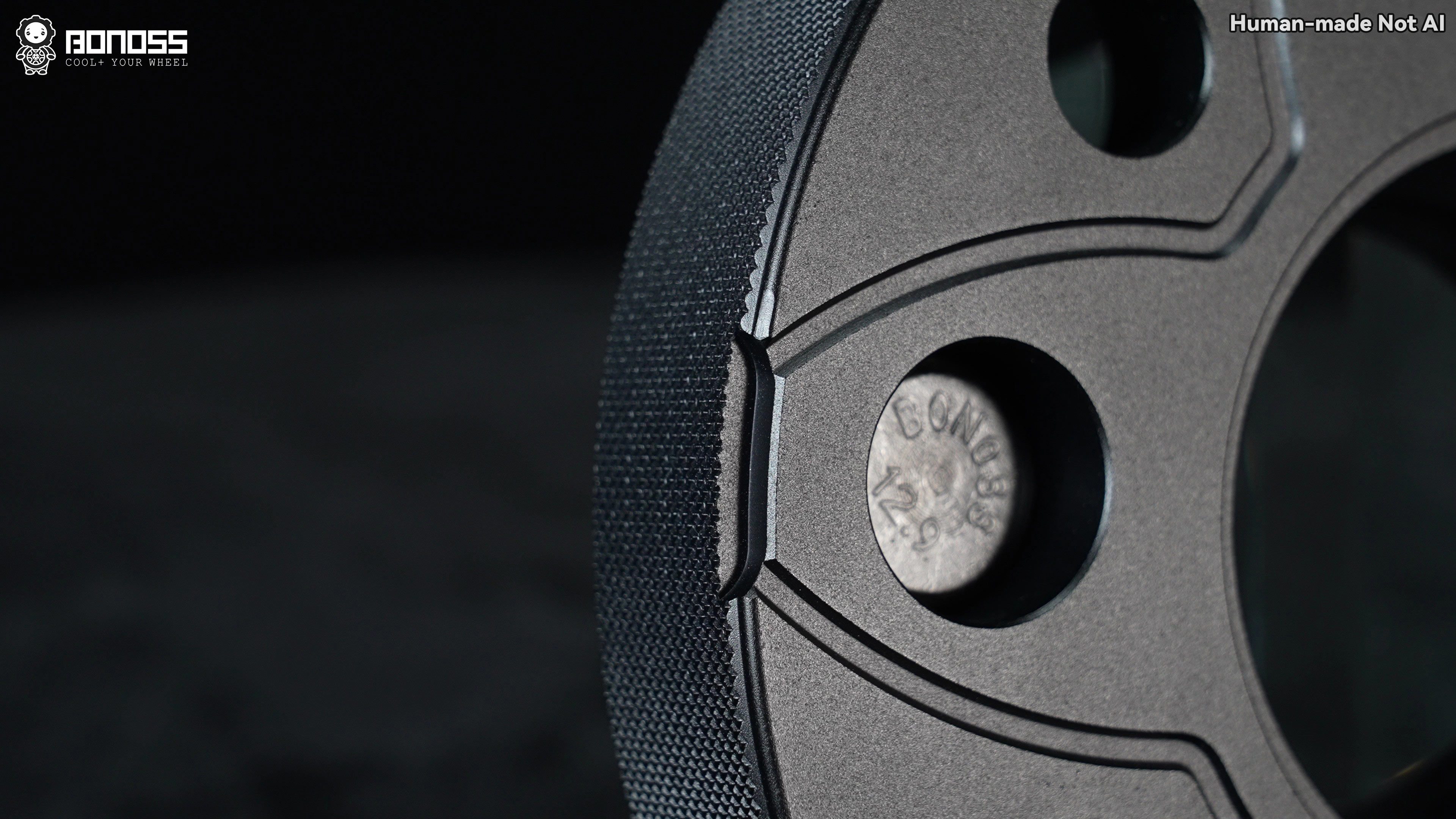
The active-cooling passages open pathways around the spacer body rather than leaving a visually solid disc. That is the design’s purpose.
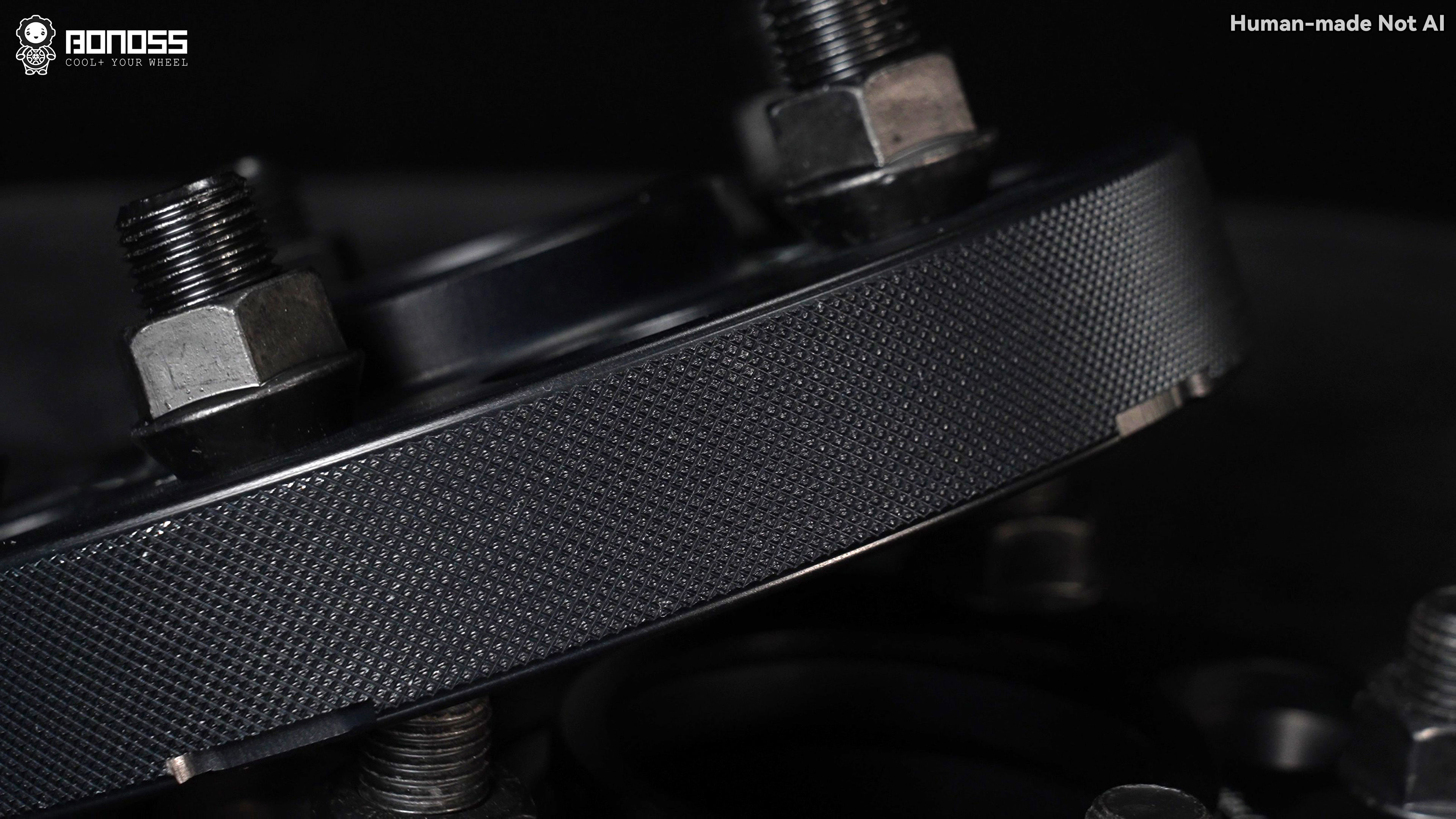
The side knurling gives the spacer edge a distinct machined texture.
What the Test Reports Actually Support
The reports provide more useful evidence than vague adjectives. For the 6061-T6 spacer material, TÜV reported hardness of 101–103 under ISO 6506-1:2014 in the hardness test report. A separate neutral salt-spray report records 240 hours of exposure with no defects under ISO 9227:2022+Amd 1:2024. That is a defined corrosion-test result, not a promise that every spacer will remain cosmetically unchanged forever.
For M14x1.5 ISO Grade 12.9 studs, SGS reported 1,268 MPa tensile strength under ISO 898-1:2013+Cor-1:2013, 391–401 HV10 hardness under ISO 6507-1:2018, and 121 kN proof load under ISO 898-1:2013+Cor-1:2013. The individual reports cover tensile strength, hardness, and proof load.
TÜV testing of its stud samples reported 1,233 MPa tensile strength and 386–390 HV10 hardness using the respective ISO methods in its tensile report and hardness report. Different laboratories, samples, and measurement variation can produce different readings. Quoting each result beside its own report is more honest than averaging them into a number that appears nowhere.
The ISO Grade 10 nuts are different components with different thread engagement and test methods. SGS reported 358–362 HV0.5 hardness under ISO 6507-1:2018 and 138.8 kN proof load under ISO 898-2:2012 in the nut hardness report and nut proof-load report. Their values should not be expected to match the studs. Even stud values can differ between thread specifications such as M14x1.5 and M14x1.25, so the applicable report matters.
25,000 Miles Later: The Owner’s Review
At follow-up, Mr. Thomas had driven 25,000 miles since the installation. His complete durability-related feedback was: “25k miles in and still solid—no complaints.” He also said, “Rides better too.” We are preserving those as owner impressions, not converting them into instrumented ride or endurance measurements.
His product-and-service comments were equally specific:
“Quality is way better than most online spacer shops. Their customer service was quick and friendly too—no hassle at all. Loved how fast they fixed the issue.”
The long-term value of this case is narrower and more credible than a blanket safety guarantee. This owner reported no complaints after 25,000 miles on a measured, rear-only installation. Correct results still depend on the vehicle, wheel, hardware, and installation quality.
That distinction matters when reading any wheel-spacer review. “No complaints” is useful evidence of this owner’s experience; it is not a vibration measurement, a metallurgical test, or proof that every road and wheel combination will behave identically. Conversely, dismissing the mileage because it is not a laboratory study would discard exactly the ownership evidence a case article should provide. The laboratory reports and the road report answer different questions, and both are stronger when kept in their own lanes.
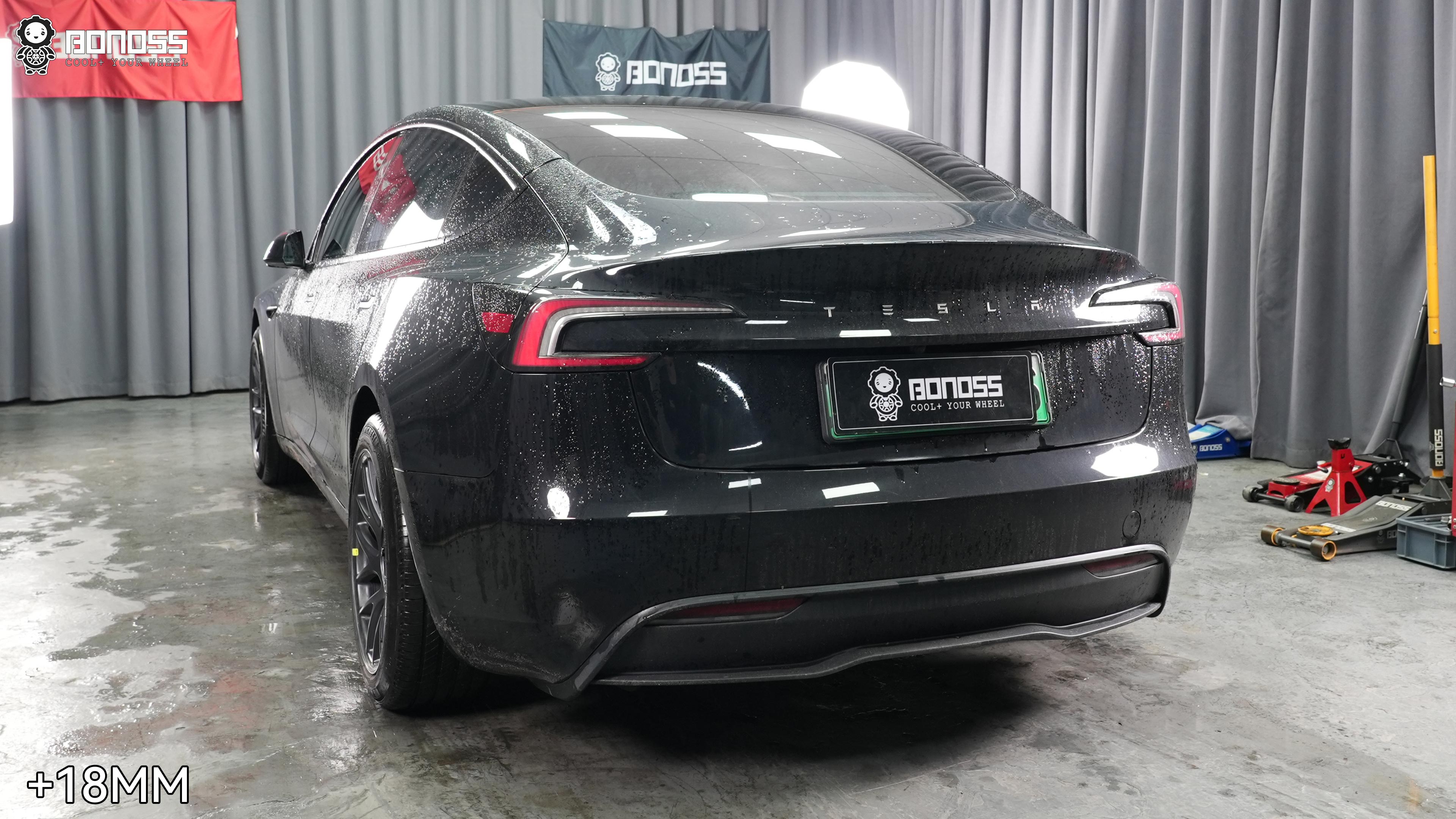
The final full-car photograph also shows why the owner considered the job complete. There was no need to chase a number at both axles after the requested rear stance had been achieved.
15mm vs. 18mm on This Highland Car
| Option | What this case supports |
|---|---|
| Approximately 8 mm front | A possible fine-tuning choice if the owner insists on reducing the small remaining front inset; not installed in this case |
| 15 mm front | Not recommended for this nearly flush Highland front axle because it would protrude more than common older-car setups |
| 15 mm rear | Stud-to-pocket arithmetic clears trimming for this wheel, but it would provide less outward movement than the selected 18 mm setup |
| 18 mm rear | The measured and installed choice for the requested flush rear stance |
The supplied price for two 18 mm 6061-T6 spacers was $125.99 with a $25 labor fee, totaling $150.99. That price reflects the fitment decision: one rear pair, not four spacers. What the case does show is that measurement determined the parts list before the purchase.
FAQ
Can you run Model 3 wheel spacers on the rear only?
Yes—this Highland RWD car used an 18 mm rear pair and no front spacers because the front wheels were already nearly flush. The decision followed separate front and rear fender-clearance checks. Rear-only fitment is not a universal rule, but it was the measured answer for Mr. Thomas’s original ET38 wheels.
What bolt pattern does a 2023 Tesla Model 3 use?
This 2023 Model 3 uses a 5×114.3 mm bolt pattern and M14x1.5 wheel hardware. The case vehicle also has a nominal 64.1 mm hub-bore specification, while the measured vehicle hub and wheel bore were 64.05 mm and 64.18 mm respectively. Those separate measurements explain why a multi-stage hub-centric spacer must fit both sides correctly.
What torque should I use for Tesla Model 3 wheel spacers?
Use 140 Nm (103.5 ft-lb) for BONOSS nuts securing the spacer to the hub and 175 Nm (129 ft-lb) for original nuts securing the wheel to the spacer. The first value comes from BONOSS installation instructions; the second comes from the owner’s manual. Do not apply one value to both joints or substitute hardware without confirming compatibility.
Do I need to trim my studs for 18mm spacers on a Model 3?
No trimming was needed for this original wheel because the calculated 8.13 mm remaining stud projection fit within its 16.23 mm wheel pockets. The arithmetic uses the measured 26.13 mm factory projection and 18 mm spacer thickness. Another wheel may have different pockets, so measure it rather than assuming the same result.
Will 18mm spacers cause vibration on a Tesla Model 3?
This owner reported no complaints after 25,000 miles, but that single follow-up cannot guarantee that every installation will be vibration-free. Controlled hub-centric location, compatible hardware, clean seating, and correct torque are the relevant checks. The 64.05 mm hub, 64.1 mm spacer outside diameter, and 64.18 mm wheel bore were measured separately for this installation.
Do wheel spacers affect Tesla range?
No—wheel spacers have no meaningful effect on Tesla range. If they’re properly sized and installed, any change in aerodynamics is tiny. Real-world range differences are negligible and usually lost in variables like driving style, weather, tire pressure, and wheel/tire choice.
A Measured Rear Upgrade, Not a Thickness Contest
This case makes the argument for restraint. Mr. Thomas kept his original 235/45ZR18 wheels, left the nearly flush front axle alone, and used 18 mm spacers at the rear to reach the stance he wanted. The no-trimming conclusion came from stud and pocket measurements, while the hub-centric fit came from treating the vehicle and wheel as two distinct interfaces.
If you are considering 2023 Tesla Model 3 18mm wheel spacers, use this as a verification example rather than copying its thickness blindly. For shoppers ready to compare a rear pair, the BONOSS forged active cooling wheel spacers product page is the next stop; bring your actual wheel and hub measurements with you.

About Robert Wall
Robert Wall is a Senior Automotive Engineer at BONOSS with over 9 years of experience in automotive component R&D, specializing in the structural design and safety validation of wheel spacers, wheel adapters, and high-strength fasteners. He is actively involved in product testing and on-track evaluation and is dedicated to translating engineering expertise into accessible modification knowledge — helping enthusiasts upgrade their vehicle’s stance and handling without compromising safety.