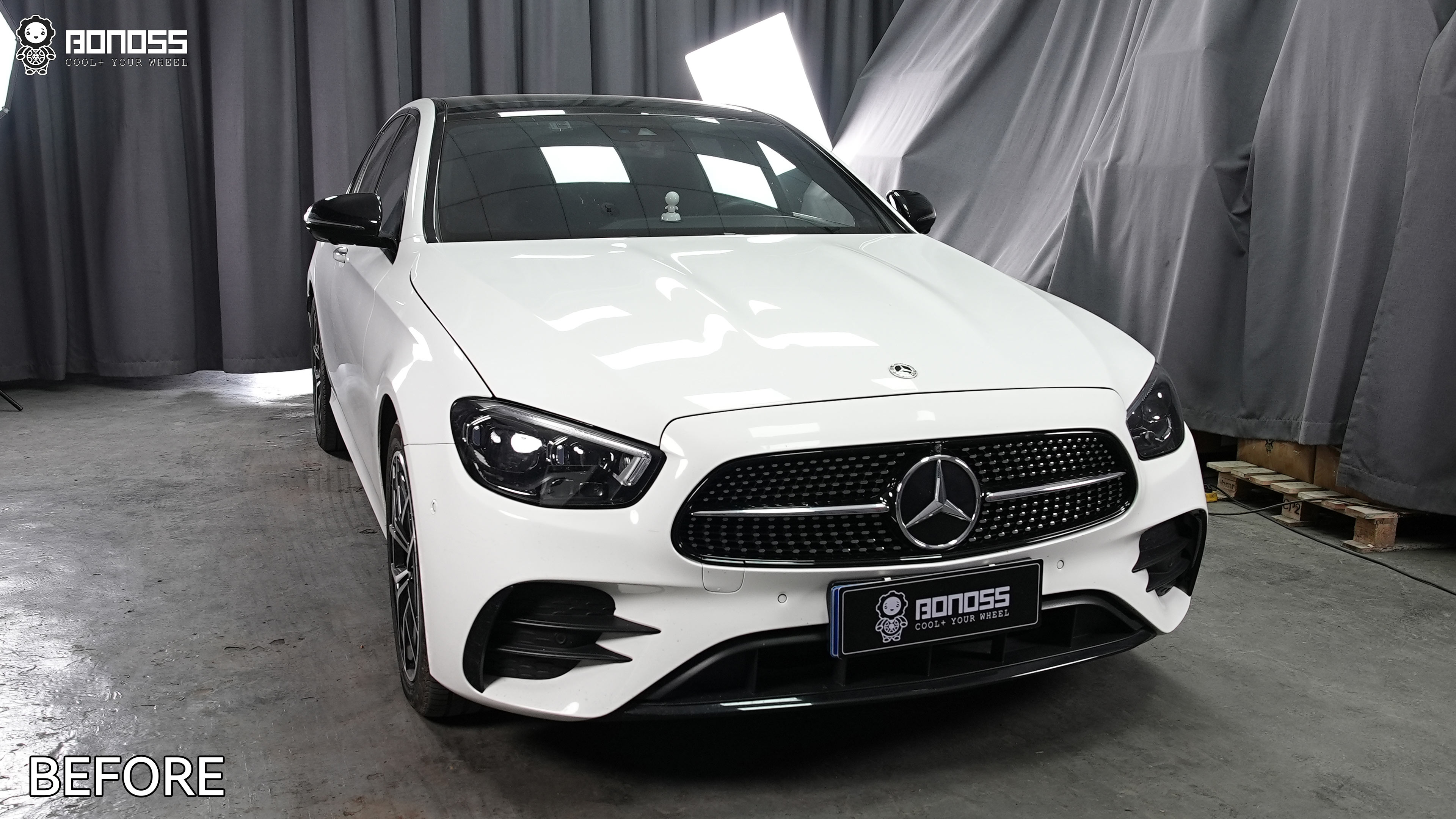
Some cars look unfinished from the factory, and once you see it, you can’t unsee it. The W213-generation E-Class — Mercedes-Benz’s mid-size sedan platform sold from 2017 onward — has clean lines and good proportions, but its stock wheels sit visibly inside the fenders. Mr. Allen saw it. After months of debating sizes, he brought his completely stock 2021 Mercedes-Benz E-Class to us on September 13, 2025 with one clear goal: a flush stance on the factory 18-inch wheels. No new rims. No rubbing. No guessing.
We measured instead of guessing. The answer for his car turned out to be 2021 Mercedes-Benz E-Class 15mm spacers up front paired with 12mm spacers in the rear — a staggered setup that moved the effective offset from the stock ET+43 to ET+28 at the front axle and ET+31 at the rear. Thirteen months and 9,300 miles later, his verdict is on record: no vibrations, no weird noises, zero issues. Here is the full case, with every measurement we took along the way.
Spec Quick Reference
Before the photos, the numbers. Every value below either comes from the owner’s manual or was measured on this specific car — nothing pulled from forum folklore.
| Item | Specification |
|---|---|
| Vehicle | 2021 Mercedes-Benz E-Class (W213), stock condition |
| Bolt Pattern (PCD) | 5x112mm |
| Center Bore | 66.6mm (66.42mm measured on this car) |
| Lug Bolt Thread | M14x1.5, R14 ball seat |
| OEM Wheels and Tires | 18-inch, 245/45ZR18, ET+43 |
| Effective Offset After Install | ET+28 front, ET+31 rear |
| Spacer Thickness | 15mm front, 12mm rear |
| Wheel bolt torque — BONOSS extended bolts | 140 Nm (103.5 ft-lb) per BONOSS installation instructions |
| Wheel bolt torque — OEM bolts | 150 Nm (110 ft-lb), per the owner’s manual |
| Required extended bolts | 60mm front, 57mm rear, ISO Grade 12.9 |
| Spacer material | Forged 6061-T6 aluminum |
One torque note that saves people from expensive mistakes: use one torque value for each fastening step — 140 Nm on the BONOSS hardware that secures the spacer, and 150 Nm on the bolts that secure the wheel. Do not mix or average the two. Both are acceptable, because each value belongs to a different fastener set.
If you are cross-shopping generations or verifying fitment on your own car, our E-Class bolt pattern guide covers 5×112 fitment, center-bore specs, and thread data across E-Class models in more detail.
Before and After: Four Corners, One Flush Stance
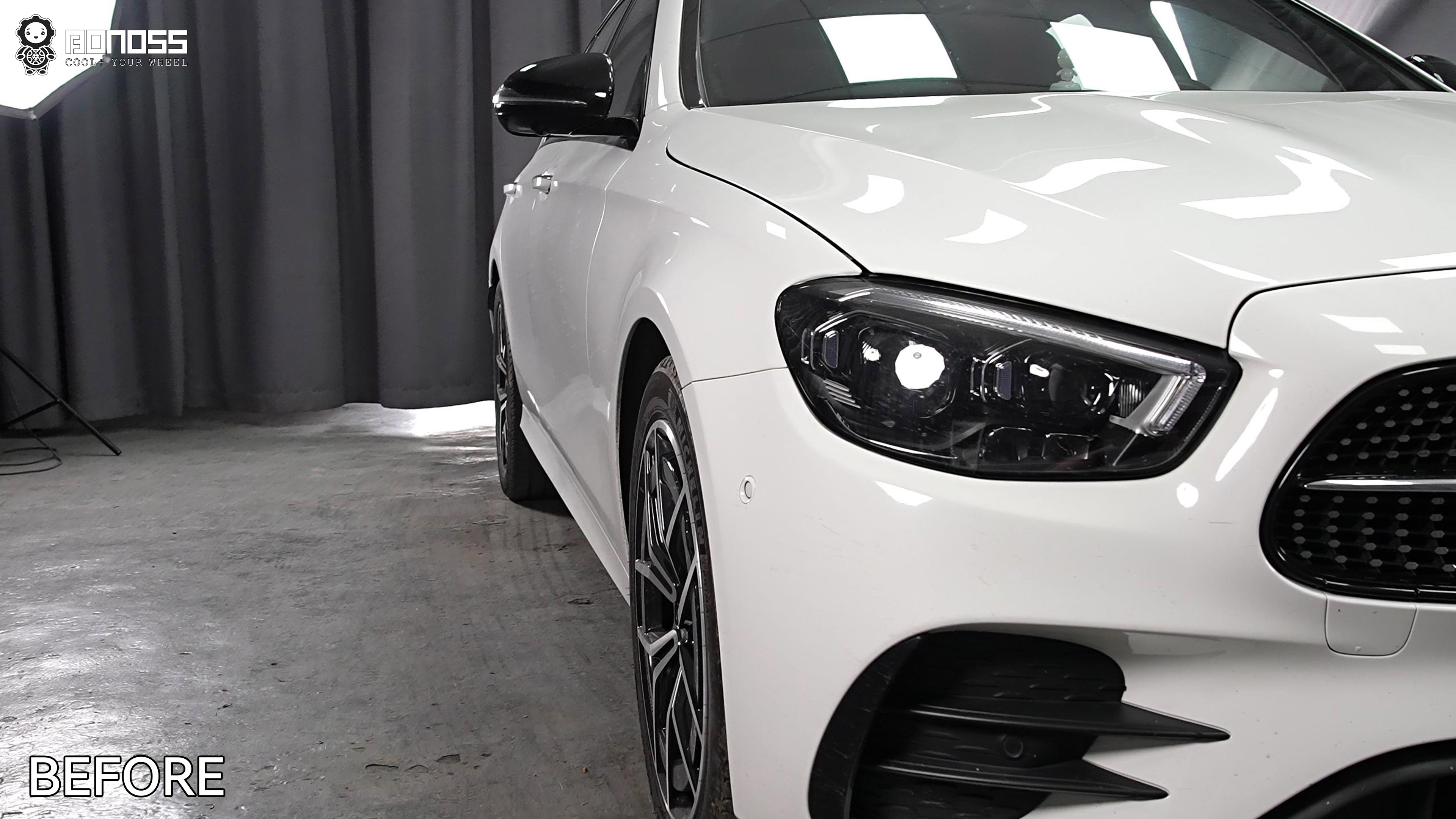
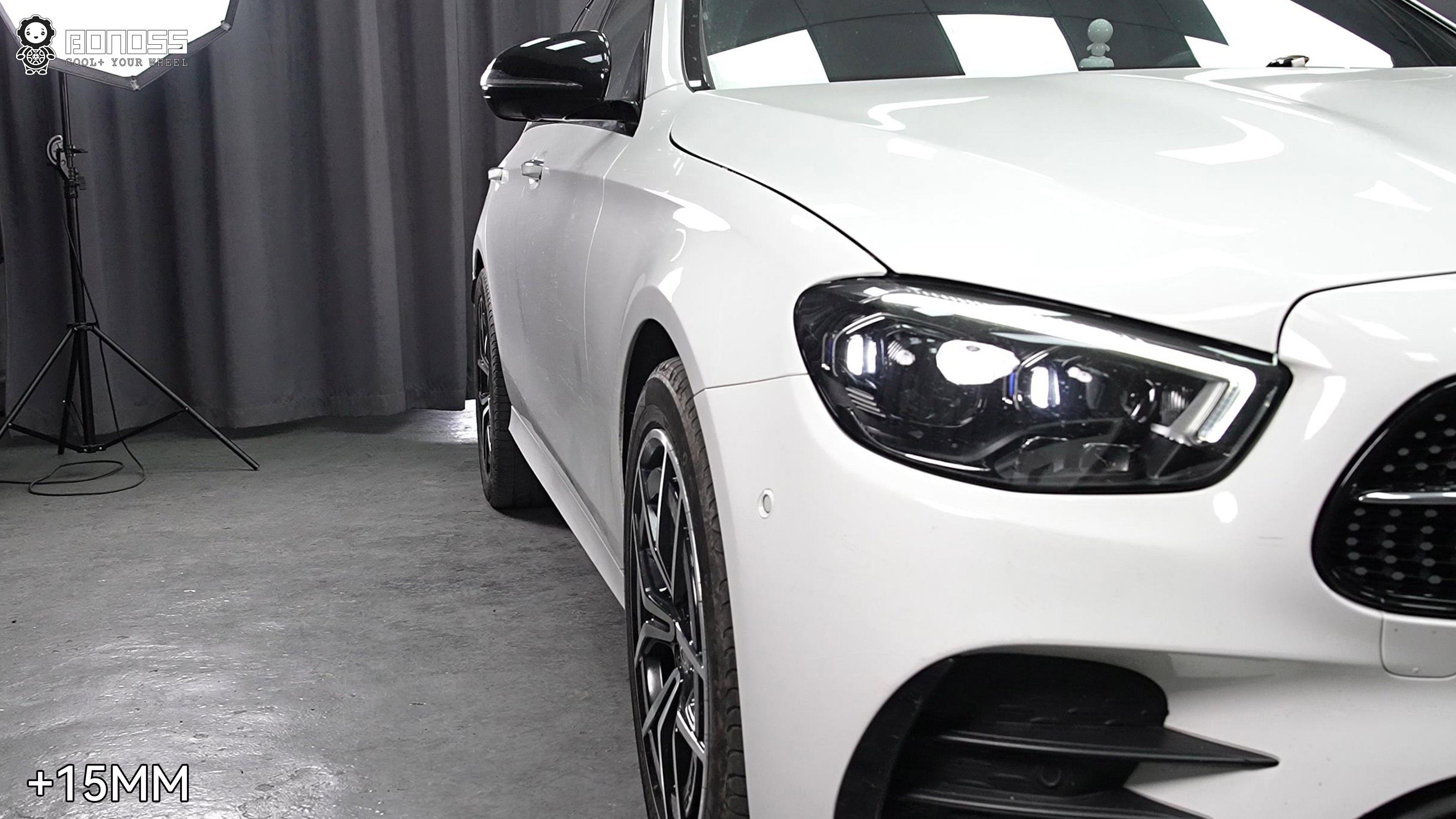
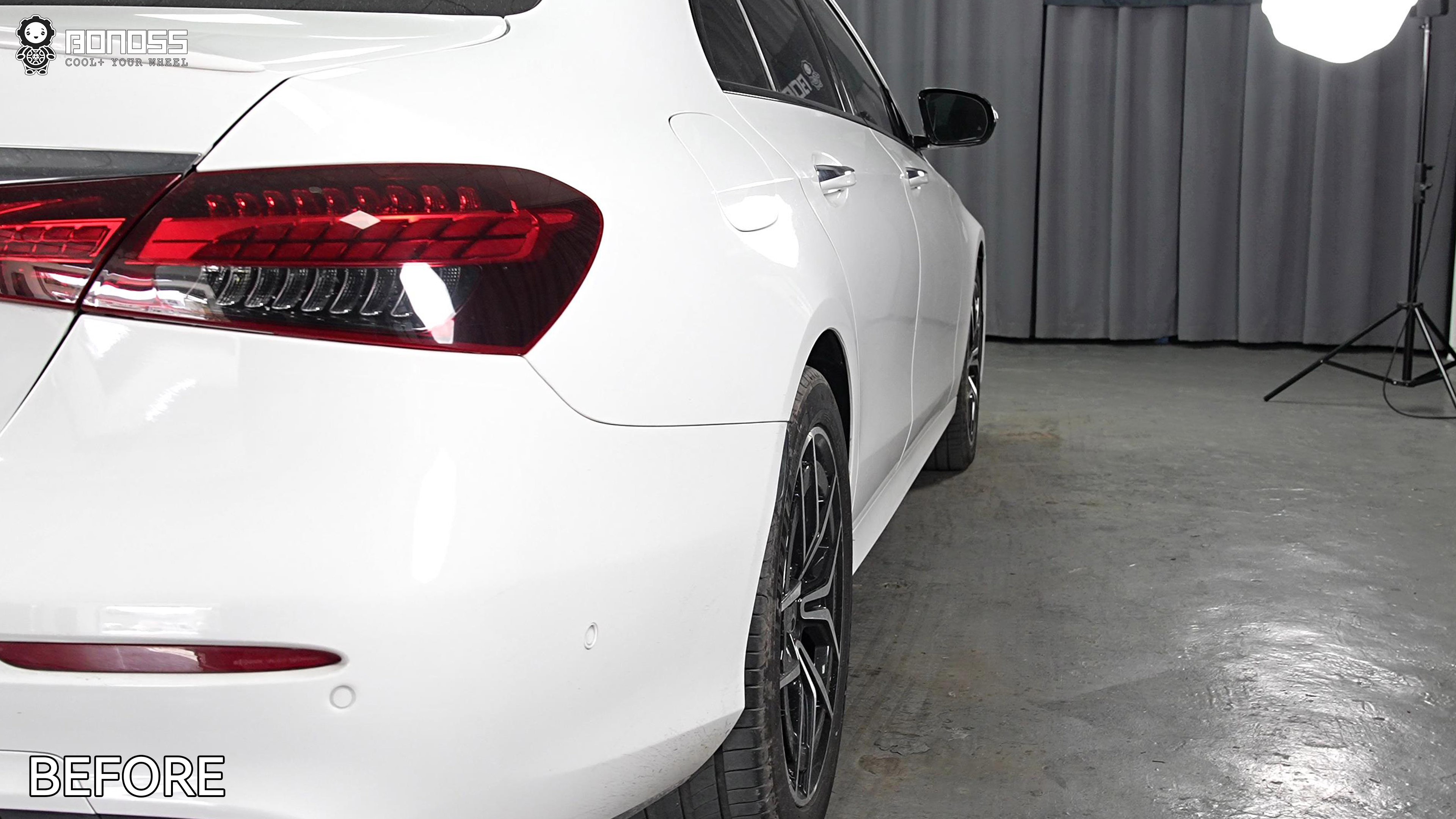
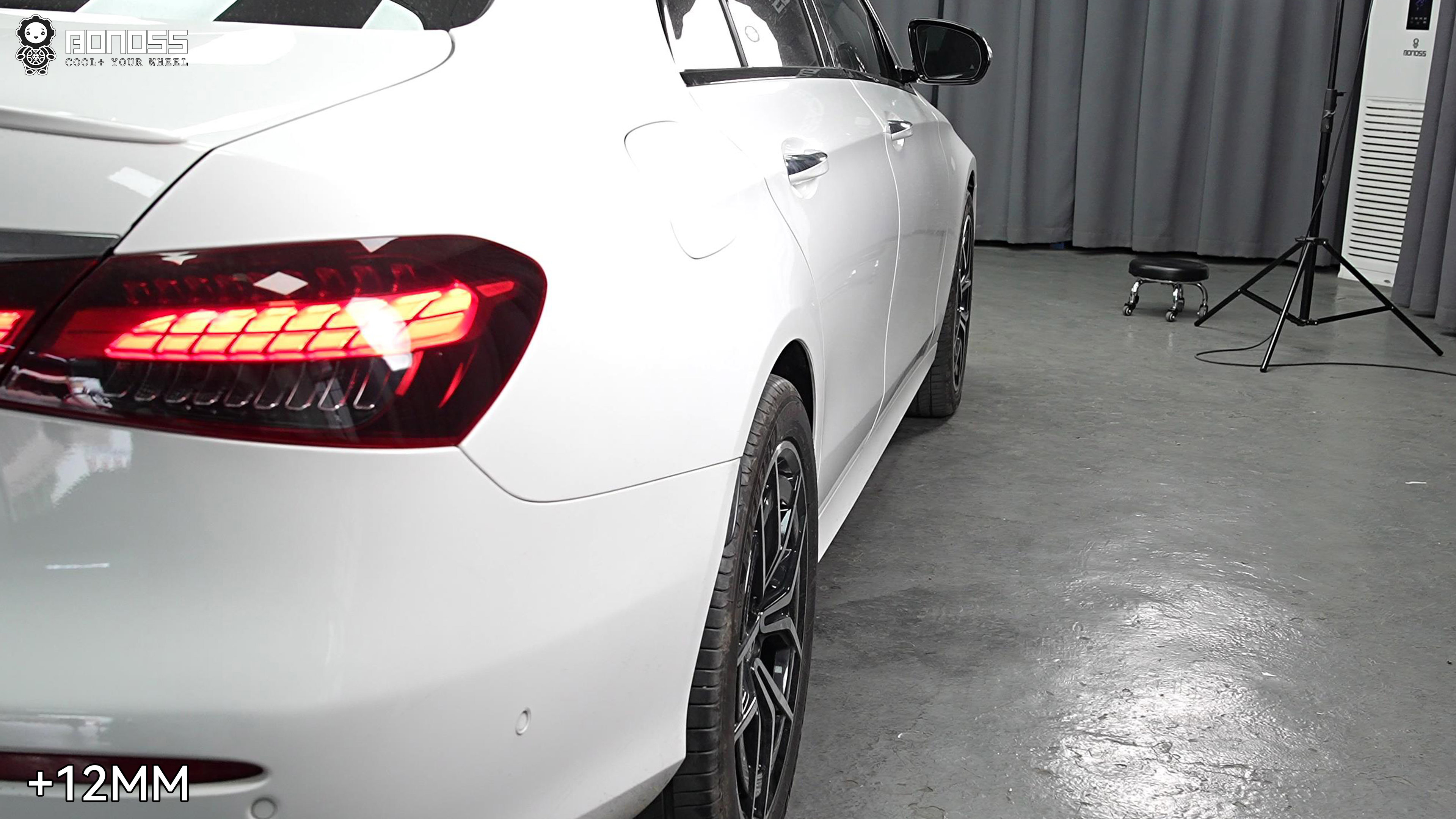
This is the E-Class 15mm spacers before and after sequence in full — every corner photographed before a single bolt was loosened, then again after the hardware went on. Same car, same wheels, same driveway. The only variable is the staggered spacer kit.
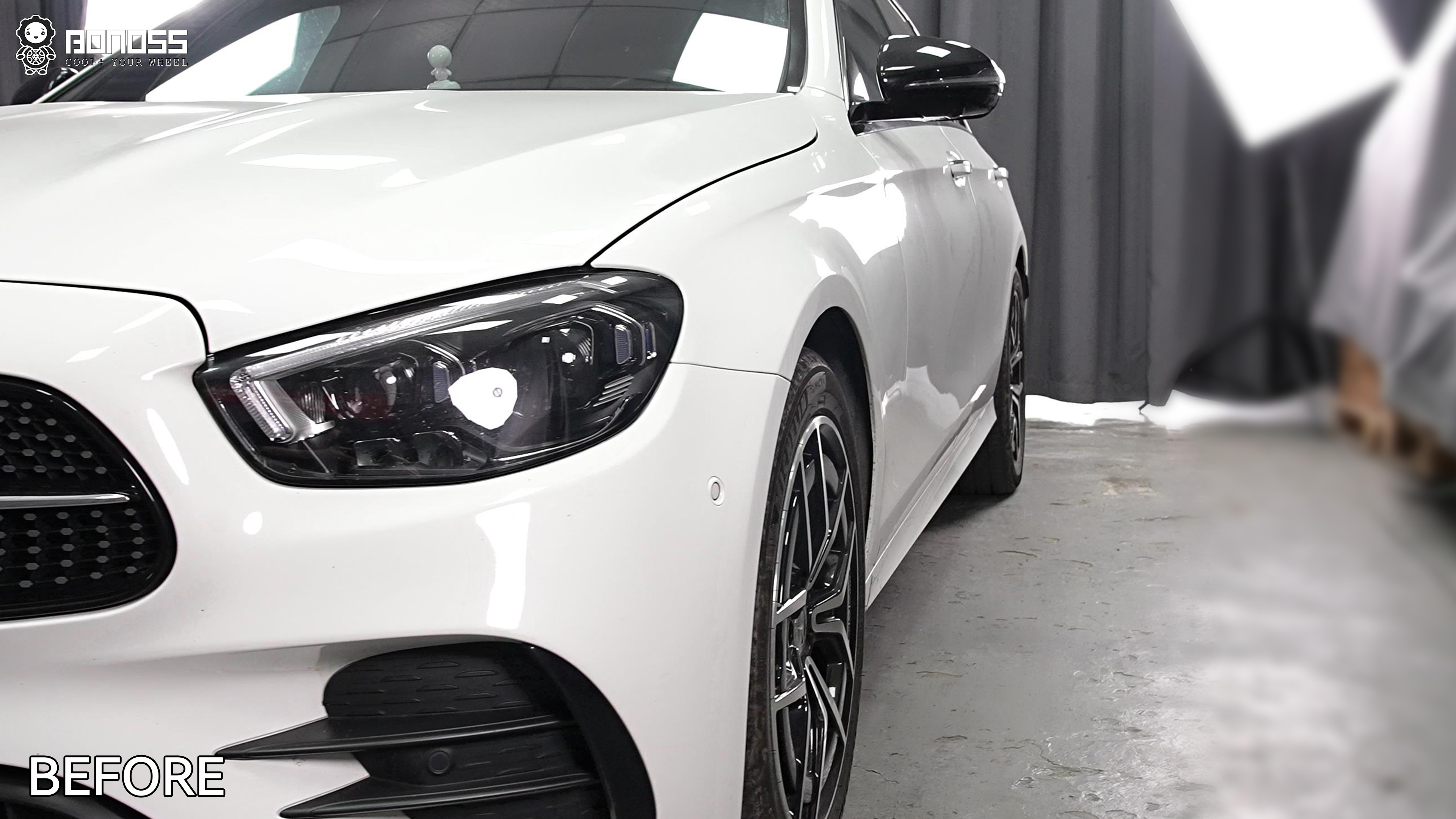
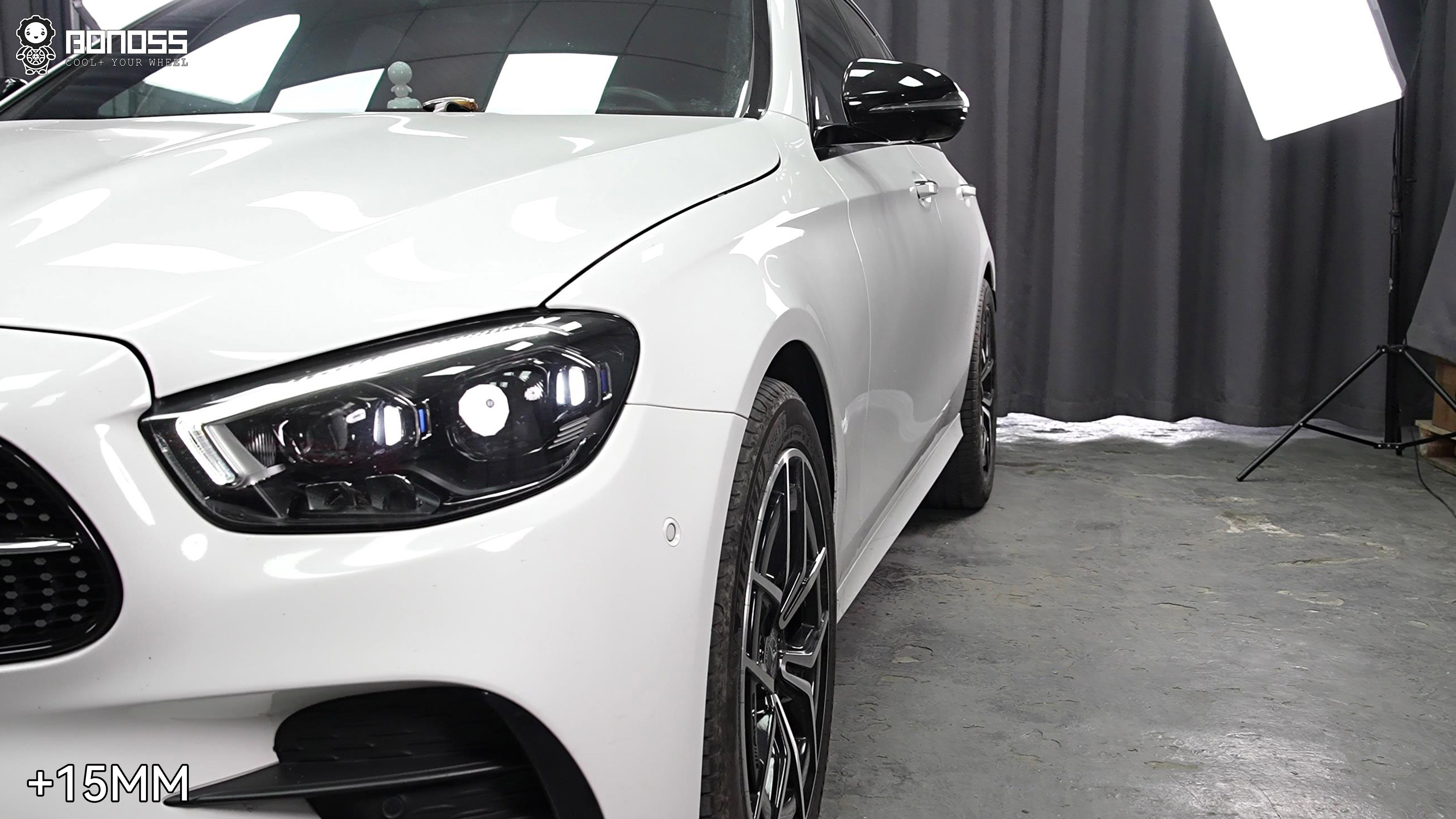
Driver’s Side, Front
In stock form, the left-front wheel sat noticeably behind the fender line — the classic “tucked” look that makes even a clean W213 appear to stand on tiptoes. With the 15mm spacer in place, the wheel face now sits essentially flush with the arch. The car looks planted rather than perched.
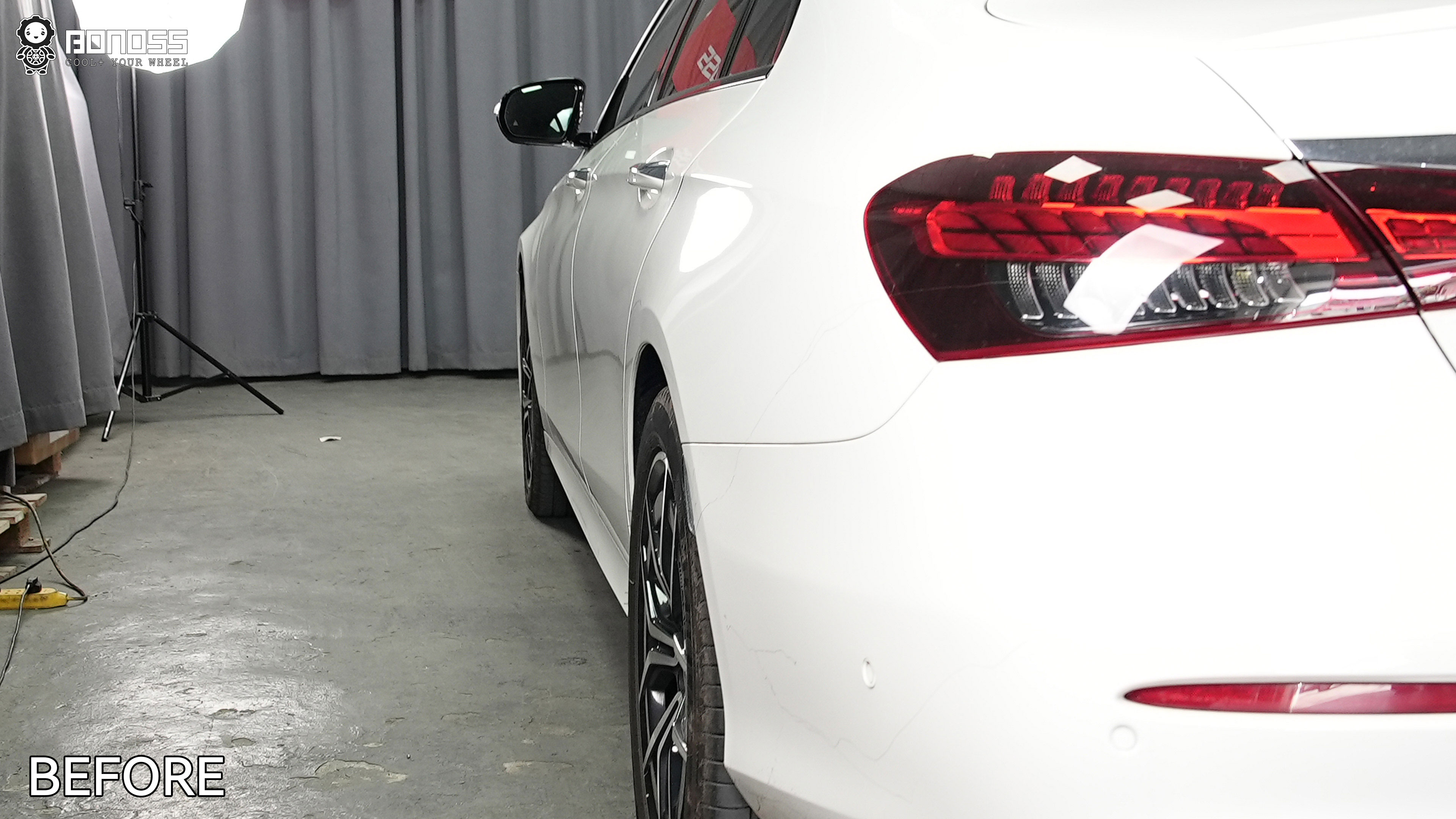
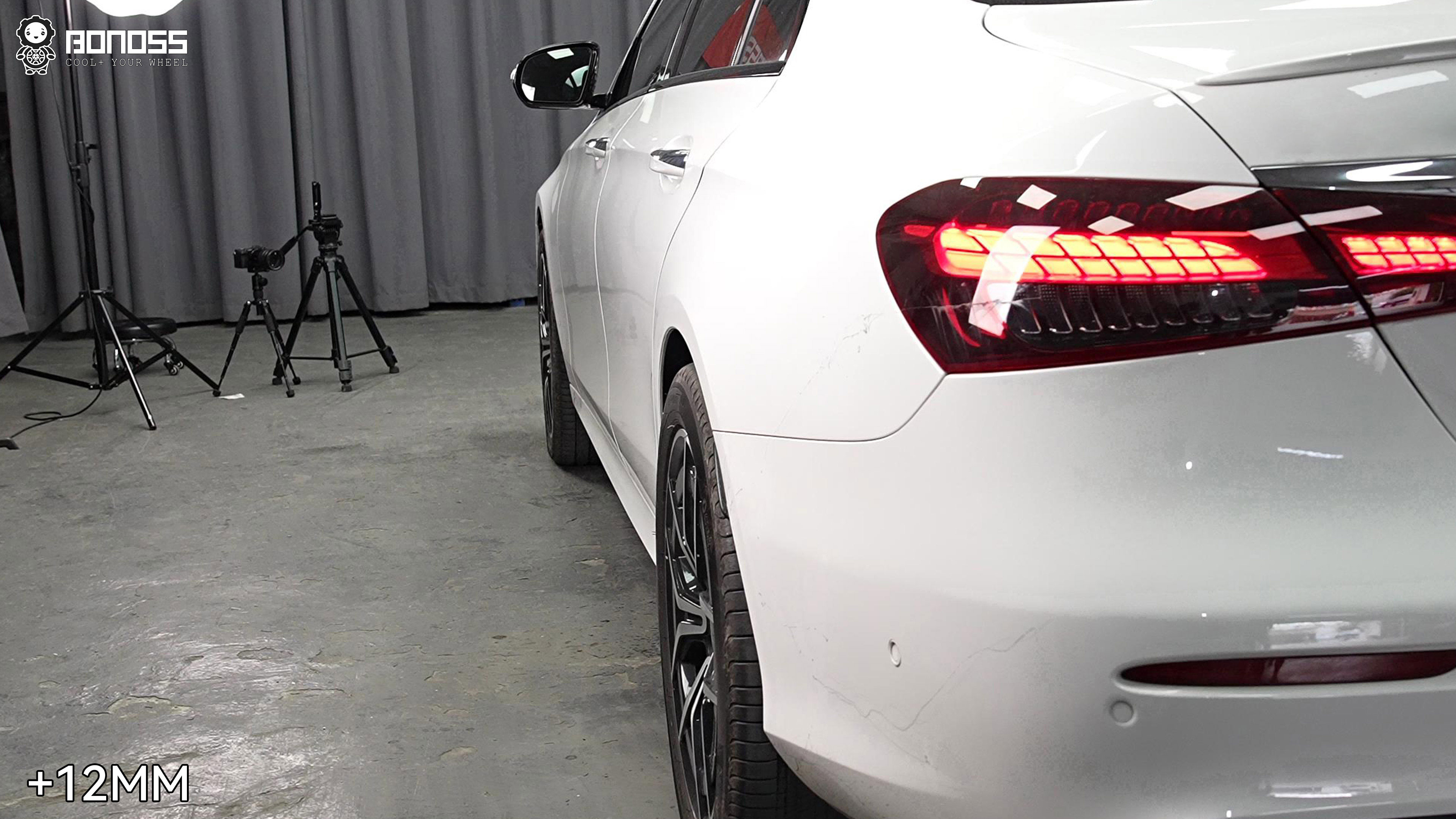
Driver’s Side, Rear
The rear needed less correction. Our measurements showed roughly a 12mm inset, so a 12mm spacer brought the left-rear wheel level with the fender without pushing it past flush. Subtle, but it is exactly the kind of subtlety that separates a measured setup from a guessed one.
Passenger Side, Same Story
Symmetry matters — an inset that differs side to side usually points to a measurement error or a suspension issue. Both passenger-side corners mirrored the driver’s side almost exactly, which told us the chassis was square and the spacer pairing was correct for the whole car, not just one corner.
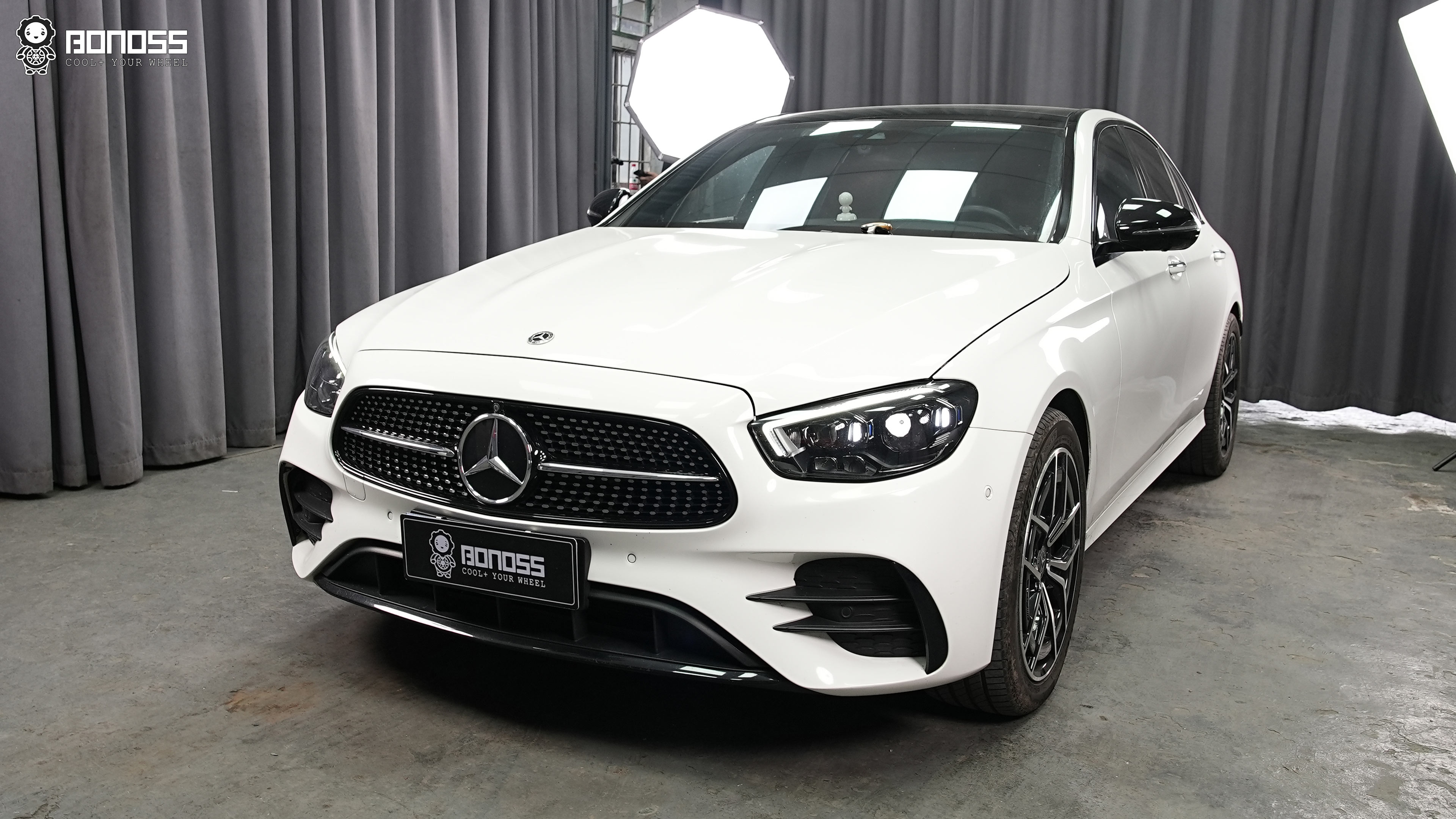
The Finished Car
Step back and the transformation reads clearly from any angle. The wheels fill the arches, the sidewalls line up with the fender edges, and the E-Class finally has the stance its body lines were designed for. Mr. Allen’s reaction when he walked around the car: “fitment is spot on — stance looks great.”
Why 15mm Front and 12mm Rear? The Measurement Session
Spacer thickness should never be a guess. Our team measured the fender-to-wheel gap on this car with a high-accuracy ruler before recommending anything. The front wheels sat about 15mm inside the fenders; the rears sat about 12mm inside. That is the entire logic behind the staggered kit — and it is why buying “a set of four 15mm spacers” off a generic listing would have pushed the rear wheels past flush into poke territory.
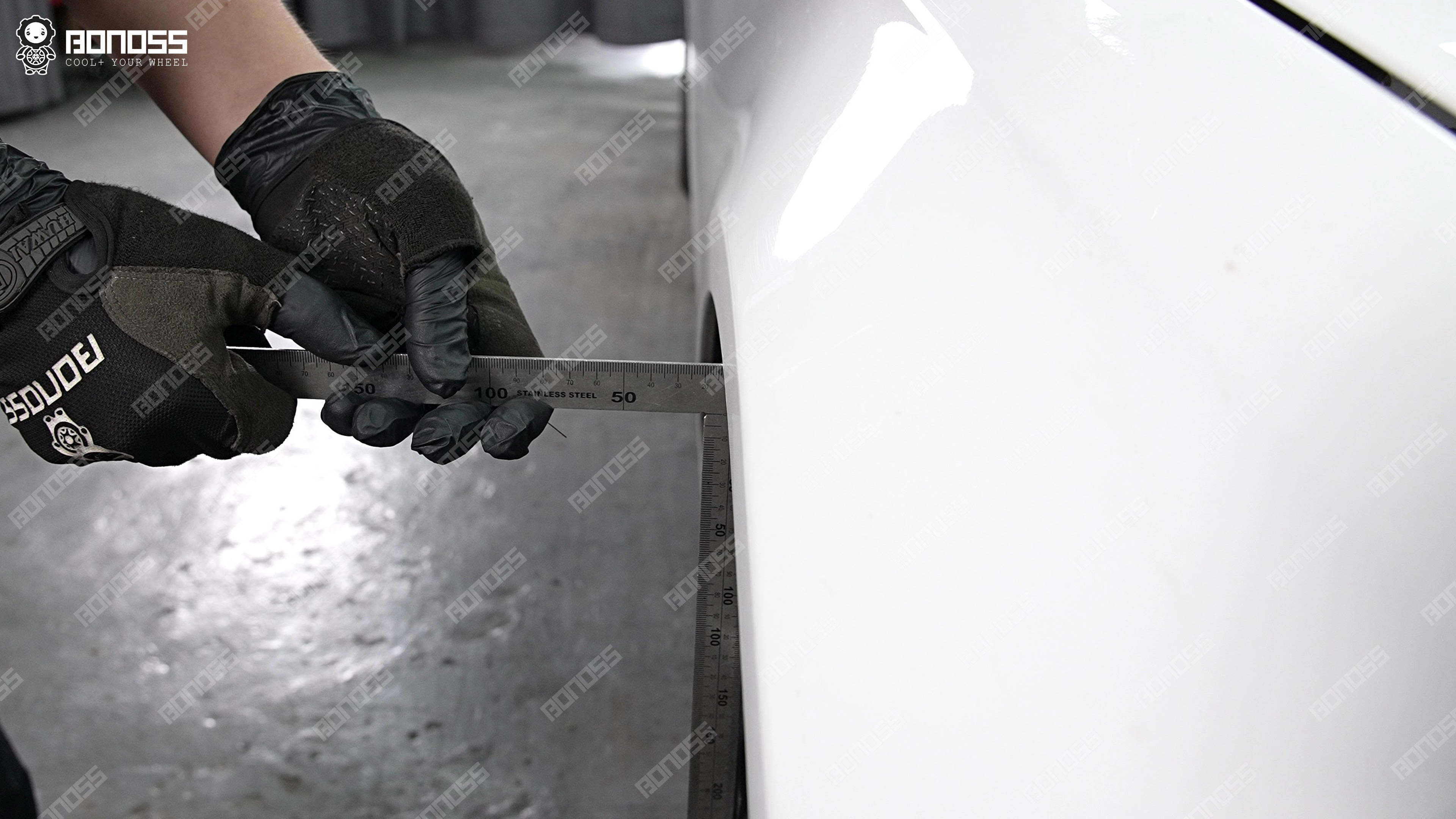
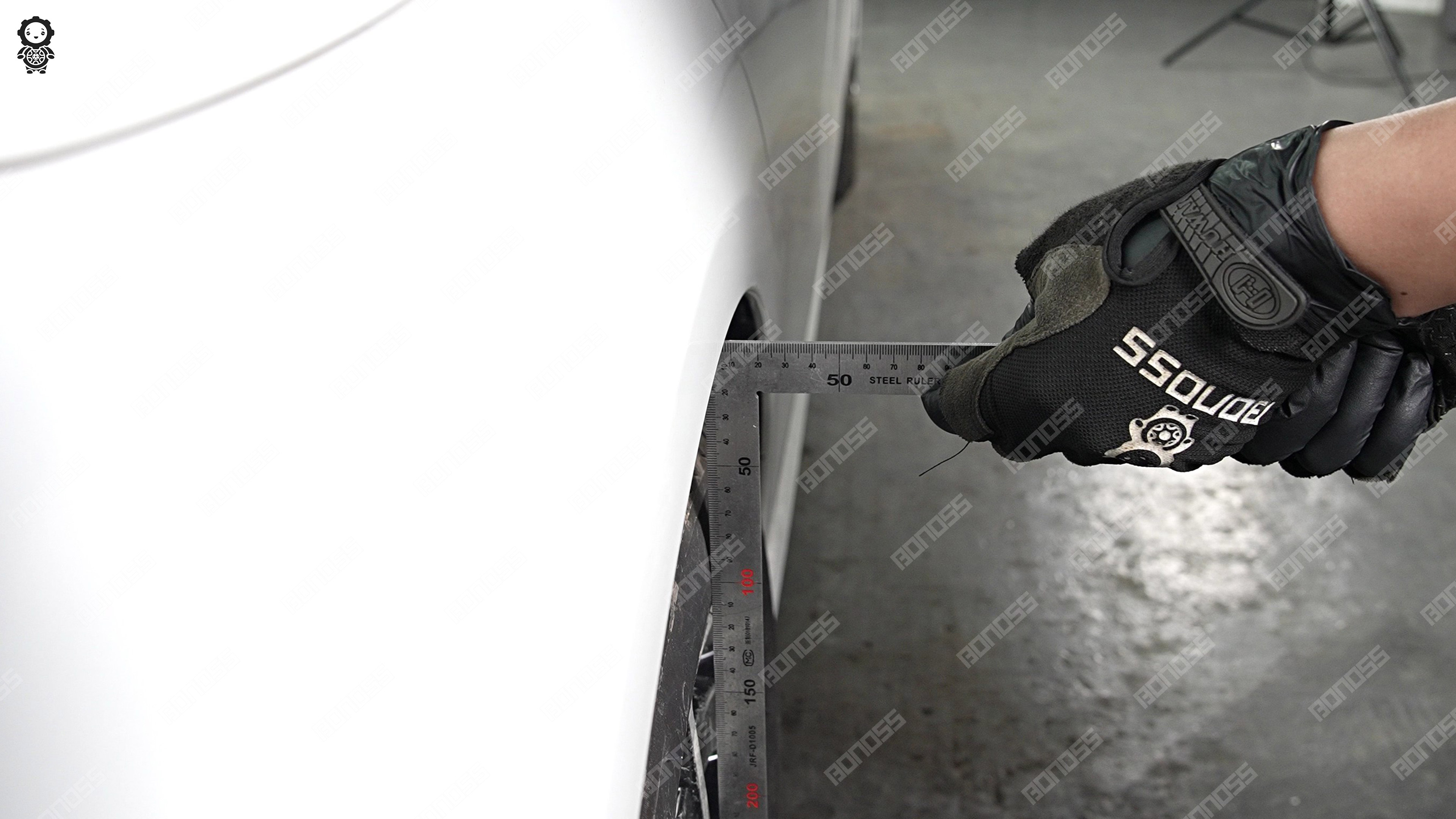
Why not simply run 15mm everywhere, since the front measurement said 15mm? Because the rear axle told a different story. A 15mm spacer at the rear would have pushed the tire 3mm past flush — into poke territory — inviting fender contact on compression and a stance that reads aftermarket rather than OEM-plus. The 12mm rear spacer threads that needle: flush, not proud. Honestly, this staggered pairing is the single decision that makes the whole car look right, and it cost nothing but five minutes with a ruler.
The offset math confirms what the ruler showed. The factory 18-inch wheels carry an ET+43 offset. Subtract the 15mm front spacer and you get ET+28; subtract the 12mm rear spacer and you get ET+31. Both values keep the tire inside the fender on this body while eliminating the inset look. This W213 15mm front 12mm rear spacer kit combination is what we now recommend for stock-body cars chasing a flush stance on OEM wheels.
The Hub-Centric Numbers Most Sellers Never Show You
Here is where this install gets genuinely interesting, because three different parts of the car measure three different ways — and all three measurements are correct.
With a vernier caliper, the axle hub’s center bore register measured 66.42mm. With a micrometer, the OEM wheel’s center bore measured 66.61mm. And the spacer’s hub-centric outer lip is machined to 66.5mm. None of these parts was designed to the same nominal number, because they are not the same mating face.
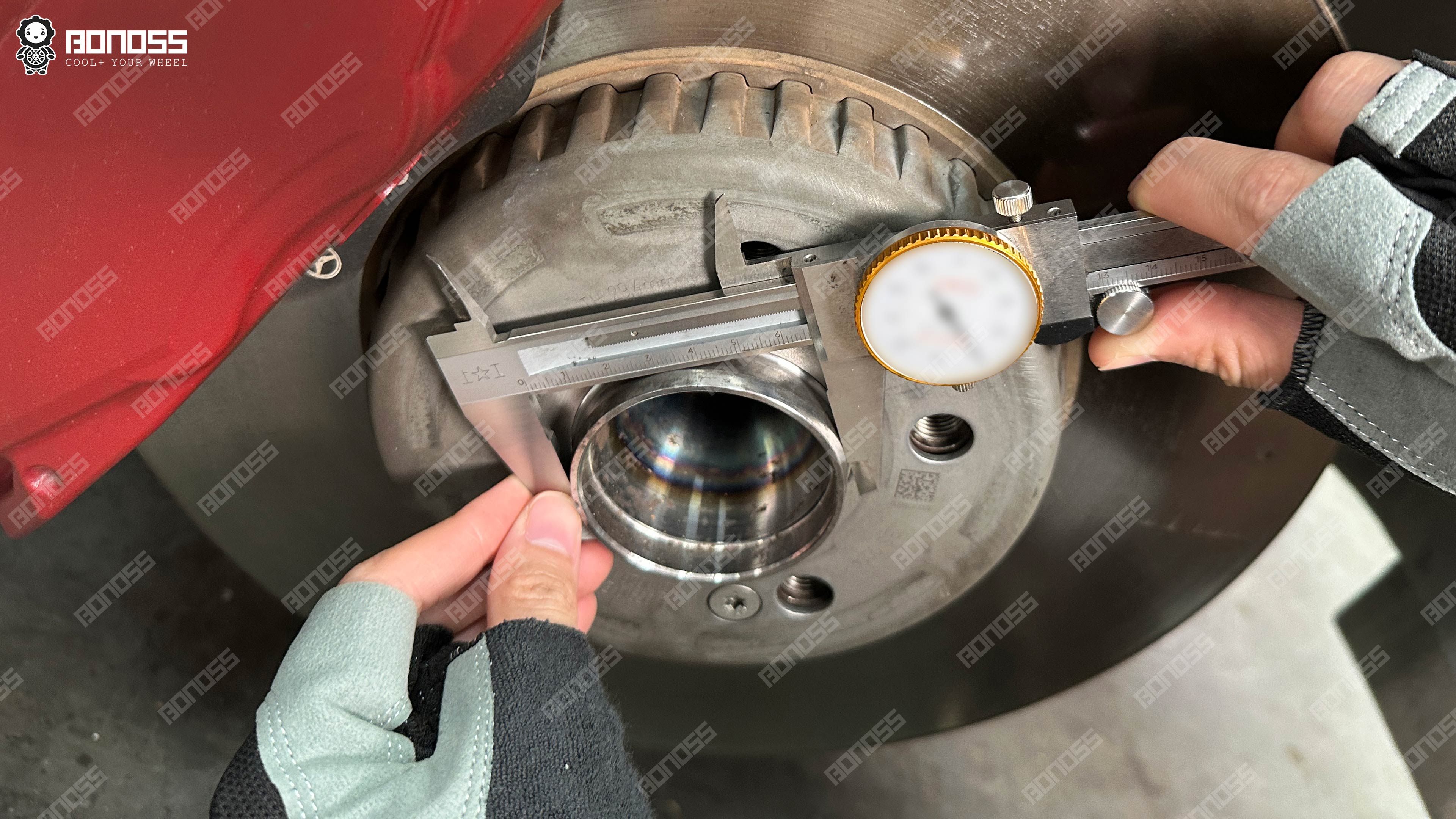
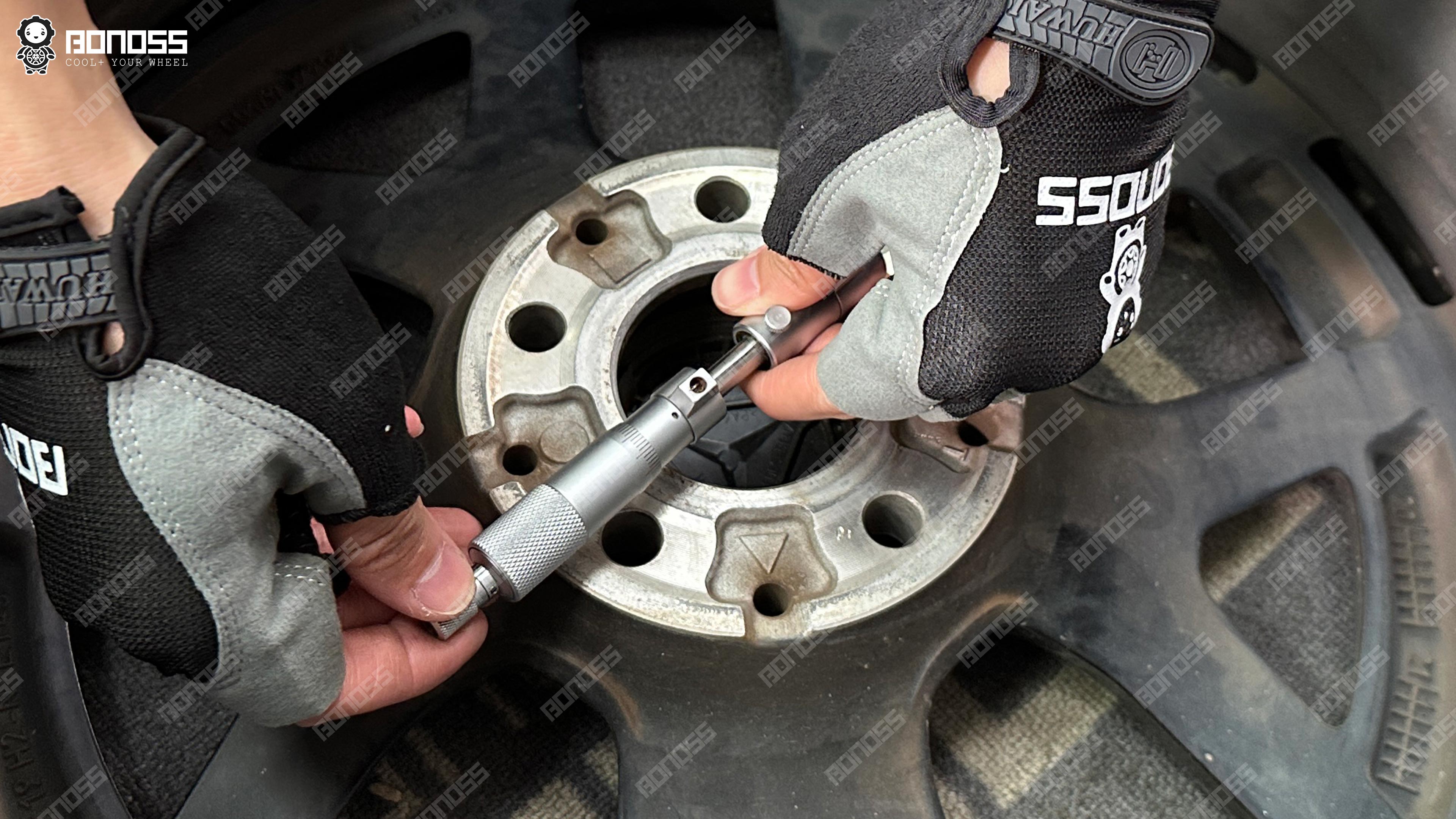
Read those numbers again. The factory wheel bore (66.61mm) is already 0.19mm larger than the factory hub (66.42mm). Mercedes-Benz itself builds in assembly clearance, tolerance, and corrosion allowance — the OEM fit is not zero-gap, and anyone who tells you it should be has never put a micrometer on one. Our spacer’s 66.5mm lip against the 66.61mm wheel bore leaves a 0.11mm diametral clearance — just 0.055mm per side. That is a tight, genuinely hub-centric fit. On the car side, a multi-stage inner bore profile matches the 66.42mm hub register.
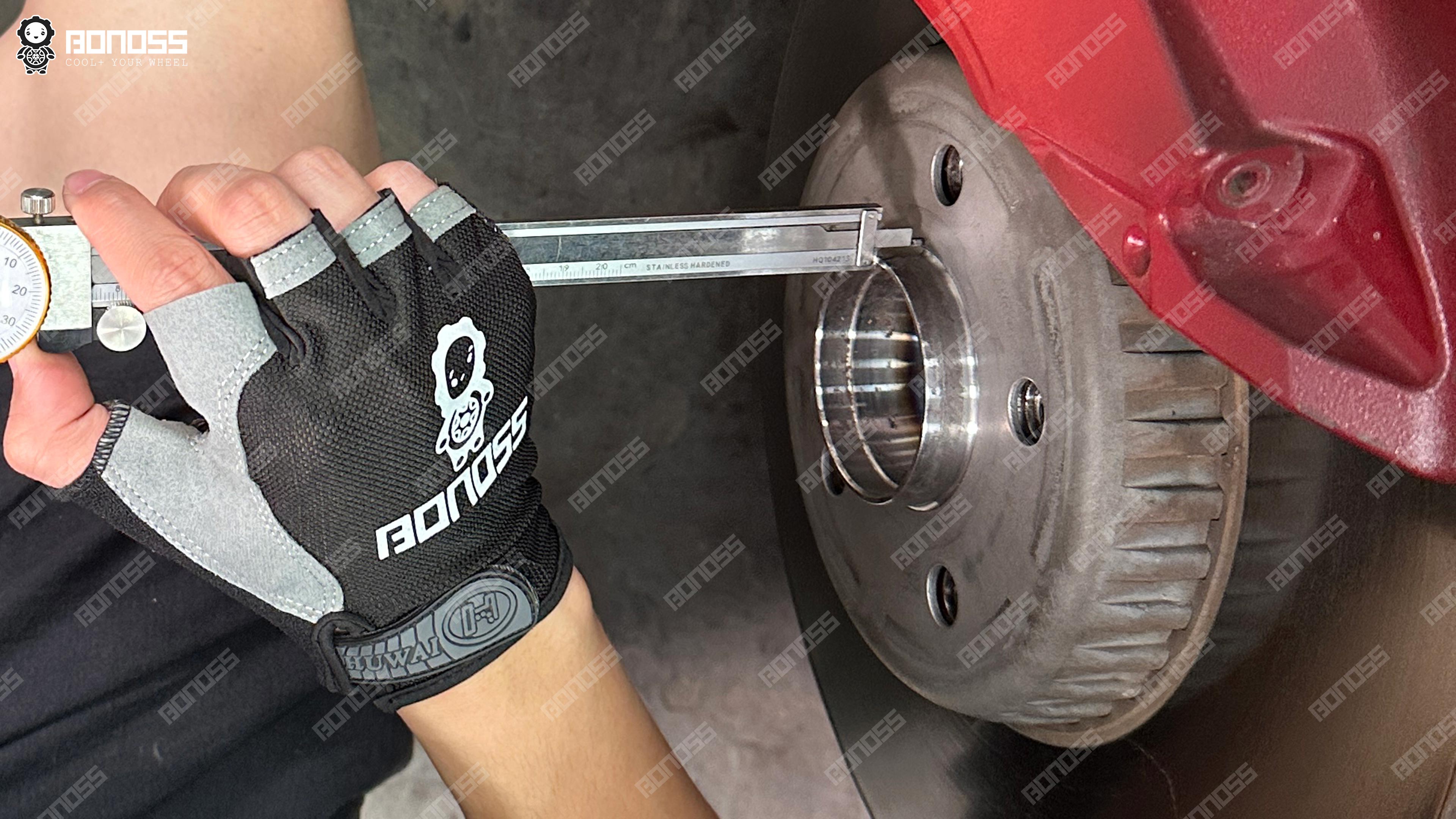
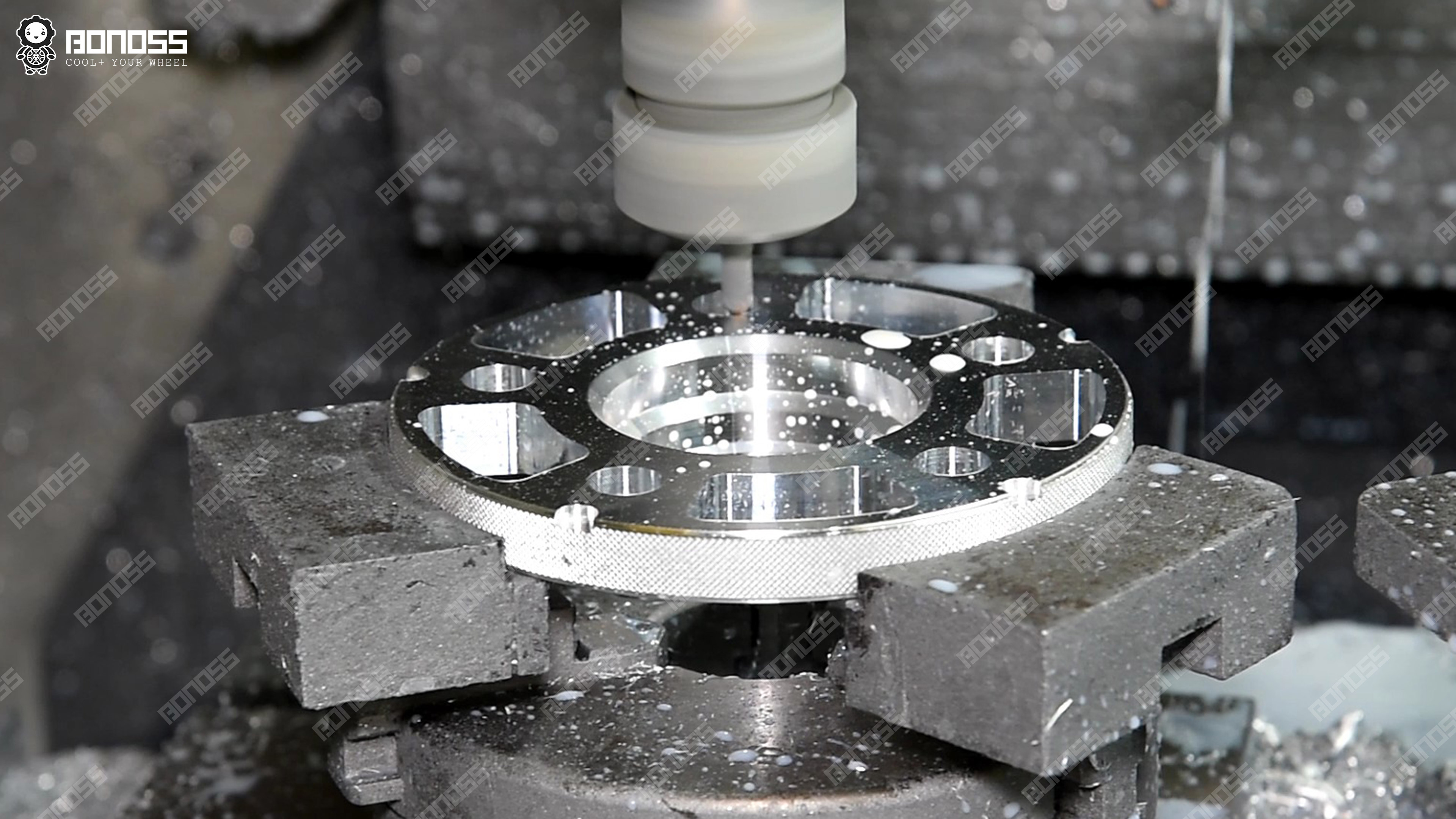
One spacer, two different mating dimensions, both held correctly. That is only possible because the spacers are CNC-machined to a 0.02mm tolerance class — the precision that keeps the wheel concentric, which is what actually prevents high-speed vibration and uneven bolt loading. We also verified the hub step height on both axles with the caliper: 12.47mm up front, 11.75mm at the rear, so the register engagement was confirmed before a single spacer was torqued down.
The Wheel Bolt Math: Why This W213 Needed 60mm and 57mm Bolts
If you take one warning away from this article, make it this one: do not order hardware for a W213 based on advice written for an older E-Class. The W211 and W212 generations shipped with stock wheel bolts carrying roughly 27mm of thread. This W213’s factory bolts measure 45mm of thread below the contact seat — we verified it with a vernier caliper. Bolt data from the wrong generation will leave you with hardware that is dangerously short or uselessly long.
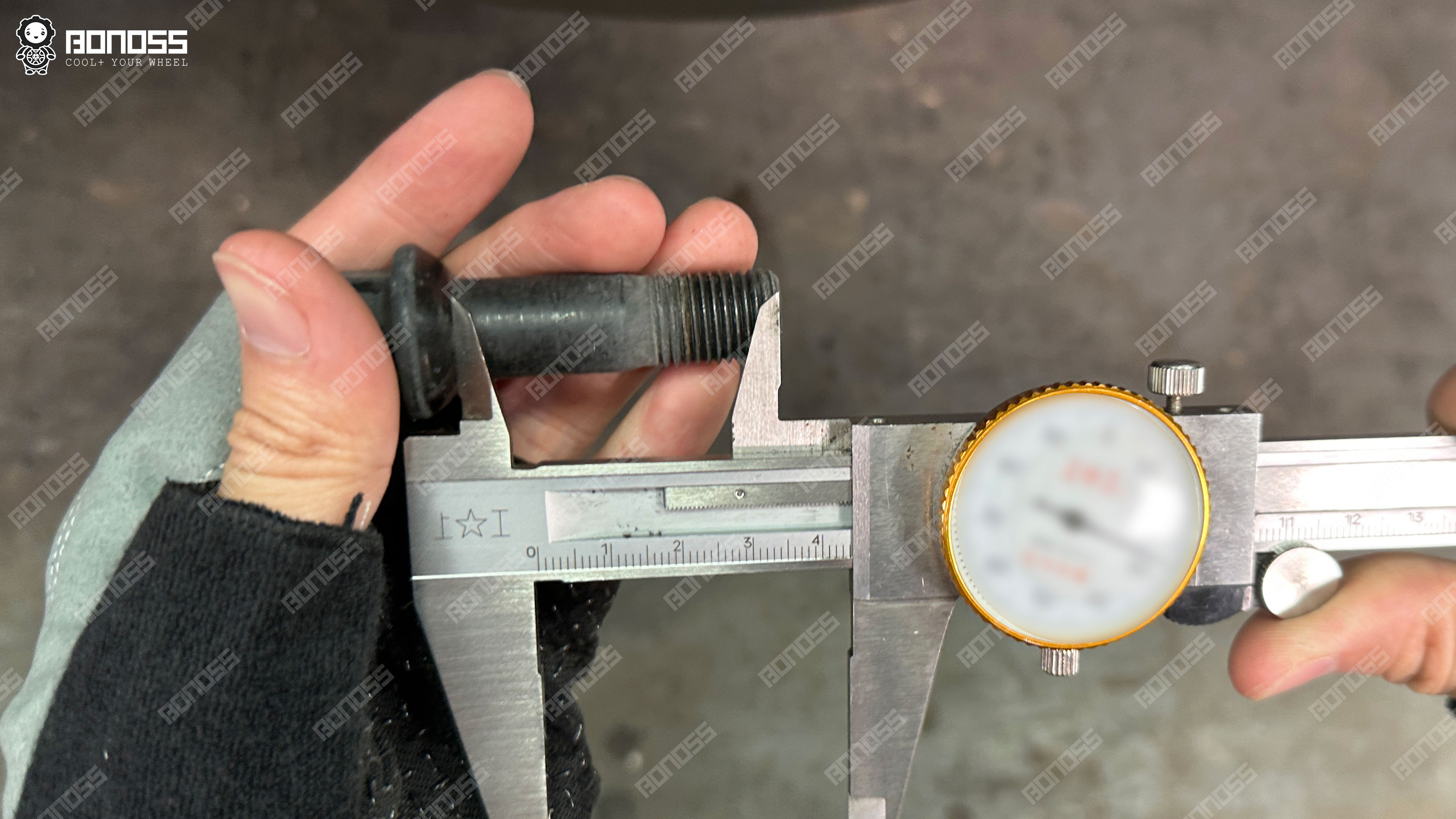
The math itself is simple. A spacer sits between the wheel and the hub, so it consumes thread engagement equal to its thickness. To preserve the stock engagement, the extended bolt’s thread length must equal the stock thread length plus the spacer thickness:
- Front: 45mm stock + 15mm spacer = 60mm thread length extended bolts
- Rear: 45mm stock + 12mm spacer = 57mm thread length extended bolts
That is exactly what went on this car — ISO grade 12.9 extended wheel bolts in 60mm and 57mm thread lengths, paired to each axle. For the full breakdown of thread engagement and seat types, our Mercedes E-Class wheel bolt size guide goes deeper.
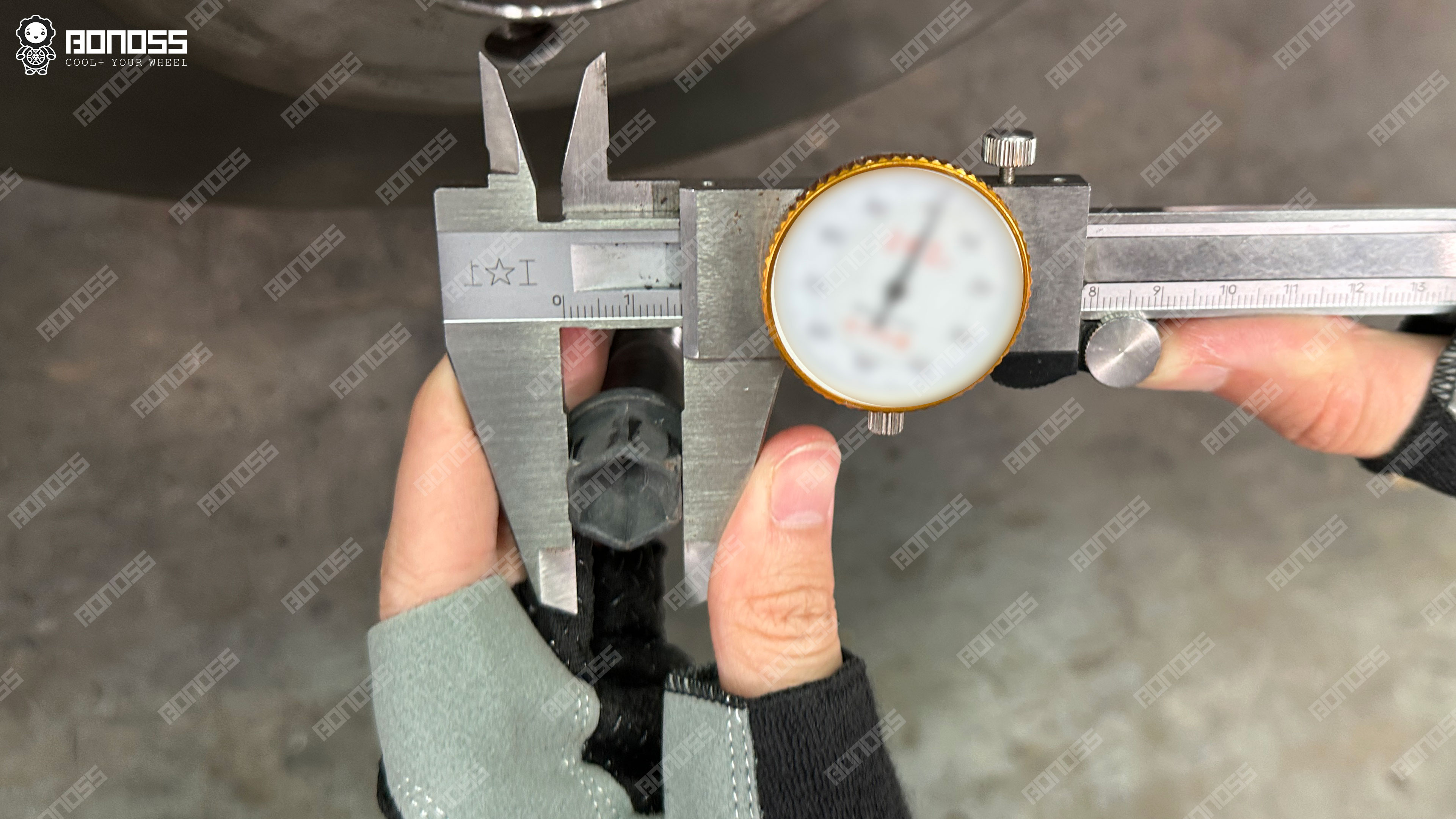
One more bolt detail that is easy to get catastrophically wrong: seat shape. The factory Mercedes hardware uses an R14 ball seat — a rounded contact face — which is completely different from the cone seat found on most Japanese and American vehicles. Install cone-seat bolts on a ball-seat wheel and the contact patch shrinks to a ring, clamping force distributes unevenly, and you have built yourself a genuine safety hazard. Every bolt in this kit matches the R14 ball seat. We also confirmed the factory 17mm hex head size with the caliper before assembly, so the owner’s existing wheel tools still fit.
Installation: Parts, Torque, and What It Cost
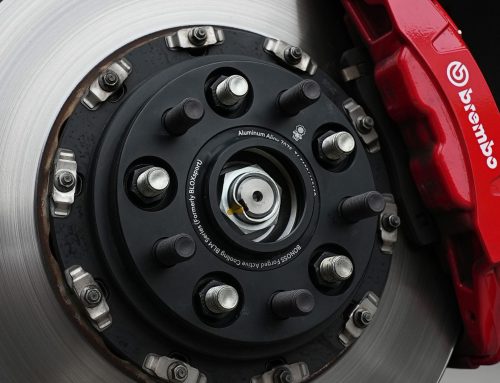
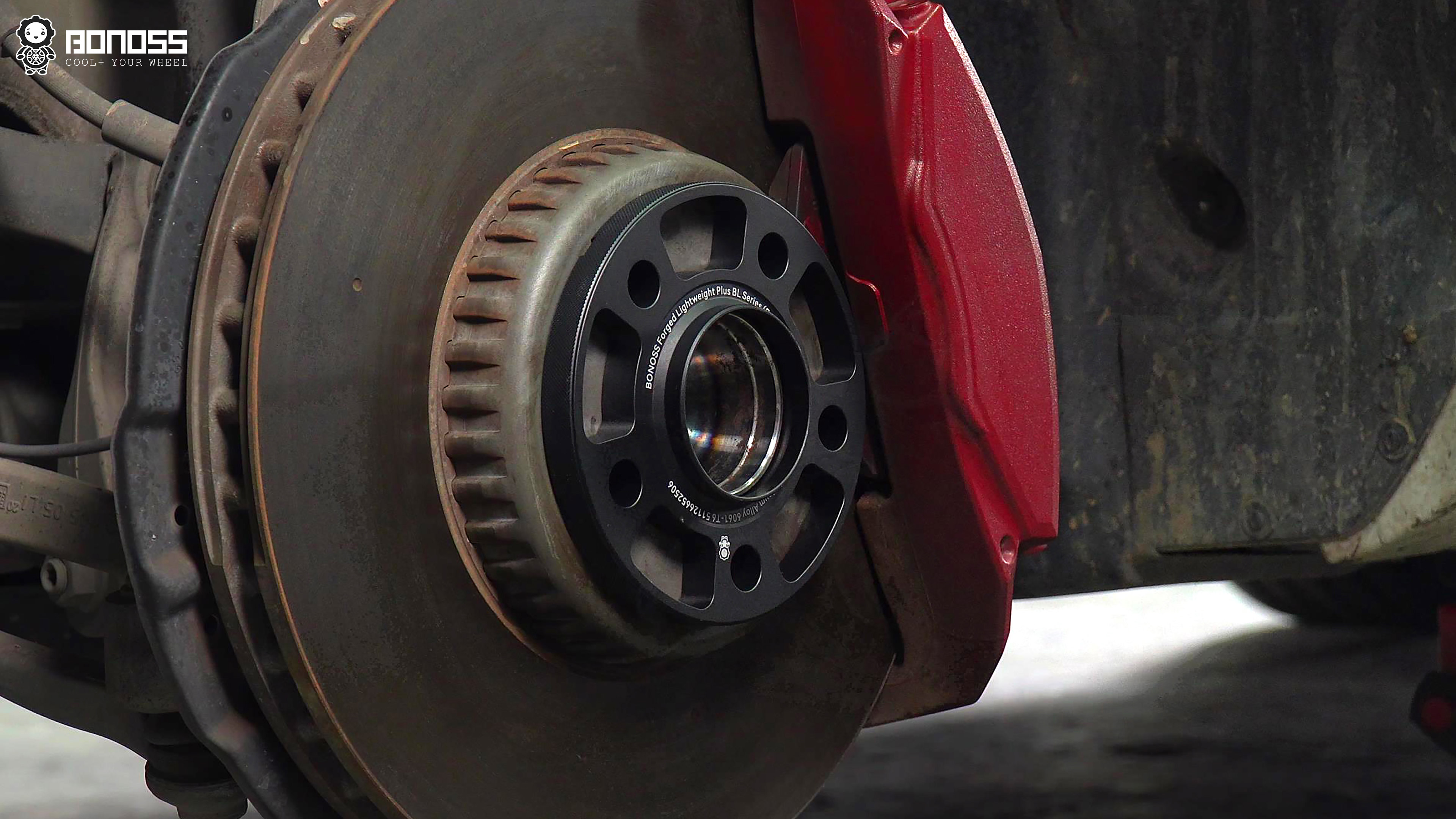
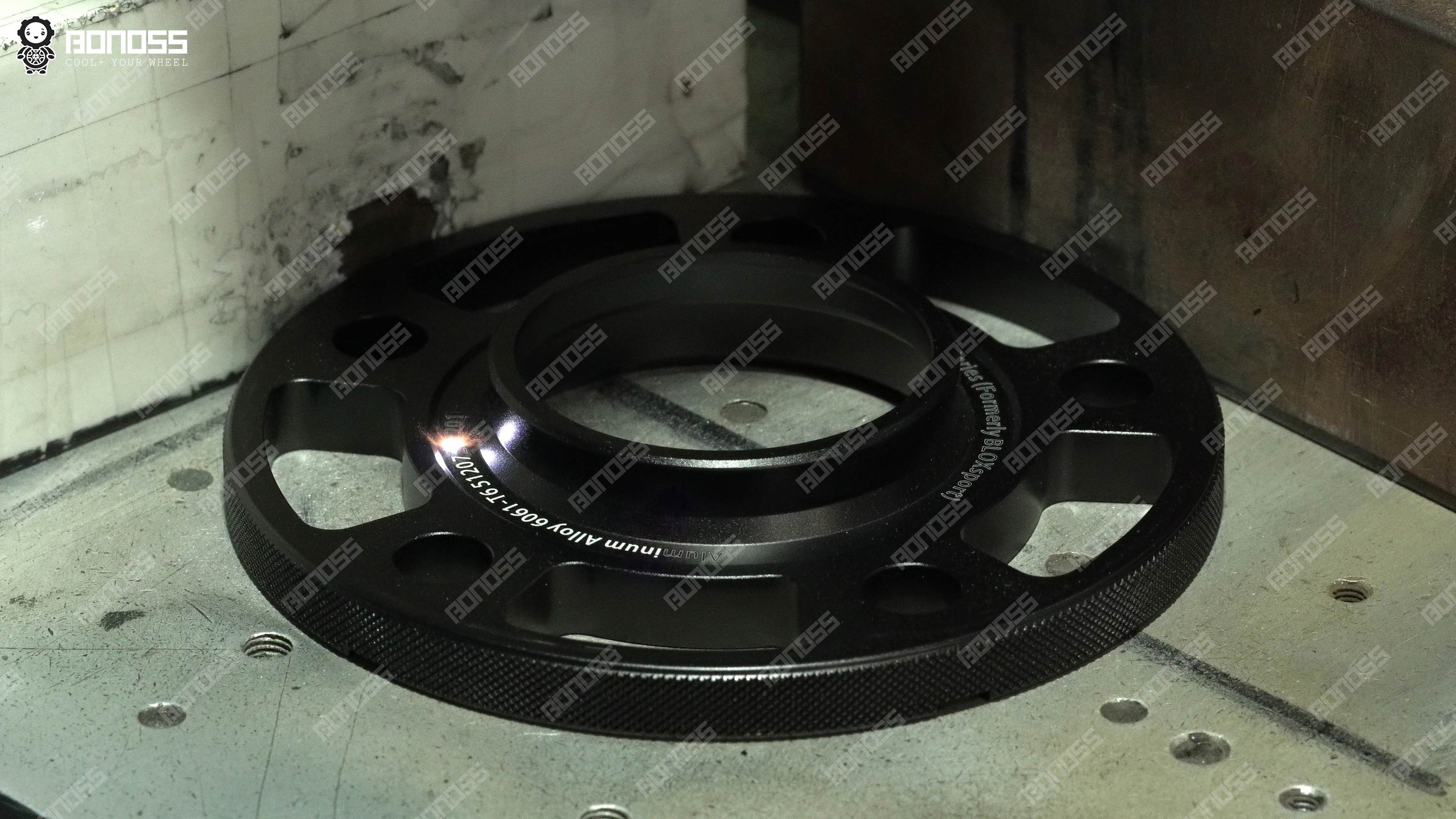
The hardware arrived as two axle-specific packages: a pair of 15mm spacers with ten 60mm extended bolts for the front, and a pair of 12mm spacers with ten 57mm extended bolts for the rear. Both spacer sets are from the BONOSS forged lightweight plus line — forged 6061-T6 aluminum with machined weight-relief pockets that trim rotating mass without touching the structure.
Up close, the design details are visible: the multi-stage hub-centric lip that matches both the 66.42mm hub register and the 66.61mm wheel bore, the side knurling that aids grip during installing, and the disassembly grooves machined into the spacer so it can be separated from the hub years from now without a fight. Small things, but they are the things you appreciate on the second install.
The procedure was straightforward. Hubs cleaned, spacers seated on the registers, wheels mounted over the hub-centric lips, BONOSS extended bolts run down in a star pattern and torqued to 140 Nm (103.5 ft-lb) per BONOSS installation instructions. Labor for the full four-corner job came to $20.
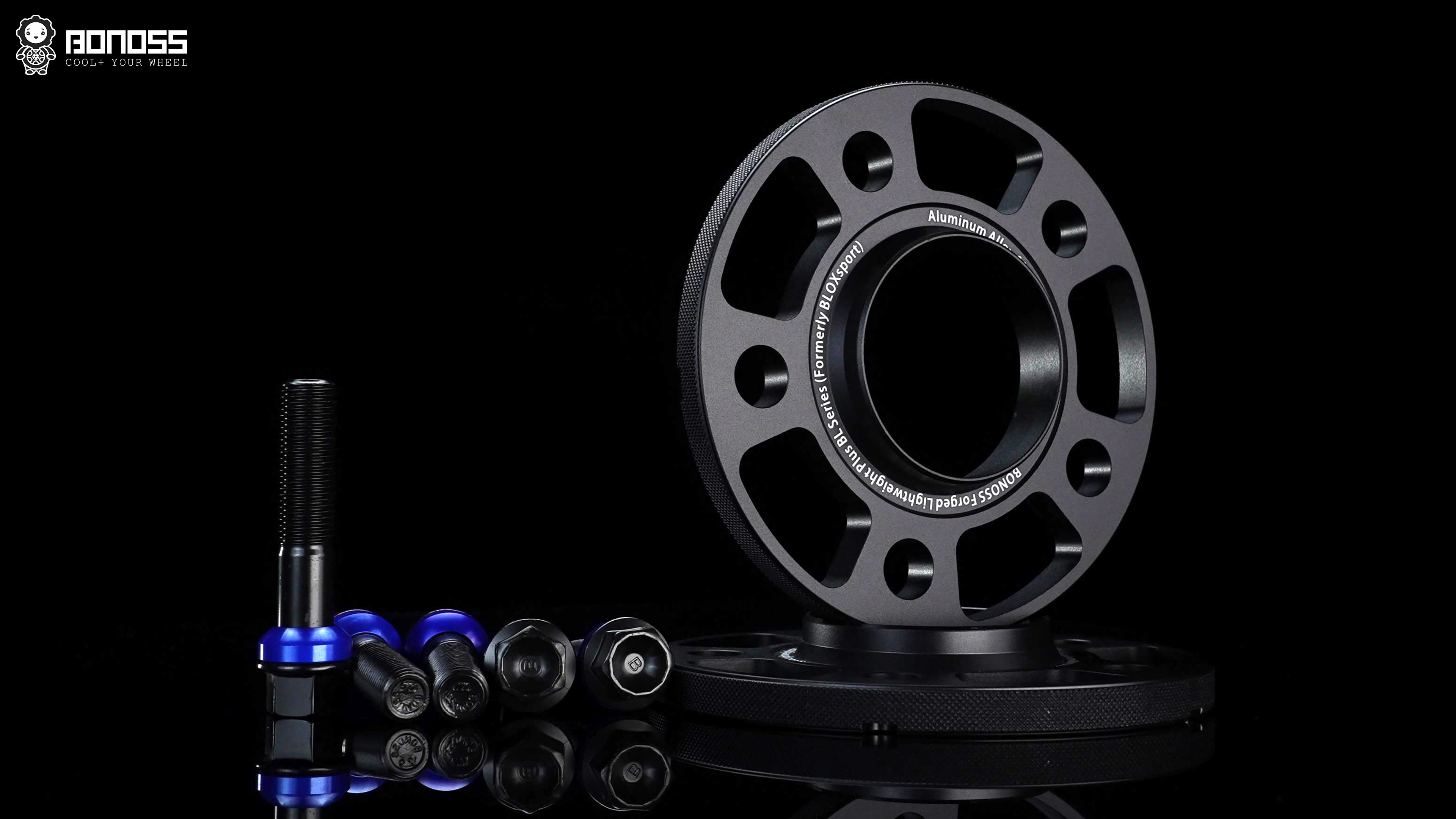
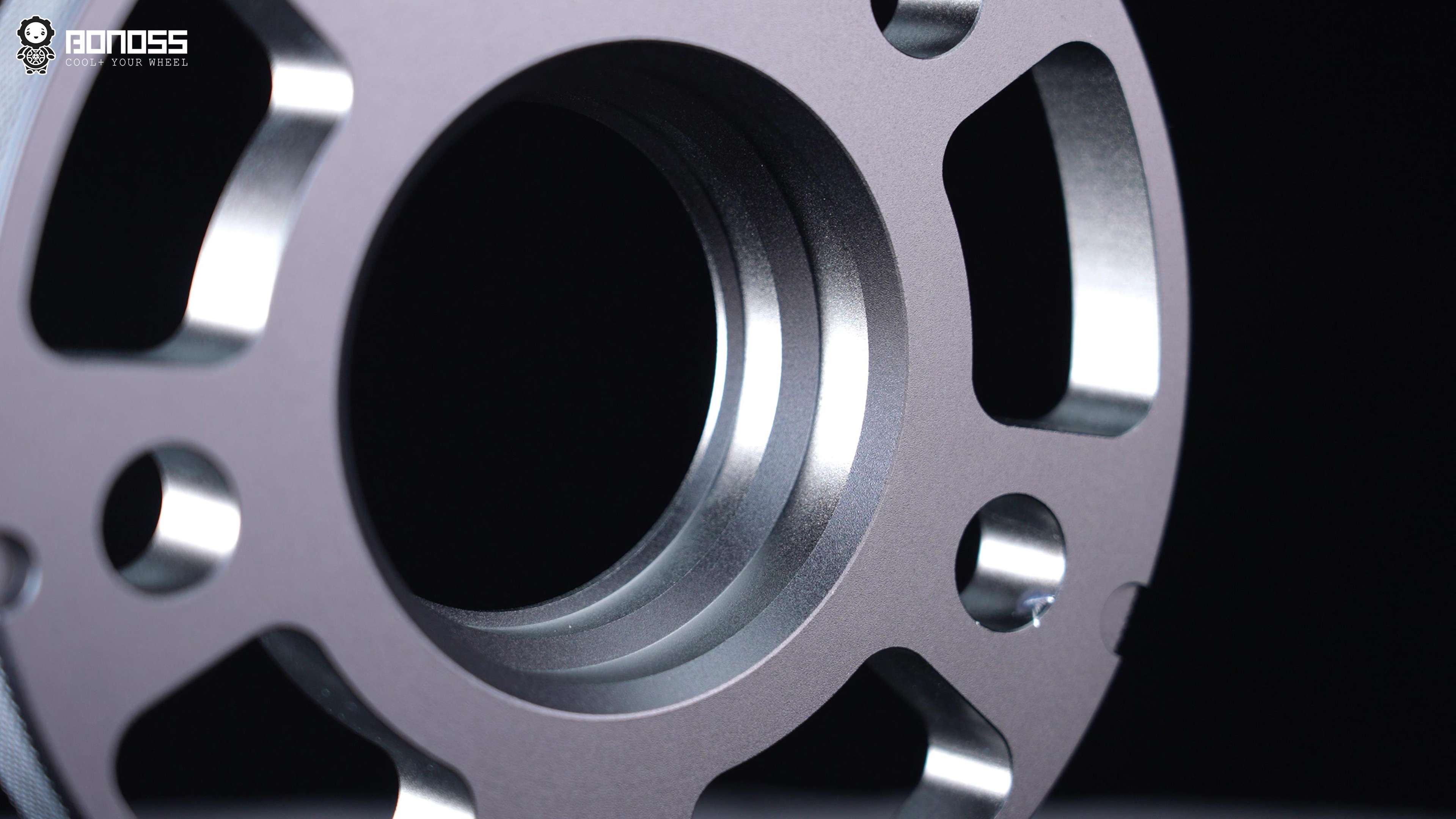
Two habits worth stealing from this install: clean the hub register before seating the spacer, because a thin layer of rust scale between the mating faces undoes the precision you paid for; and re-check bolt torque after the first stretch of driving, following the interval in the BONOSS installation instructions. Neither step costs anything. Both protect everything.
Rubbing and Clearance Check
Because the fender gaps were measured before the spacers were chosen — not after — there was no suspense here. At full steering lock in both directions and over the kind of driveway aprons and dips that compress a suspension, the tires clear the fender liners with room to spare. That was on installation day. The more meaningful clearance test is the one that has been running ever since: 9,300 miles of daily driving with zero contact, zero rub marks, and zero complaints. Worth underlining why: the clearance margin was engineered in before purchase, not discovered after. Measuring first is what turns “should be fine” into “is fine.”
What Mr. Allen Reported After 9,300 Miles
Mr. Allen’s first words after the install:
“Been wanting spacers for my ’21 E-Class for a while now, finally pulled the trigger. Had no idea which size would fit right, but these guys helped me get the correct size. Got them on and fitment is spot on—stance looks great. Quality is solid, and I’m confident they’ll last a few years. Highly recommend.”
And his follow-up after putting real distance on the setup:
“Super impressed with these spacers. Support team was knowledgeable and professional. Great price for a top-quality product. 9,300 miles in—no vibrations, no weird noises, zero issues.”
That second quote is the one that matters. Wheel spacer horror stories almost always trace back to guessed sizes, lug-centric fit, wrong bolts, or wrong torque — four variables this install nailed down with a ruler, a caliper, a micrometer, and a torque wrench. Nine thousand three hundred miles of silence from the suspension is what getting all four right sounds like.
Build Sheet: Copy This W213 Setup
Everything used on this car, in one place:
- Vehicle: 2021 Mercedes-Benz E-Class (W213), stock suspension and body
- Wheels and tires: OEM 18-inch, 245/45ZR18, ET+43
- Front spacers: BONOSS forged lightweight plus, 15mm, 5×112, hub-centric, 6061-T6
- Rear spacers: BONOSS forged lightweight plus, 12mm, 5×112, hub-centric, 6061-T6
- Front bolts: ISO grade 12.9 extended wheel bolts, M14x1.5, R14 ball seat, 60mm thread
- Rear bolts: ISO grade 12.9 extended wheel bolts, M14x1.5, R14 ball seat, 57mm thread
- Torque: 140 Nm (103.5 ft-lb) on BONOSS spacer hardware, per BONOSS installation instructions
- Cost: $139.99 for the front pair with bolts, $136.99 for the rear pair with bolts, $20 labor — $296.98 all-in
If your E-Class is stock-bodied and riding on the factory 18s, this sheet transfers directly. If you have changed wheels, offsets, or suspension, treat this as the method rather than the answer: measure your own gaps, then pick your own numbers.
The Hardware Behind It: Test Data, Not Brochure Talk
We keep this section short because the case above is the real argument, but the paperwork deserves a mention. The 6061-T6 spacer material carries a TÜV-tested hardness of 101–103 (test method ISO 6506-1:2014, report here) and survived a 240-hour neutral salt spray exposure with no defects (ISO 9227:2022+Amd 1:2024, report here). The M14x1.5 ISO grade 12.9 extended bolts tested at 1236 MPa tensile strength under SGS (ISO 898-1:2013+Cor-1:2013, report here), with a TÜV-run test of a separate sample batch reading 1273 MPa (report here).
Why two different tensile numbers? Different laboratories, different sample batches, and ordinary measurement scatter — both readings comfortably exceed the grade 12.9 requirement, and both come from actual certificates. The same logic applies elsewhere in the paperwork: the nuts test differently from the wheel bolts because they are different parts with different thread engagement, and M14x1.5 hardware does not share data with M14x1.25 hardware. Across the program there are over 75 SGS and TÜV test reports, and the honest way to read them is exactly this way — certificate by certificate.
FAQ: 2021 E-Class Spacer Questions, Answered
Are 15mm wheel spacers safe on a 2021 Mercedes E-Class?
Yes — provided the spacers are hub-centric, the bolts are extended to preserve thread engagement, and everything is torqued to spec. This car is the evidence: correct 60mm and 57mm bolts restoring the stock 45mm engagement, 0.055mm-per-side hub-centric clearance, proper two-stage torque, and 9,300 trouble-free miles. The hardware itself is independently tested — the grade 12.9 fasteners carry SGS and TÜV tensile certificates well above their rating. Safety failures come from skipping those steps, not from the spacers themselves.
What bolt pattern do I need for 2021 Mercedes E-Class wheel spacers?
The 2021 E-Class (W213) uses a 5x112mm bolt pattern, a 66.6mm center bore, and M14x1.5 wheel bolts with an R14 ball seat. Any spacer you buy must match all four specifications — the pattern alone is not enough.
What is the correct torque spec for 2021 E-Class wheel spacers?
Since this install uses BONOSS extended bolts throughout, the final torque is 140 Nm (103.5 ft-lb). Two values, two fastener sets: 140 Nm (103.5 ft-lb) on the BONOSS hardware, per BONOSS installation instructions, and 150 Nm (110 ft-lb) on the OEM wheel bolts, per the owner’s manual. Use each value only on its own fastener set.
Can wheel spacers cause vibration on a W213 E-Class?
They can when the fit is lug-centric or the machining is sloppy — but a properly hub-centric setup runs silent. Vibration almost always means the wheel is being centered by the bolts instead of the hub, so tiny runout turns into shake at highway speed. Our spacer lip leaves just 0.055mm of radial clearance against the OEM wheel bore, the 0.02mm CNC tolerance keeps everything concentric, and this car has logged 9,300 miles with no vibrations at all.
Why are the hub measurements different on the car, the wheel, and the spacer?
Because they are three different mating faces with three different jobs. The axle hub measured 66.42mm, the OEM wheel bore 66.61mm — even the factory leaves 0.19mm for assembly tolerance and corrosion allowance. The spacer’s 66.5mm lip splits the difference to stay tight against the wheel while its multi-stage inner bore matches the hub. Matching two dimensions on one part is exactly why 0.02mm-class machining matters.
Do W213 E-Class spacers fit a C-Class or GLC?
Often the pattern and bore match — many Mercedes models share 5×112 and a 66.6mm center bore — but bolt length, brake clearance, and fender gaps are model-specific. Measure your own car the way we measured this one instead of assuming a parts-bin swap.
Conclusion: The Flush Look, Earned With a Ruler
Mr. Allen’s 2021 Mercedes-Benz E-Class 15mm spacers project succeeded because nothing was assumed. The staggered 15mm/12mm pairing came from measured fender gaps, the 60mm and 57mm bolts came from measured thread engagement, the hub-centric fit came from three separate precision measurements, and the result has now proven itself over 9,300 miles. If you are ready to buy 2021 Mercedes E-Class wheel spacers with the same measured approach, the exact hardware from this case — the BONOSS forged lightweight plus wheel spacers for the W213 E-Class, backed by a 10-year warranty — is the best-price starting point we can point to, because we watched it work.

About Daisy Harris
Daisy Harris has worked for 6 years at BONOSS as an automotive technician, installing and testing wheel spacers, wheel nuts, and wheel bolts. She has personally installed and verified more than 200 wheel-spacer setups across sport sedans, SUVs, and EVs. Her installation guides and reviews are built on real installs, measured clearances, and long-term wear notes — not on spec sheets.