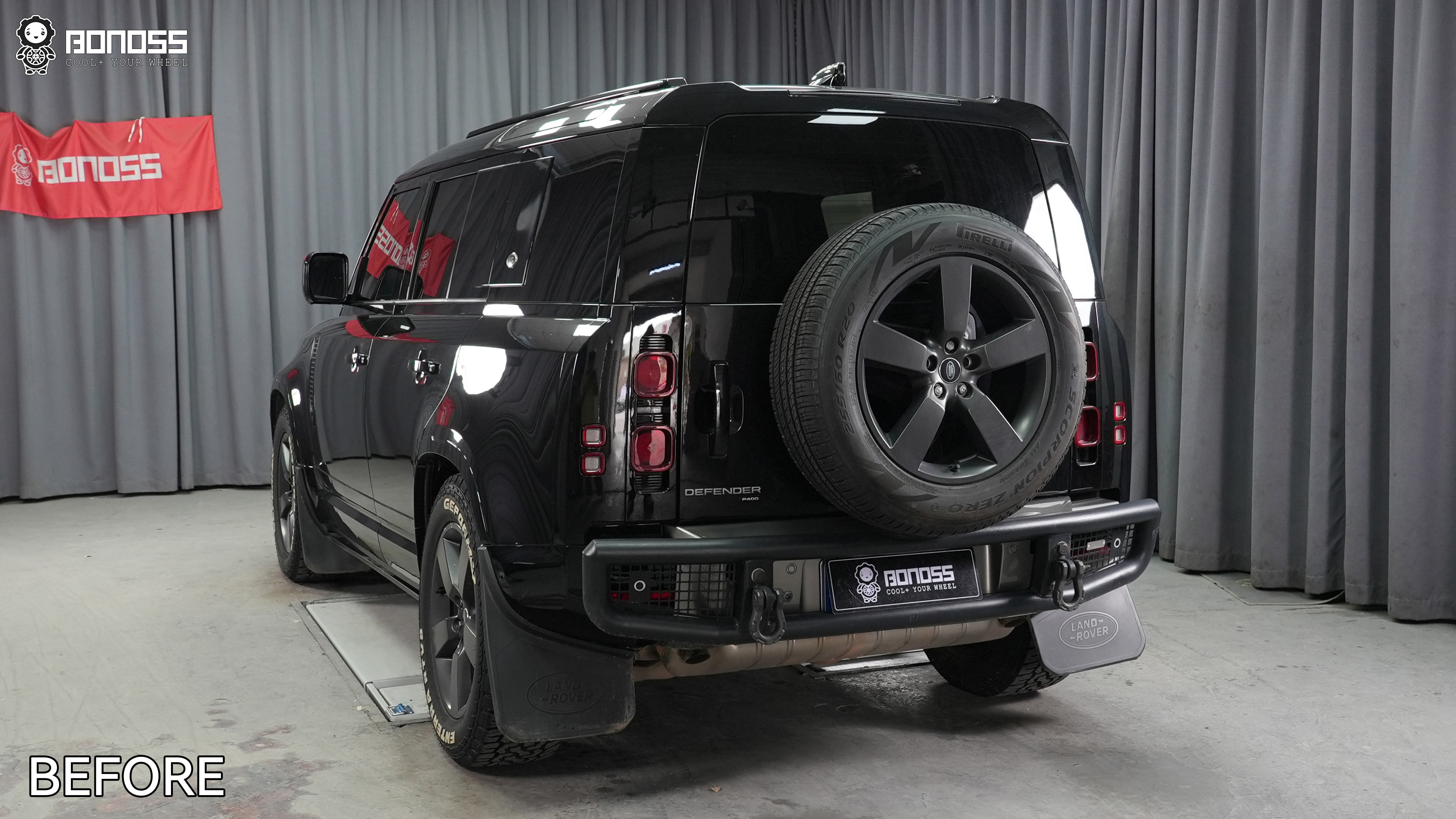
After 6,000 miles of daily driving and off-road trips, the 2023 Land Rover Defender 35mm wheel spacers from BONOSS have earned a straightforward verdict: they work, they hold up, and they solved a real problem that thicker tires created. Nicholas Collins runs a 2023 Defender 110 (L663) with 275/60R20 all-terrain rubber swapped over the factory 255/60R20s. The front looked planted. The rear sat deep under the arches — tucked, narrow, visually unbalanced against the front track. A 35mm rear-only setup fixed the stance and, critically, kept the factory studs intact. Thinner spacers would have required cutting them.
The Defender L663 — Land Rover’s current-generation platform introduced in 2019, replacing the L316 that ran from 1983 through 2016 — runs a 5x120mm bolt pattern with a 72.5mm hub bore and M14x1.5 thread pitch. Those are dimensions shared with several European platforms, but the hub-centric matching has to be precise. If you’re working through your own sizing math, our Defender L663 spacer sizing reference breaks down stud lengths, hub step heights, and offset calculations in detail.
Here’s what six months and 6,000 miles of real-world use revealed.
Spec Quick Reference
| Item | Value |
|---|---|
| Vehicle | 2023 Land Rover Defender 110 (L663) |
| Bolt Pattern (PCD) | 5x120mm |
| Hub Bore — Vehicle (measured) | 72.48mm |
| Hub Bore — Spacer | 72.5mm |
| Wheel Center Bore (measured) | 72.61mm |
| Thread Size | M14x1.5 |
| Factory Lug Nut Seat & Socket | Flat seat, 22mm hex |
| Spacer Thickness | Rear 35mm |
| Material | Forged 6061-T6 aluminum |
| OEM Wheel | 255/60R20, ET+41.5mm |
| AT Tire Fitted | 275/60R20 |
| Resulting Offset (Rear) | ET+6.5mm |
| Hub Step Height (Front / Rear) | 12.37mm / 12.38mm |
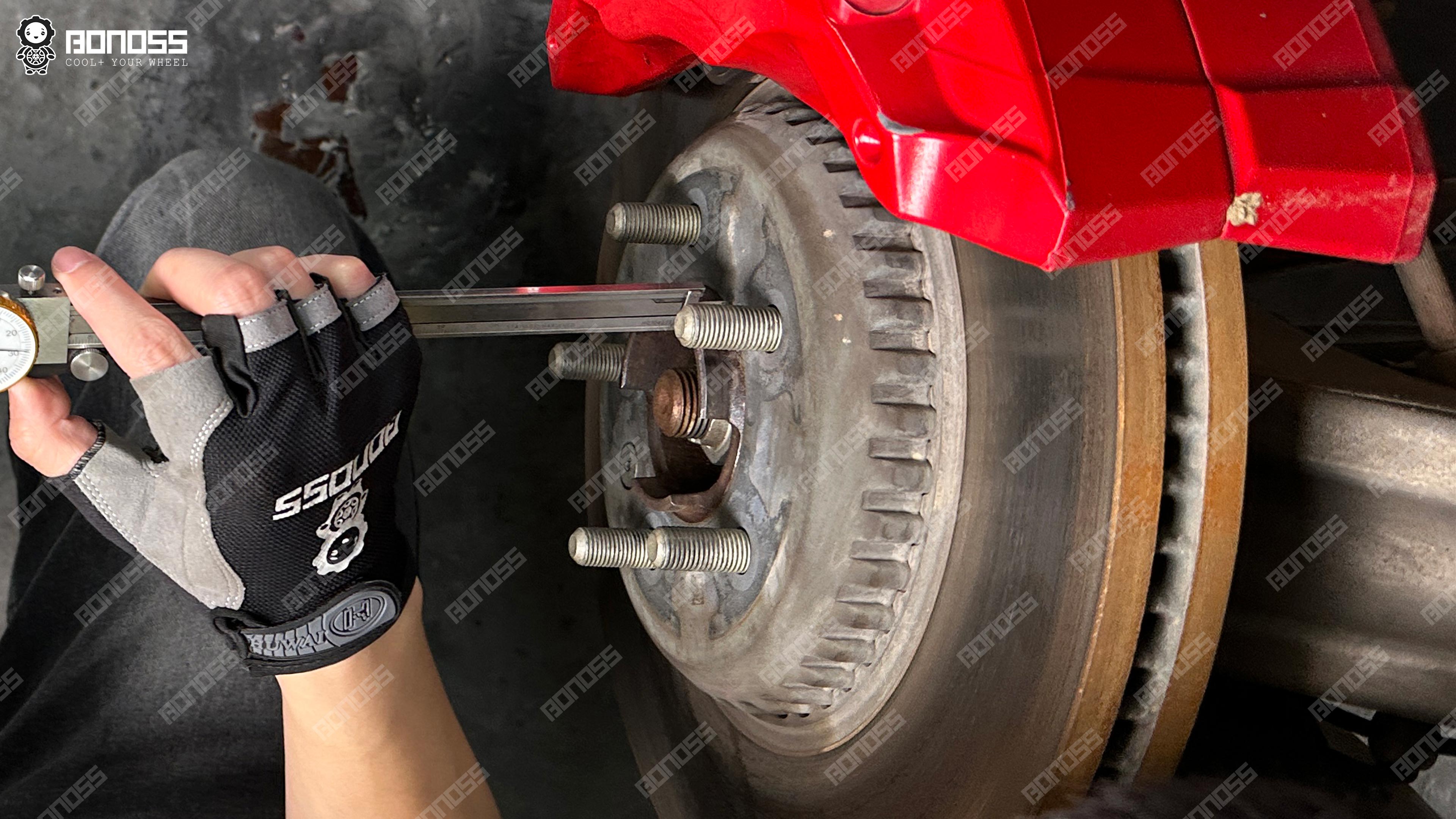
| Stud Protrusion (Front / Rear) | 28.31mm / 28.23mm |
| Wheel Pocket Depth | 5.82mm |
| Torque — Spacer to Hub (BONOSS nuts) | 140 Nm (103.5 ft-lb) per BONOSS installation instructions |
| Torque — Wheel to Spacer (factory nuts) | 140 Nm (103.5 ft-lb) per the owner’s manual |
Use ONE torque value for the entire installation — both specifications call for 140 Nm (103.5 ft-lb). Match the source to the hardware being torqued. When uncertain, confirm compatibility and use the more conservative figure.
The Problem: AT Tires and a Tucked Rear
Nicholas picked up his 2023 Defender 110 and almost immediately swapped the stock 255/60R20 tires for 275/60R20 all-terrain rubber. Wider tread, more aggressive sidewall, better grip in dirt and gravel. The front end looked planted and aggressive — the kind of stance that makes the Defender look ready for anything.
The rear? It looked like the wheels were hiding.
The factory wheels carry an offset of ET+41.5mm. When you mount a tire that’s 20mm wider on the same barrel, the extra width splits roughly evenly — half pushes outward, half pushes inward. The inward portion eats into your inner clearance, and the outward portion doesn’t compensate enough. Net result on the Defender: the rear sat tucked, looking narrow and top-heavy. The track width difference between front and rear was visually jarring at curb-side.
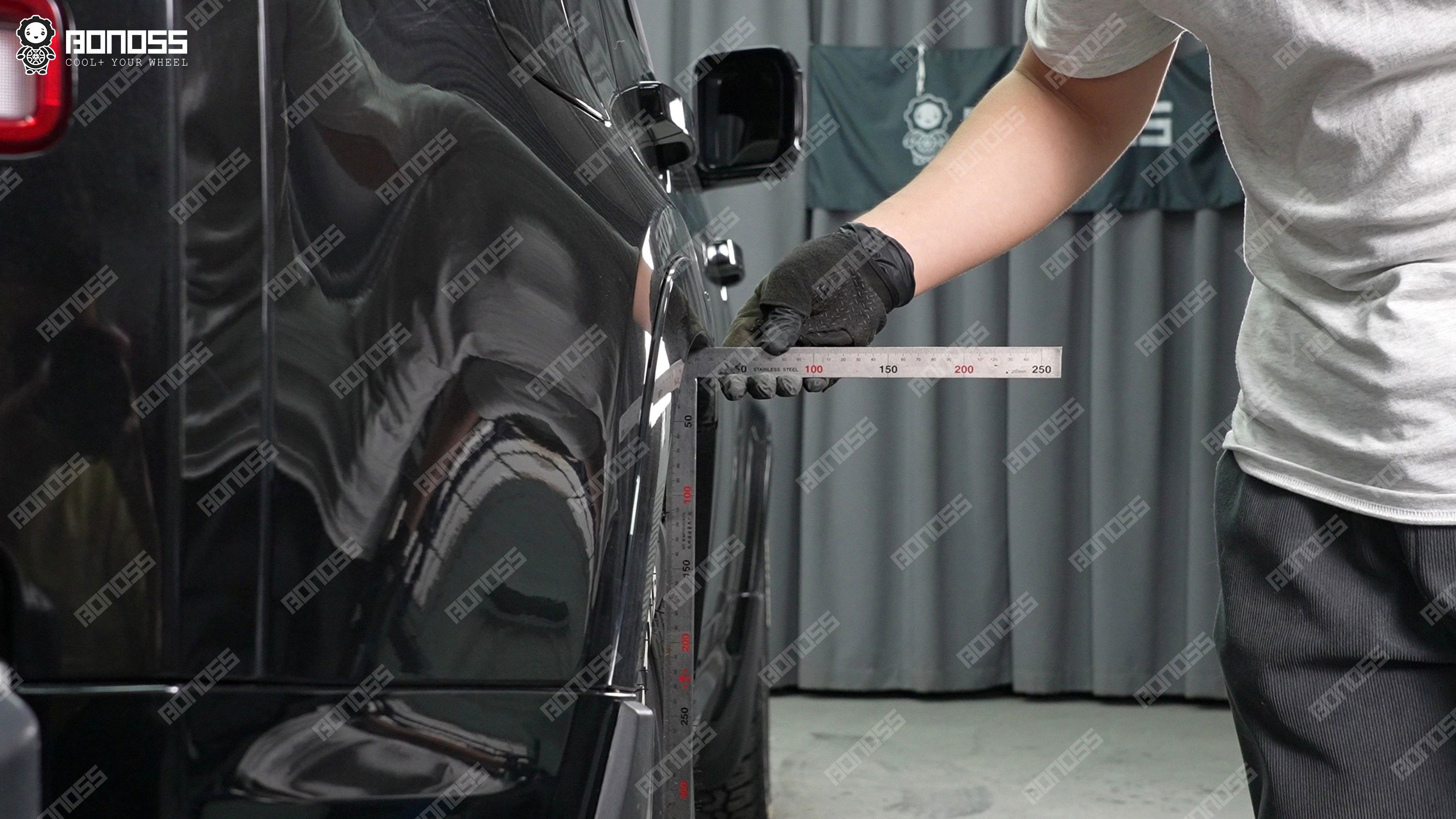
Our team measured the right rear fender clearance with a high-accuracy ruler to determine how much push was safe. The measurement confirmed that 35mm would bring the tire face flush with the arch — not poking past, not still tucked. Less than that and the visual imbalance would persist. More than that and the tire would risk contacting the fender lip at full suspension compression, especially off-road where articulation is unpredictable.
As Nicholas put it:
“Swapped on new AT tires and the front looked good, but the rear sat way too tucked for my liking. Shoutout to BONOSS, they walked me through everything and got me the right spacers with the exact size and type I needed.”
20mm vs 35mm Defender Spacer: Why Thickness Matters
Here’s where most people get it wrong. They pick 20mm spacers because the number sounds reasonable, bolt them on, and discover the factory studs stick out past the spacer face. On a 20-inch Defender wheel, the pockets aren’t deep enough to swallow protruding studs — so you either trim the studs with a hacksaw or return the spacers.
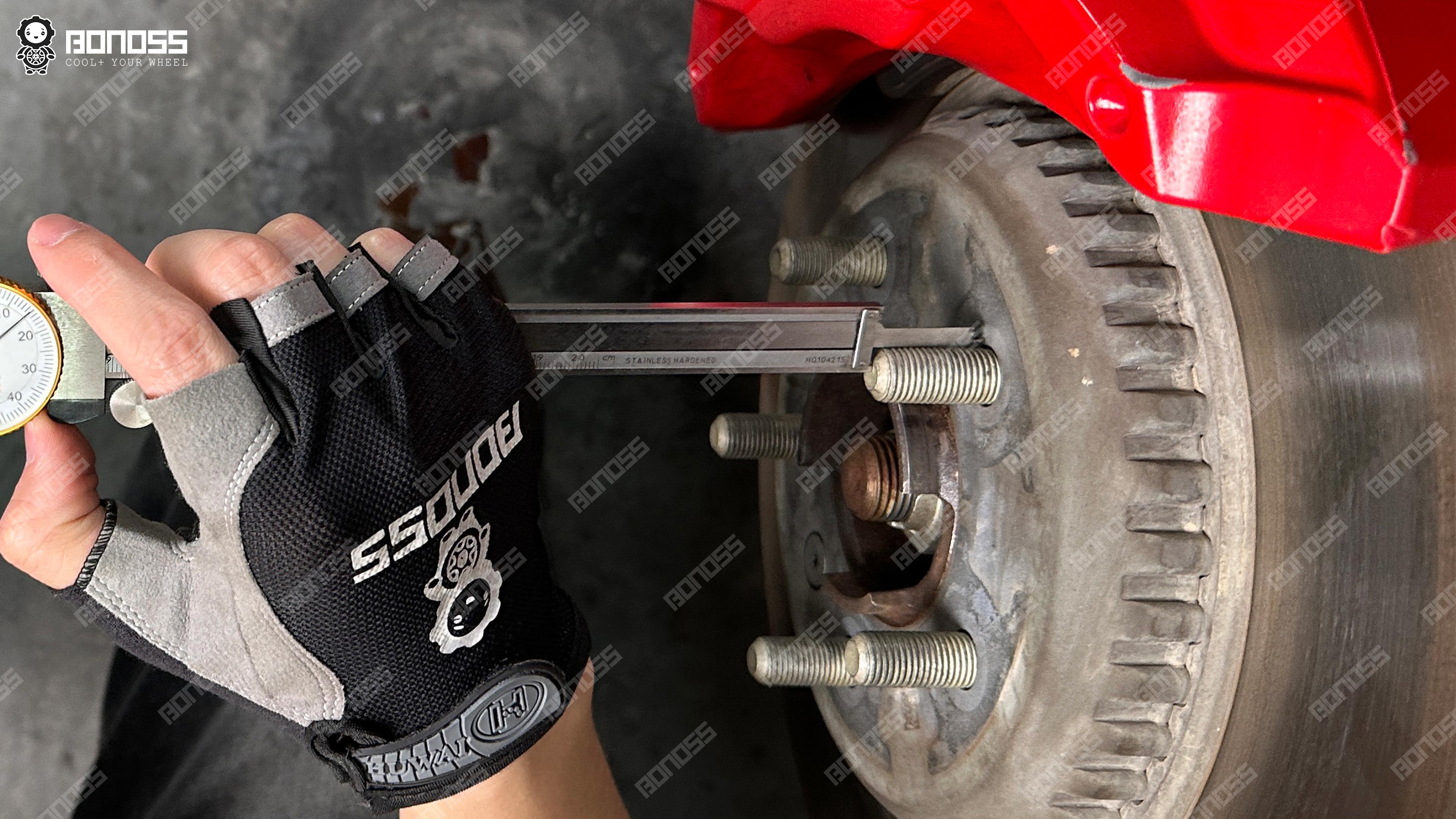
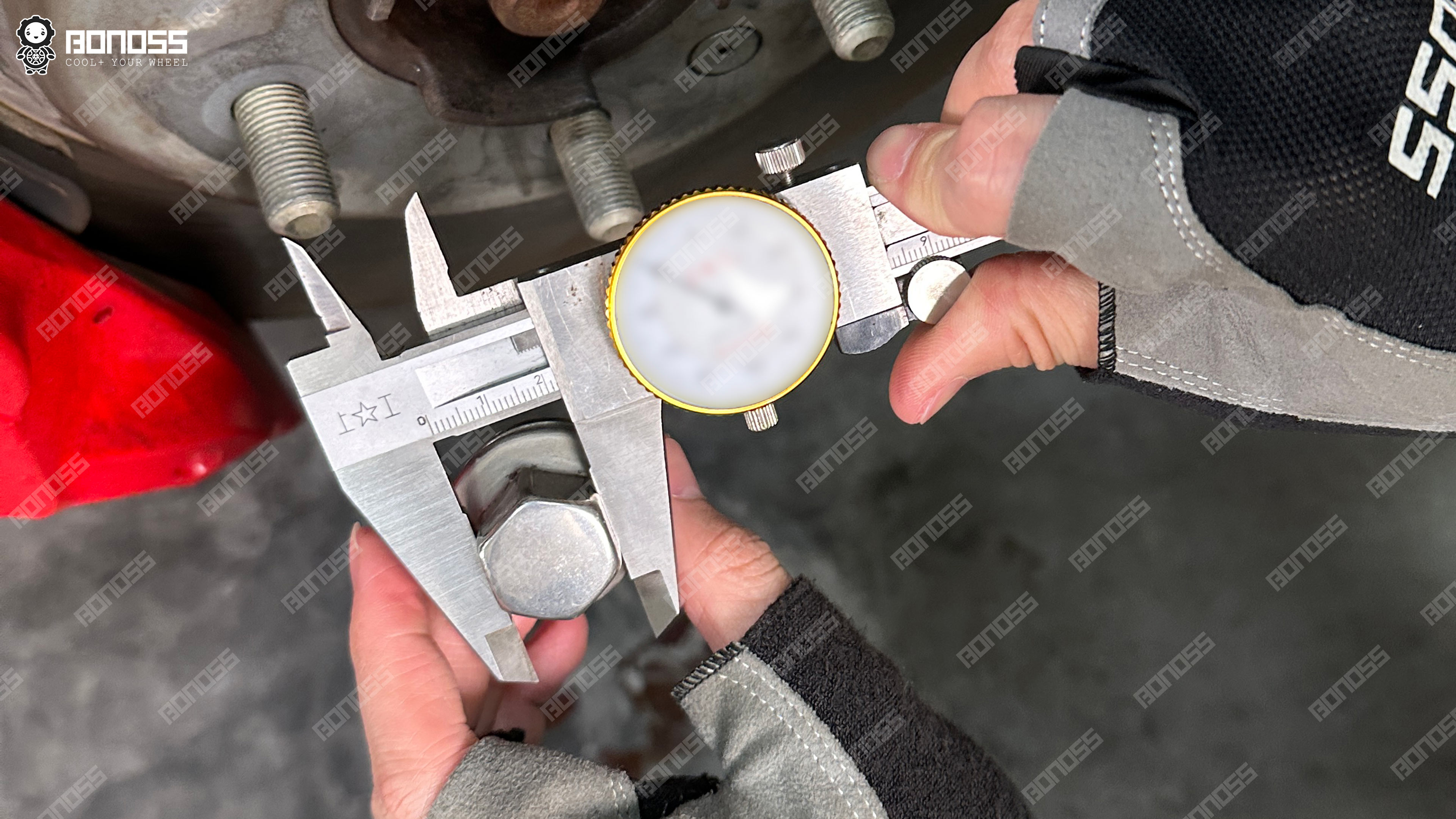
We measured the factory stud protrusion on both axles with a vernier caliper. Front studs measured 28.31mm from the hub face to the threaded tip. Rear studs measured 28.23mm. Then we measured the wheel pocket depth — the recessed relief on the back of the wheel where the stud would sit — at 5.82mm on the vernier caliper.
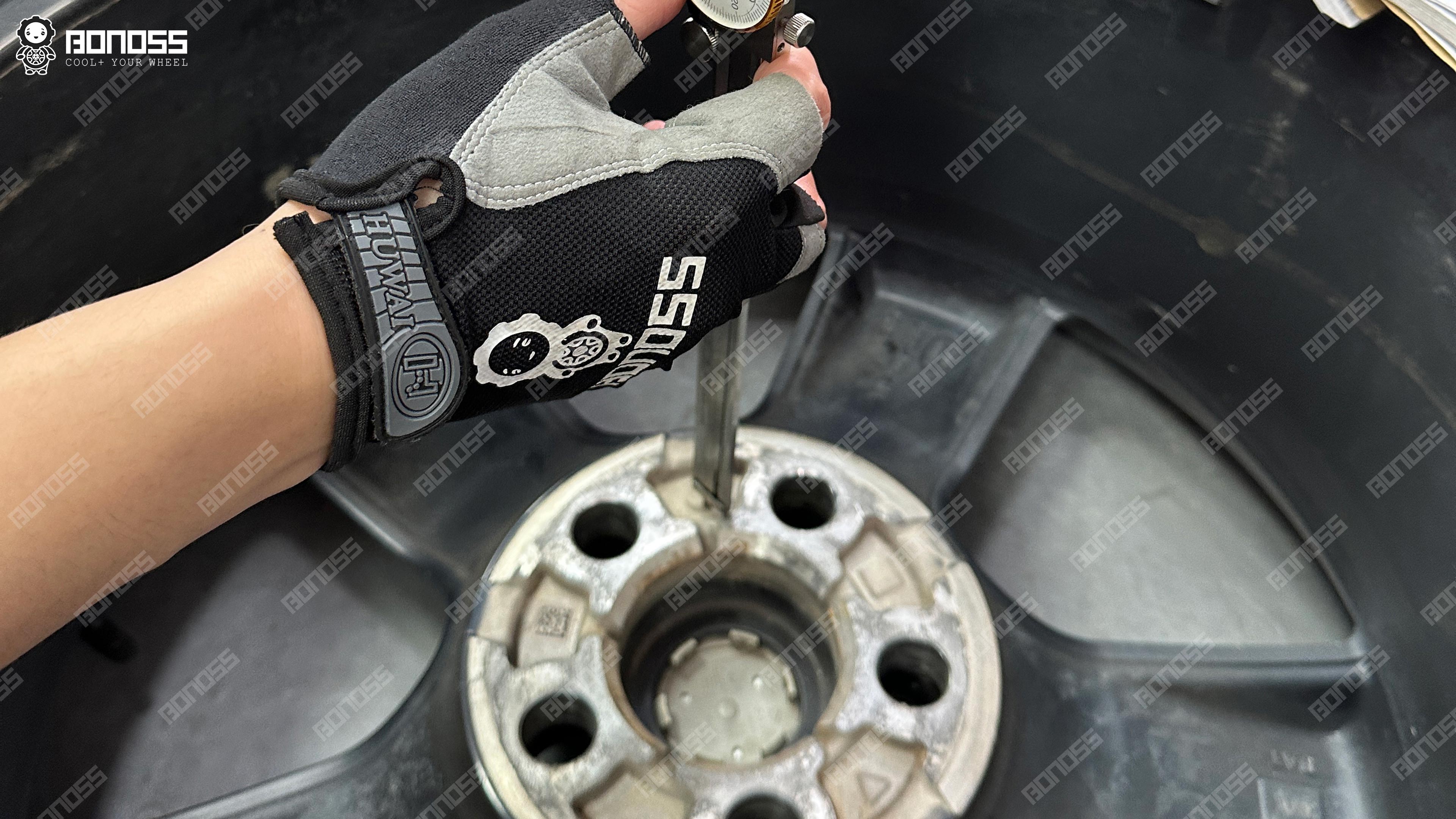
The math is simple and unforgiving. A 20mm spacer leaves 8.23mm of factory stud sticking past the spacer face (28.23 minus 20). The wheel pocket only has 5.82mm of depth. That’s a 2.41mm overrun — the wheel physically cannot seat flat against the spacer. You’d be torquing down on a gap, which is exactly how you get vibration, loose hardware, and damaged wheels.
Bump up to 25mm and the numbers barely work: 28.23 minus 25 equals 3.23mm of protrusion, which fits within the 5.82mm pocket.
At 35mm: 28.23 minus 35 equals -6.77mm. The factory studs are fully buried inside the spacer body. No trimming. No clearance drama. The spacer’s own ISO Grade 12.9 studs handle the wheel-side load entirely.
Hub-Centric vs Lug-Centric 5×120: Why It Matters
A spacer sits between two mating surfaces — the vehicle hub on one side and the wheel center bore on the other. These aren’t the same size, and they’re not supposed to be.
Here’s what we measured on Nicholas’s Defender:
- Vehicle hub outer diameter: 72.48mm (vernier caliper)
- Wheel center bore: 72.61mm (micrometer)
- BONOSS spacer hub outer diameter: 72.5mm
The factory wheel bore (72.61mm) is already 0.13mm larger than the vehicle hub (72.48mm). That’s not a defect. Manufacturers build in assembly clearance, tolerance stack-up margin, and anti-corrosion allowance. Zero-interference fits are rare in production vehicles.
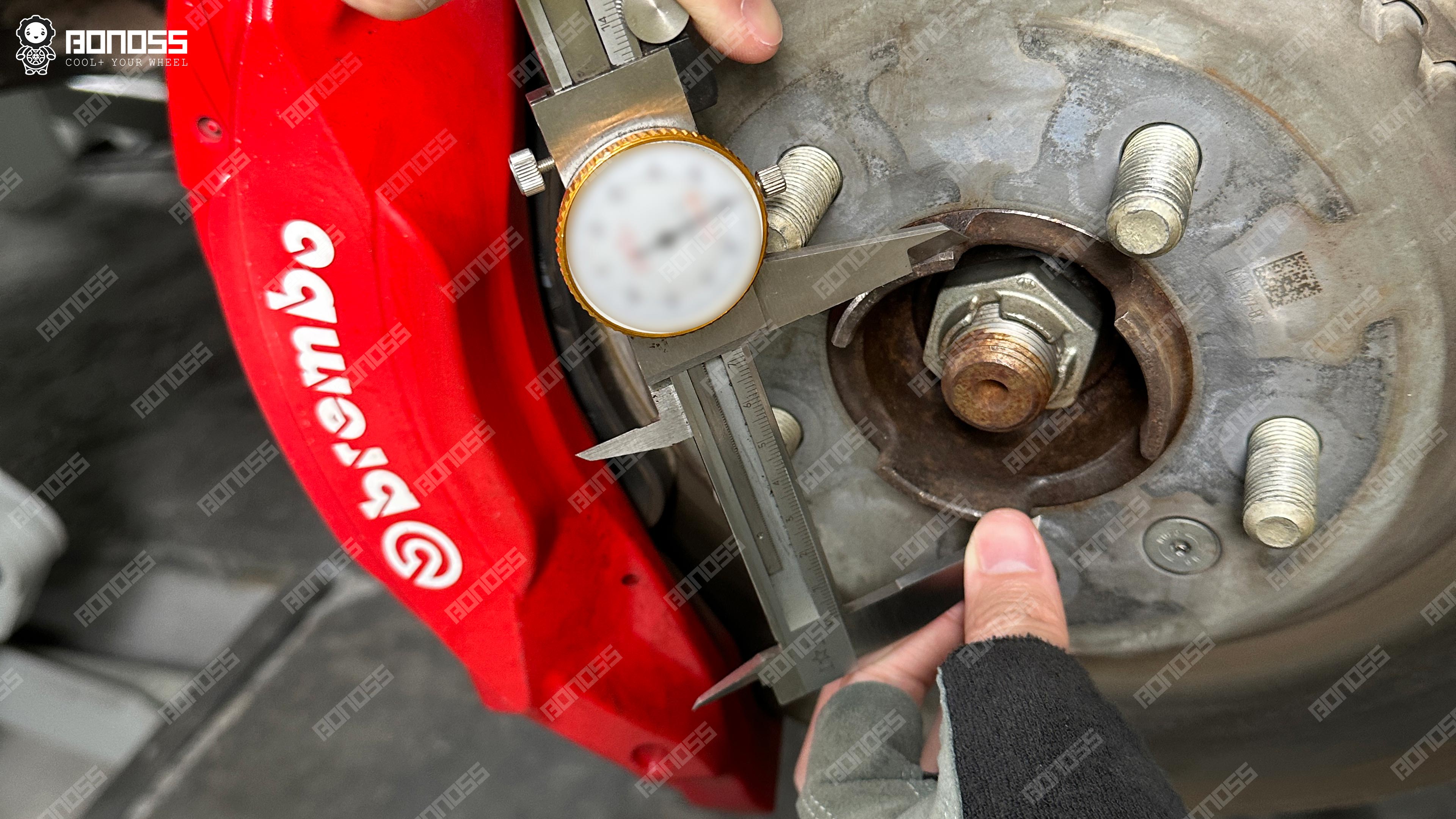
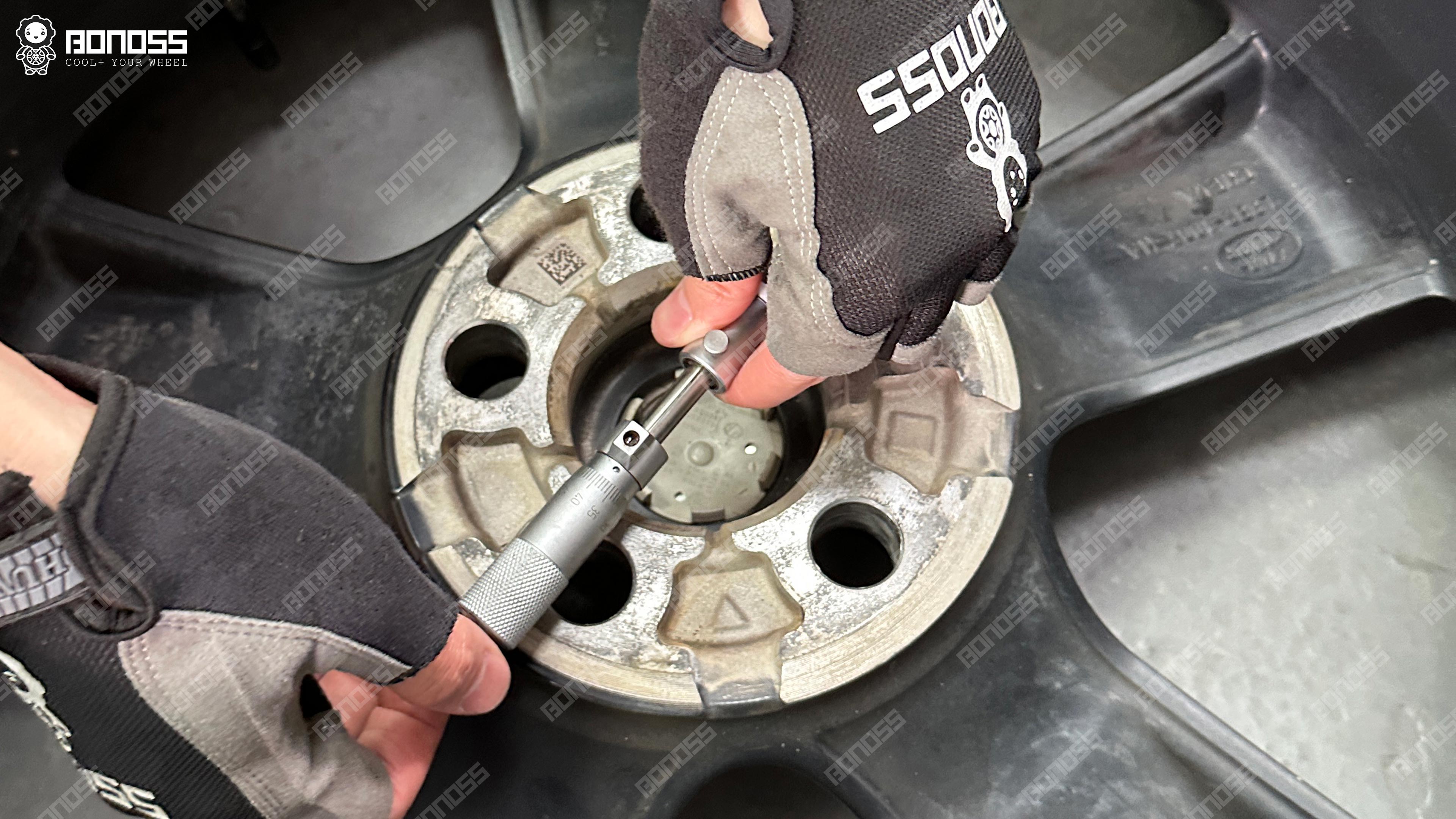
The BONOSS spacer splits the difference between the two surfaces. Its 72.5mm outer diameter creates a 0.11mm diametral clearance with the 72.61mm wheel bore — that’s 0.055mm per side. On the vehicle side, the spacer’s multi-stage internal hub structure nests onto the 72.48mm factory hub through a series of stepped bores that match the hub’s stepped register. This dual-sided matching is why CNC machining tolerance matters so much. BONOSS machines to 0.02mm precision, which keeps the concentricity tight enough to prevent high-speed vibration and uneven bolt loading.
A lug-centric spacer doesn’t center on the hub at all — it relies entirely on the lug nuts to find center through the bolt holes. That works on some applications but introduces more runout risk, especially at highway speeds and under braking. For a 5×120 platform carrying a 2,700-plus-pound axle load and seeing off-road articulation, hub-centric is the correct approach. The hub register carries the radial load; the studs carry only clamping force. That’s how the factory designed it, and that’s what a proper spacer preserves.
One note on L663 vs L316 spacers compatibility: the previous-generation L316 Defender uses a completely different hub diameter and bolt pattern. Spacers are absolutely not interchangeable between the two platforms. If you’re running an older Defender, check your specific hub bore before ordering — the numbers are different.
What You’re Getting: Active Cooling and Forged 6061-T6
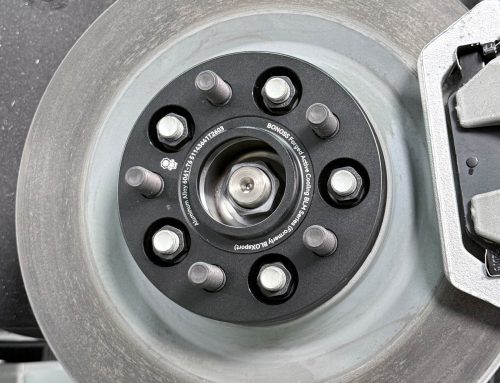
The BONOSS spacers Nicholas installed are forged active cooling hub-centric spacers for the Defender L663, machined from 6061-T6 aluminum with a few design features worth understanding before you spend money.
Active cooling grooves. The spacer body features machined cooling channels on the mating face. The concept is straightforward: as the wheel and brake rotor heat up during hard driving or long descents, the grooves create airflow paths that help move heat away from the hub assembly. On a Defender doing off-road work in summer heat — where brake temps climb and hub bearings take a beating — thermal management isn’t a gimmick. It’s a functional design choice that addresses a real failure mode.
Forged 6061-T6 construction. Forging compresses and aligns the grain structure of the aluminum billet, producing higher shear and tensile strength than casting at equivalent weight. The material itself carries third-party verification: TÜV Rheinland tested the 6061-T6 material at 101-103 HBW hardness per ISO 6506-1:2014, and the same material passed 240 hours of neutral salt spray exposure with zero defects per ISO 9227:2022+Amd 1:2024. That’s relevant for anyone driving in winter conditions or coastal environments.
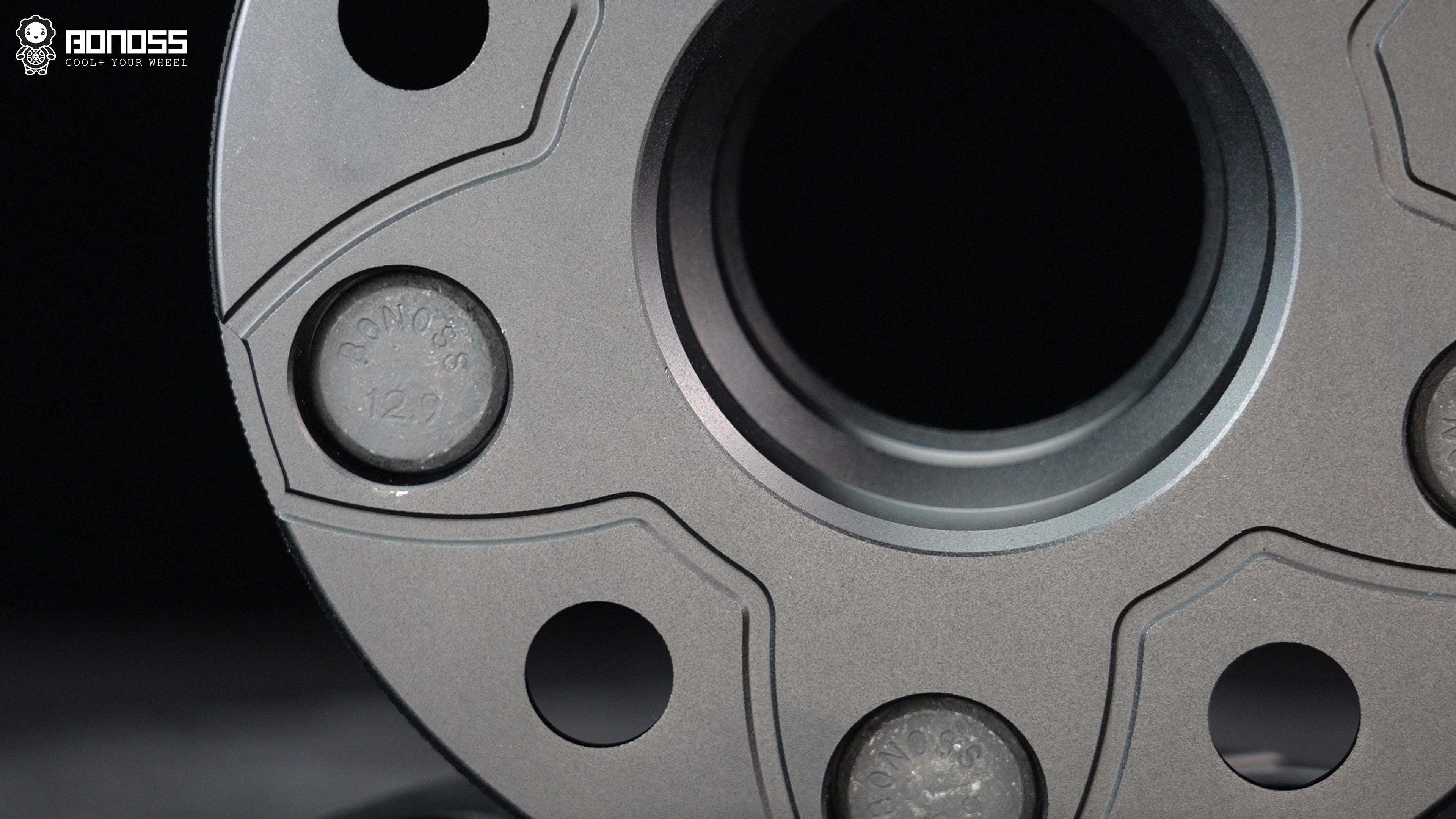
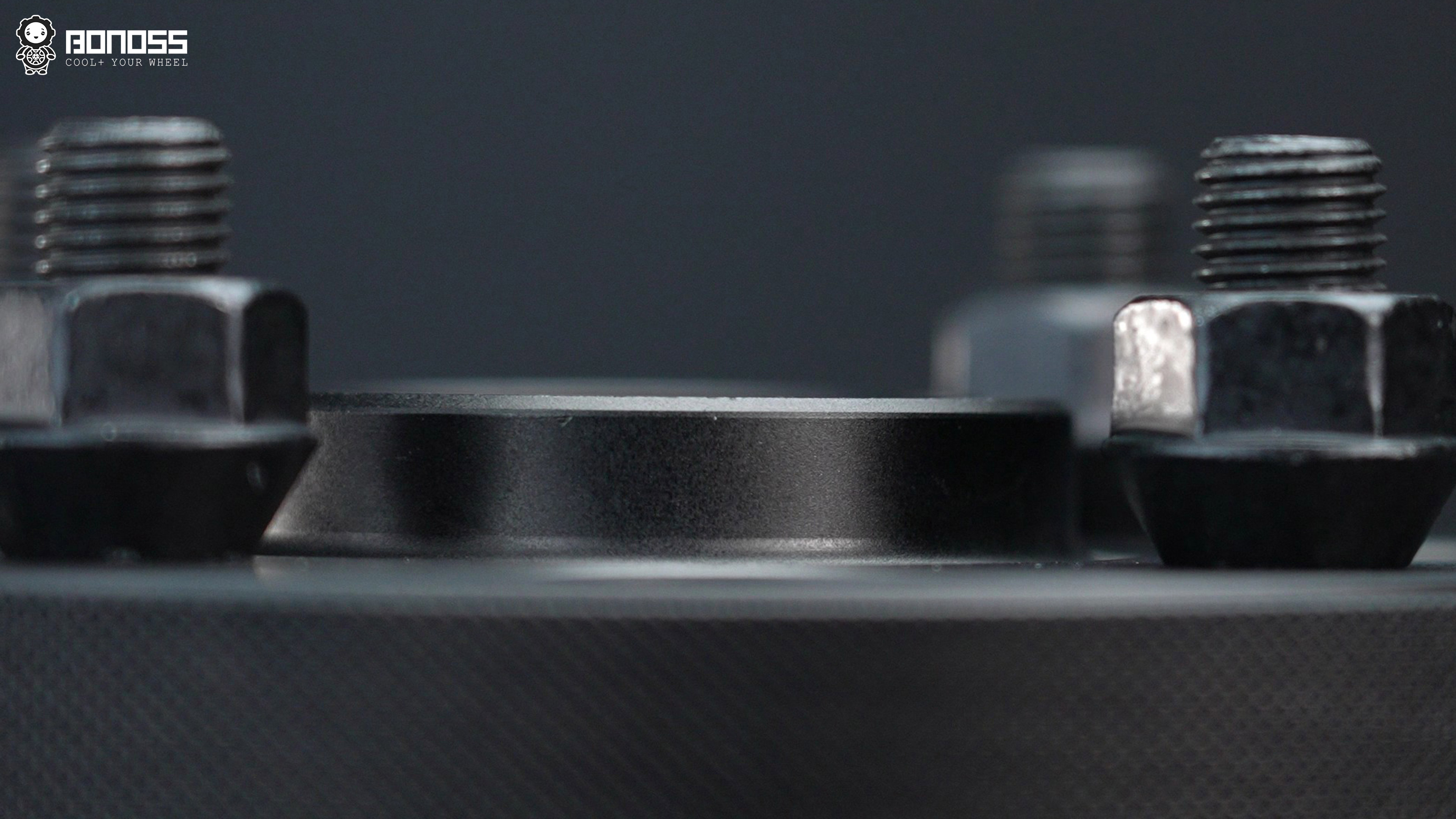
ISO Grade 12.9 wheel studs and Grade 10 nuts. The spacer’s integral studs are M14x1.5, ISO Grade 12.9 — matching the Defender’s factory thread pitch. SGS tested these studs at 1,268 MPa tensile strength (ISO 898-1:2013+Cor-1:2013), 391-401 HV10 hardness (ISO 6507-1:2018), and 121 kN proof load (ISO 898-1:2013+Cor-1:2013). TÜV independently verified tensile at 1,233 MPa and hardness at 386-390 HV10.
The slight difference between SGS and TÜV readings on the same stud spec is normal and expected. Different laboratories, different sample coupons, and different measurement uncertainty bands all contribute to the variance. What matters is that both independent labs confirm the hardware exceeds Grade 12.9 requirements by a comfortable margin.
It’s also worth noting that stud and nut test values aren’t directly comparable. The nut is ISO Grade 10, tested at 358-362 HV0.5 hardness (ISO 6507-1:2018) and 138.8 kN proof load (ISO 898-2:2012) by SGS. Different part, different thread engagement method, different test protocol. Even within studs alone, an M14x1.5 and an M14x1.25 would produce different numbers because thread pitch affects the tensile cross-section. The point: don’t assume all 12.9-grade fasteners deliver identical readings. Check the actual certification reports for your specific hardware.
Installation: Bolt-On, No Drama
Nicholas’s installation was a rear-only setup — 35mm spacers on the back axle only. The front already looked good with the AT tires, so there was no reason to push the front track. This is a common approach on the Defender when the stance imbalance is rear-specific.
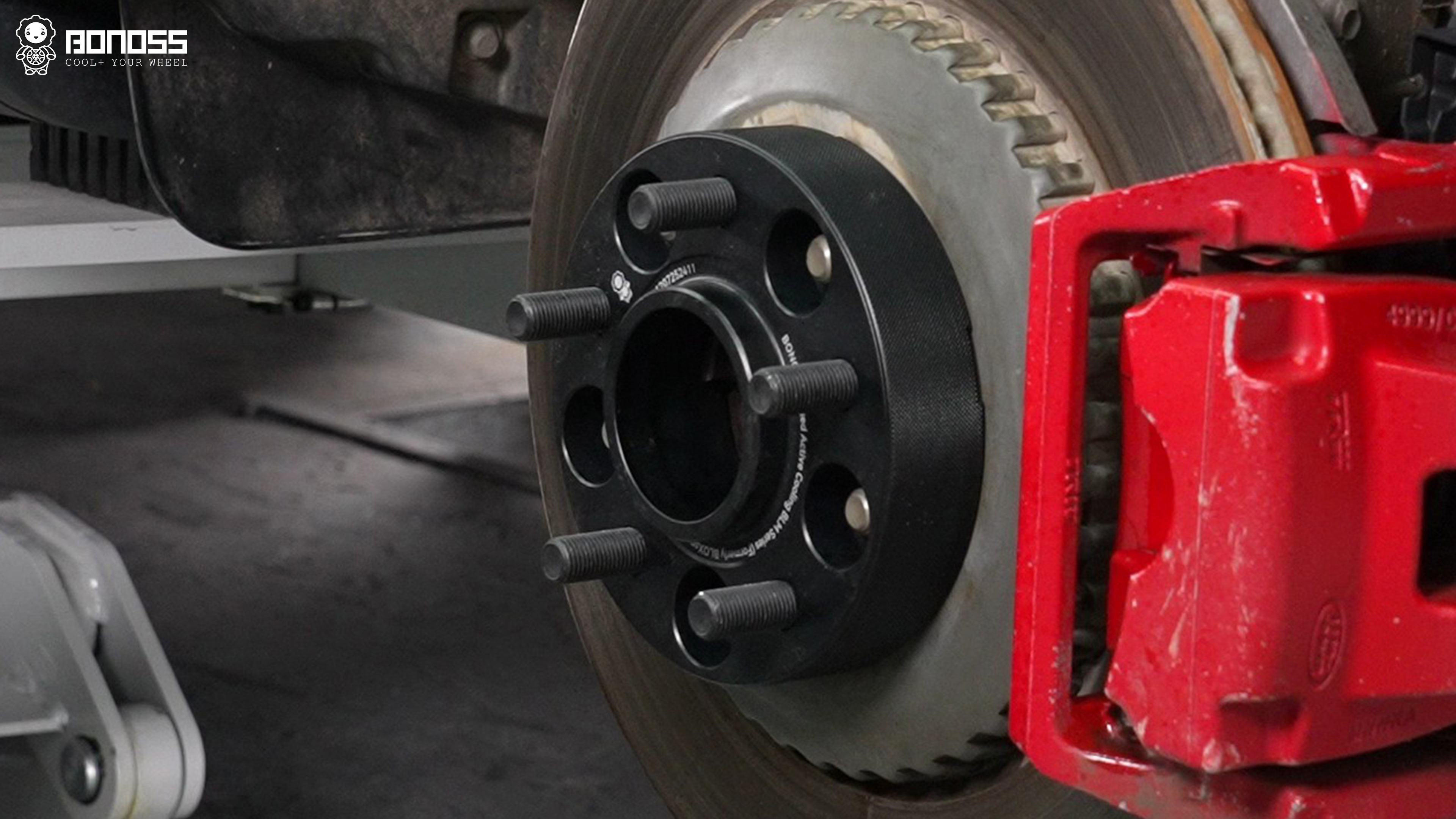
The process was straightforward. Remove the rear wheels. Clean the hub faces — road grime and corrosion on the register will throw off seating. Slide the spacers over the factory studs, ensuring the multi-stage internal bore nests onto the stepped hub register. Thread on the BONOSS-provided full-cone seat nuts and torque to 140 Nm (103.5 ft-lb) per BONOSS installation instructions. Remount the wheels on the spacer’s integral studs, and torque the factory flat-seat nuts to 140 Nm (103.5 ft-lb) per the owner’s manual.
A few details worth noting: the factory Defender hub has a stepped register — our measured rear hub step height was 12.38mm (vernier caliper). The spacer’s internal multi-stage bore is machined to match this stepped profile, which is why the spacer seats firmly without play. Brake caliper clearance was not an issue at 35mm — the spacer pushes the wheel outward, and the caliper stays put, so clearance only improves.
The factory lug nuts have a 22mm hex — we confirmed this on the vernier caliper. That means you’ll need a standard 22mm socket for the wheel-side torque, same as stock. No special tools, no trip to the hardware store.
Labor came in at $20. Total outlay: $158.99 for two forged 6061-T6 spacers plus $20 labor equals $178.99. That’s the price of a single aftermarket wheel — and you get to keep the factory wheels.
Defender L663 35mm Spacers Before and After: The Stance Fix
The visual transformation is immediate and unambiguous.
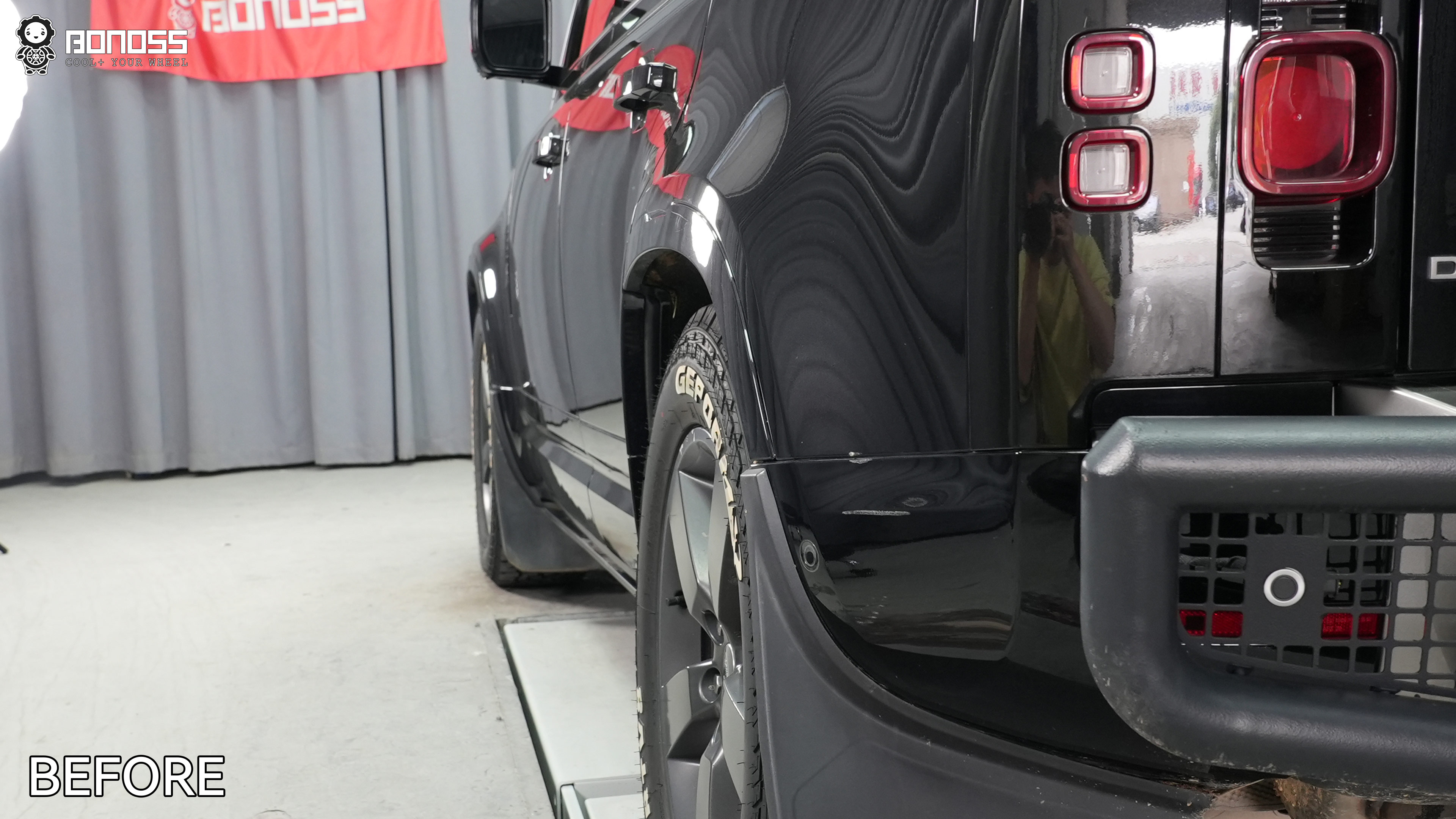
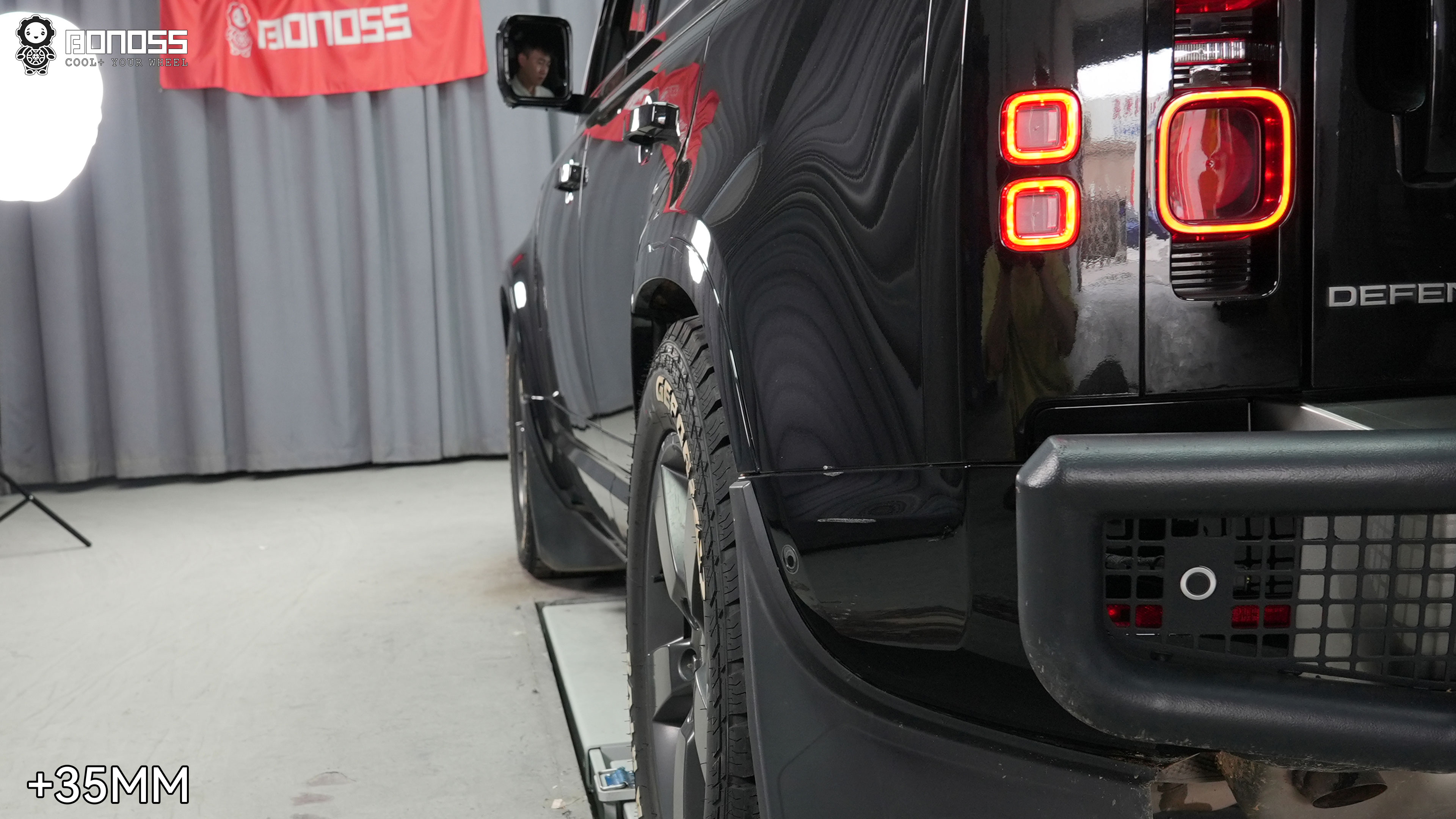
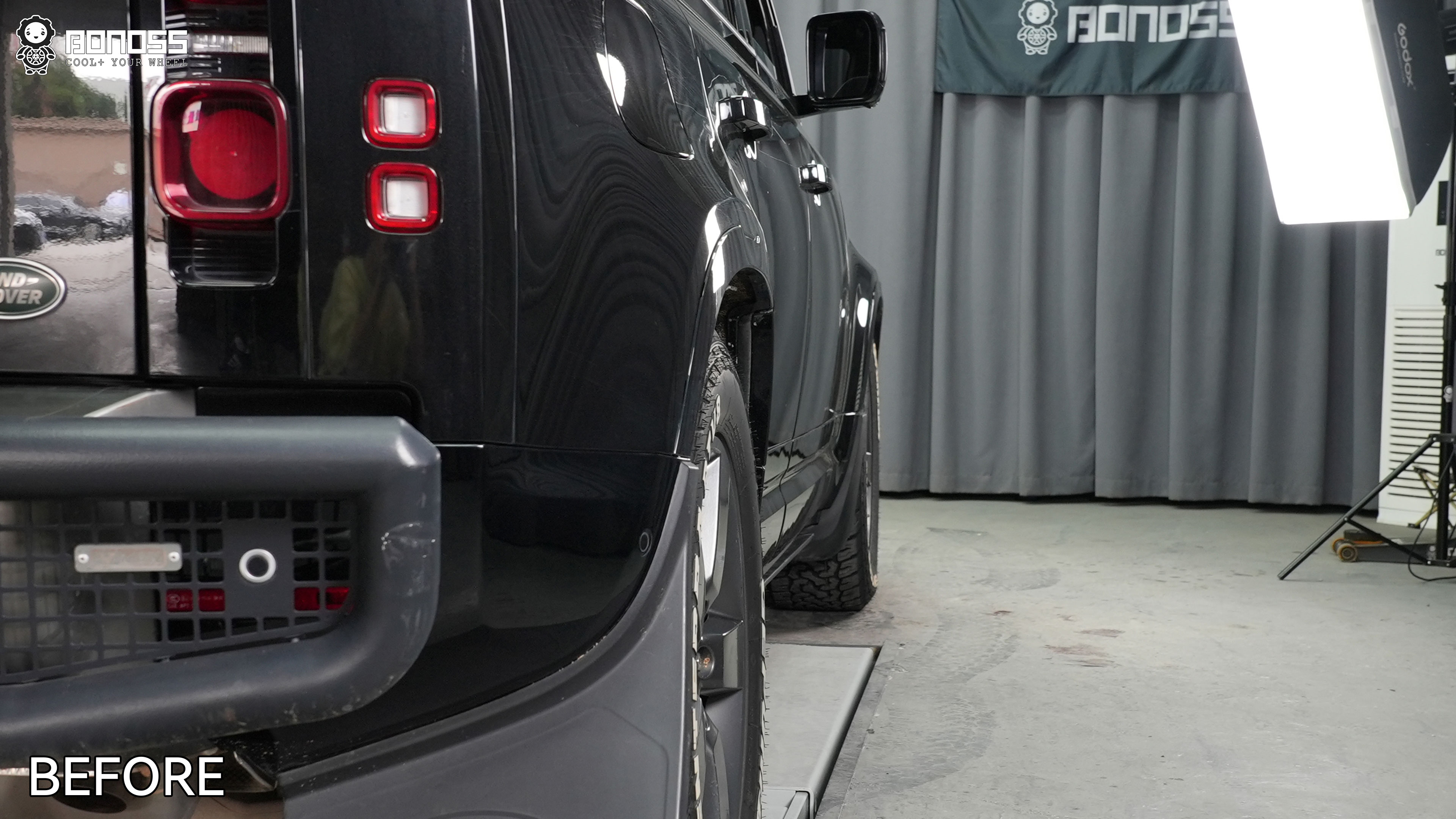
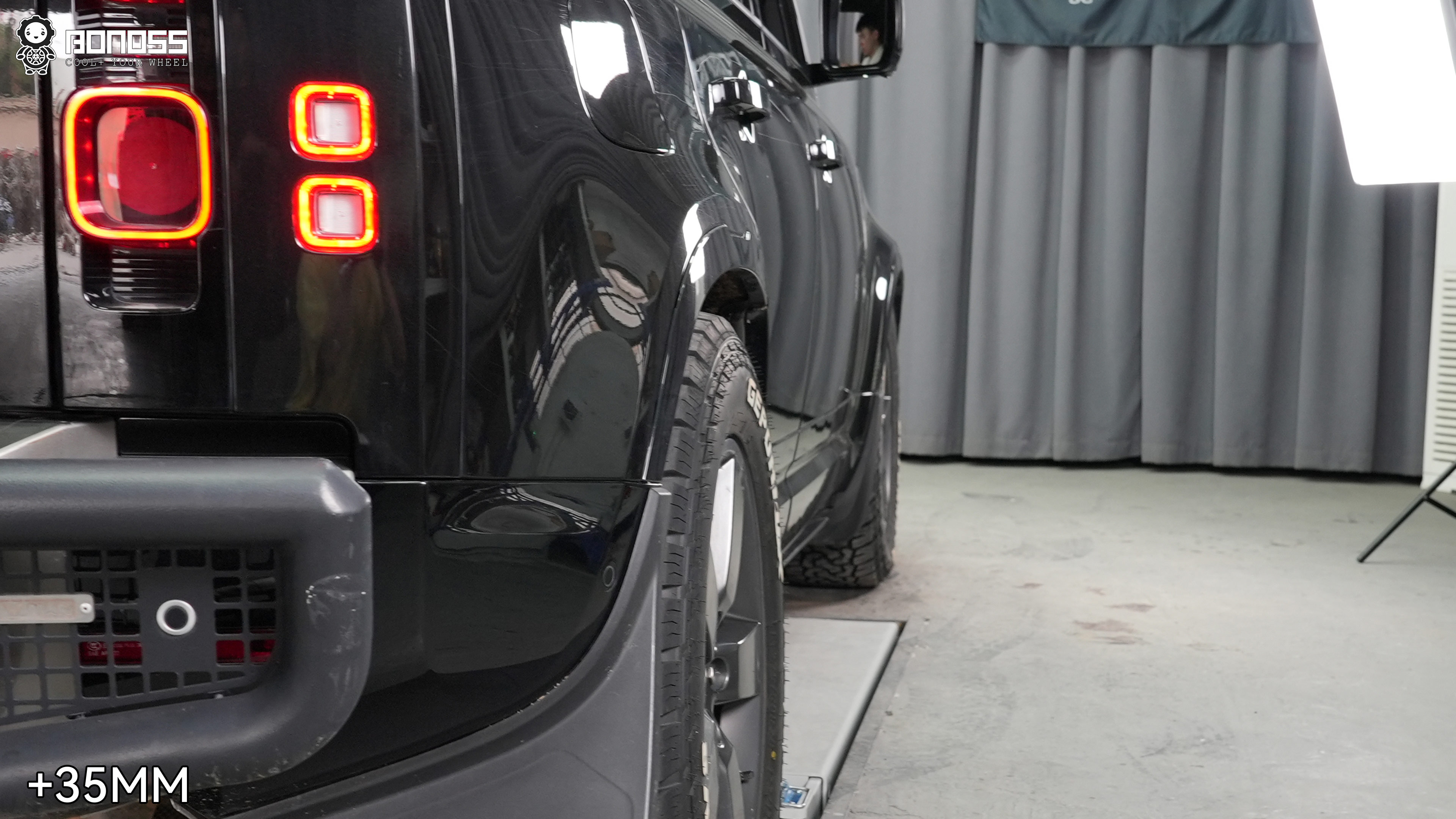
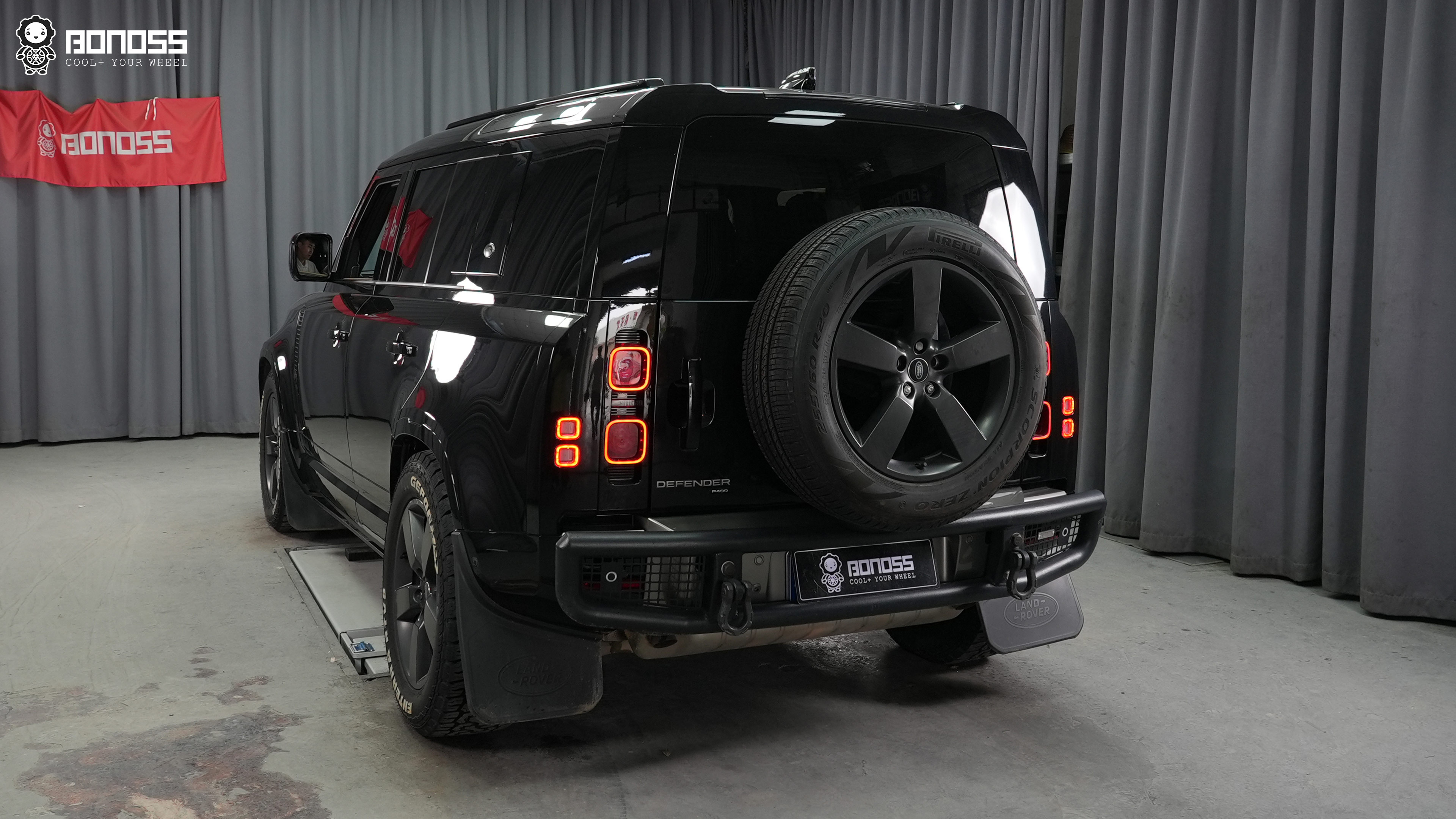
Before: the 275/60R20 AT tires sat tucked under the rear arches. The whole rear looked narrow and pinched — as if someone had installed wider rubber but forgotten to push it out to match. The track width differential between front and rear was the kind of thing you notice walking up to the truck in a parking lot.
After: the tires sit flush with the fender lips. The rear track matches the front. The Defender looks planted, squared up, proportionally correct. The 35mm push shifts the effective rear offset from ET+41.5mm to ET+6.5mm — that’s a significant track width change that reads instantly from any angle. The off-road stance went from awkward to aggressive in a single afternoon.
Nicholas’s take on the result:
“Definitely your go-to for wheel spacers. The spacers are very high quality and held up great on a long off-roading trip! 100% recommend”
Road Test and Off-Road Performance
Over 6,000 miles, Nicholas drove the Defender through daily commuting, highway runs, and a multi-day off-road trip. Here’s what stood out:
Highway stability. No vibration at any speed up to 80 mph. The hub-centric seating held — no steering wheel shake, no telltale signs of runout, no wandering. This is the real test of machining precision, and the 0.02mm CNC tolerance delivered exactly what you’d want: invisibility. Good spacers disappear under the truck. These did.
Off-road capability. Nicholas took the Defender on a long off-roading trip — the kind of terrain where articulation, heat, and impact loading all stress the wheel-to-hub interface. For Land Rover Defender spacers for off-roading, the hardware has to survive conditions that would expose any weakness in material or machining. The spacers didn’t loosen.
Towing stability. The Defender is rated for serious towing, and pushing the track width wider generally improves lateral stability under load by reducing the roll moment arm. Nicholas didn’t report specific towing feedback, but the geometry change is structurally favorable — wider track under a trailer load means less side-to-side sway transfer.
Fitment and quality feel. Nicholas’s third quote, six months in, sums up the long-term picture:
“6,000 miles in and so far so good. Fitment was spot on, and they definitely look and feel like quality parts. Pretty confident they’ll last.”
Pros and Cons
Pros:
- True bolt-on at 35mm — no factory stud trimming required
- Hub-centric with 0.055mm single-side clearance for vibration-free running
- Forged 6061-T6 with TÜV hardness and salt spray certification
- ISO Grade 12.9 studs and Grade 10 nuts — overbuilt for the application
- Active cooling grooves for hub thermal management
- 6,000-mile real-world validation including off-road use
- $178.99 total cost vs. $2,000+ for replacement wheels
Cons:
- Rear-only setup means front and rear track width differs slightly from a full-vehicle kit
- 35mm is a significant push — owners wanting a subtle change may find it aggressive
- Requires re-torquing after the first 50 miles (standard for all spacers, not unique here)
Spacers vs. Offset Rims
A fair question: why run spacers instead of just buying wheels with less offset?
Cost. A set of quality aftermarket 20-inch wheels for the Defender L663 runs $400 to $800 per wheel. Two 35mm spacers cost $158.99. The math is not close.
Flexibility. Spacers let you keep the factory wheels — which on the Defender are already well-built and good-looking. You can remove the spacers and return to stock in an afternoon. Offset rims are a permanent change that locks you into one stance.
Hub-centric integrity. A well-machined hub-centric spacer with a multi-stage bore maintains the same centering principle as the factory wheel. The load path goes through the hub register, not the studs. This is structurally sound when machined correctly — and the 0.02mm CNC precision is what makes it work. A poorly machined spacer is dangerous. A properly machined one is structurally equivalent to an offset wheel in terms of load transfer.
The tradeoff: spacers add an extra fastening interface. That’s one more set of nuts to torque and one more surface to check periodically. It’s not a dealbreaker — it’s a maintenance consideration. For Nicholas, the cost savings and the ability to keep his factory wheels made spacers the obvious choice.
Who Should Buy — And Who Shouldn’t
Buy if:
- You’ve fitted wider AT or MT tires and the rear looks tucked under the fenders
- You want to keep your factory wheels but need more track width
- You want certified material quality with documented TÜV and SGS test data
- You’re price-conscious and $178.99 beats $2,000 for new wheels
- You’re looking for the best 35mm wheel spacers for Defender with real long-term mileage data behind them
Skip if:
- You want a permanent solution and don’t mind spending four figures on new wheels
- You’re uncomfortable with the maintenance requirement of periodic re-torquing
- You want a subtle change — 35mm is a noticeable push, not a whisper
FAQ
Will 35mm spacers rub on a Defender?
No, not on a 2023 Defender 110 running 275/60R20 AT tires on rear wheels. However, the front wheels were not fitted/tested, so the same cannot be confirmed for the front. Please treat actual test fitting as the final reference. If you’re running wider tires or different wheels, measure your own clearance before committing — every setup is different.
Are wheel spacers safe on a 2023 Land Rover Defender?
Yes, when they’re hub-centric, forged from quality material, and properly torqued. The BONOSS spacers on Nicholas’s Defender have logged 6,000 miles including off-road trips with zero loosening, zero vibration, and zero fitment issues. The ISO Grade 12.9 studs carry SGS and TÜV certifications for tensile strength, hardness, and proof load. Safety comes down to three things: machining precision, material quality, and correct torque. All three are verifiable on these spacers through independent lab reports.
Can I use Defender 5×120 wheel spacers rear only?
Yes, and that’s exactly what Nicholas did. If only one axle has a stance problem — common when fitting wider tires that affect the rear differently — a rear-only setup is perfectly acceptable. The key is ensuring the track width difference doesn’t create a handling imbalance. On the Defender with AT tires, the rear needed the push; the front was already good enough. Driving dynamics were unaffected over 6,000 miles.
Do I need extended studs for 35mm spacers?
Not with BONOSS spacers on this application. At 35mm thickness, the factory studs (28.23mm rear protrusion) are fully contained within the spacer body. The spacer’s own integral ISO Grade 12.9 studs handle the wheel-side mounting. You only need to worry about stud length if you go thinner than 25mm — at which point the factory studs start protruding past the spacer face and may contact the wheel pocket.
What torque specs apply when installing 35mm spacers on a Defender?
140 Nm (103.5 ft-lb) for both fastening interfaces. Torque the BONOSS nuts (spacer to hub) to 140 Nm per BONOSS installation instructions, and torque the factory nuts (wheel to spacer) to 140 Nm per the owner’s manual. Both values are identical on this vehicle — use one torque figure for the entire installation. Confirm with the source matching your hardware.
Can I go off-roading with 35mm spacers on my Defender 110?
Yes. Nicholas completed a long off-roading trip with his 35mm spacers installed, and the hardware held up with zero issues across 6,000 total miles. The forged 6061-T6 construction, active cooling grooves, and multi-stage hub-centric design are built for exactly this use case. Re-torque after the first off-road session to be safe — that’s standard practice for any spacer, not specific to BONOSS.
Conclusion
| Category | Notes |
|---|---|
| Build Quality | Forged 6061-T6, CNC 0.02mm tolerance, TÜV and SGS verified |
| Installation | True bolt-on at 35mm — no factory stud trimming required |
| Road & Off-Road | No vibration at highway speeds, stable through off-road terrain |
| Durability (6,000 mi) | Hardware holding, no loosening, no corrosion |
| Value | $158.99 for 2pcs + $20 labor = $178.99 total |
| Overall | Recommended for L663 Defender owners running AT tires |
The 2023 Land Rover Defender 35mm wheel spacers from BONOSS solved a real problem — a tucked rear end caused by wider AT tires — and held up over 6,000 miles of mixed driving including off-road abuse. The measurements tell the story: 0.055mm single-side hub-centric clearance for vibration-free running, no stud trimming needed at 35mm, and certified material quality backed by TÜV and SGS lab reports with specific ISO test methods. At $158.99 for two spacers plus $20 labor, the value proposition speaks for itself against a $2,000+ wheel swap.
If you’re running wider tires on your L663 Defender and the rear looks wrong, this is the fix. The top-rated Defender L663 spacers page covers additional thicknesses and configurations if 35mm isn’t the number you need. Land Rover Defender 35mm spacers for sale at $178.99 total — spacers plus labor — represent the best price point in this category for hardware carrying over 75 SGS and TÜV test reports. That’s a hard combination to beat.

About Jack Miller
Jack Miller is a certified automotive technician specializing in wheel and tire systems, with over a decade of hands-on repair experience. He has served as a senior technical specialist at BONOSS for the past 7 years, advising on wheel spacer fitment, wheel bolt & wheel nut selection for thousands of customer builds. Jack’s technical guides on BONOSS are grounded in real customer cases — not theory.